%20(4).png)
![[background image] image of cityscape background (for an architect firm)](https://cdn.prod.website-files.com/68961ade6feff9cbdffc080d/69384e066e0e9a310b6817f8_061f6bac-48bf-44b8-a689-078dacd8009f.avif)
Town planning approval is a legal permit issued by a local council or planning authority that authorizes a specific use or development on a specific piece of land. It’s often called a planning permit or development consent, and without it, a lot of construction or land-use changes simply can’t proceed.
Town planning approval is a legally binding permit that a local council issues to authorize a specific land use or development, and skipping it can halt a project entirely.
| Point | Details |
|---|---|
| Permit defines the project | A planning permit authorizes a specific use on a specific parcel and usually attaches to the land itself. |
| Multiple permit types exist | Development, subdivision, demolition, and change-of-use permits each cover different project categories. |
| Pre-application meetings save time | Talking to the council before finalizing designs flags major issues before you spend on drawings. |
| Complete applications move faster | Missing documents trigger the “stop clock” and pause the statutory assessment timeframe. |
| Local advice fills the gaps | Yigal-realty offers project guidance for buyers navigating permit conditions in Beit Shemesh and nearby areas. |
A planning permit is a legal document tied to the land itself, not just the person who applied for it. It attaches to the property, so if you sell the land before starting construction, the new owner usually inherits both the permit and its conditions.
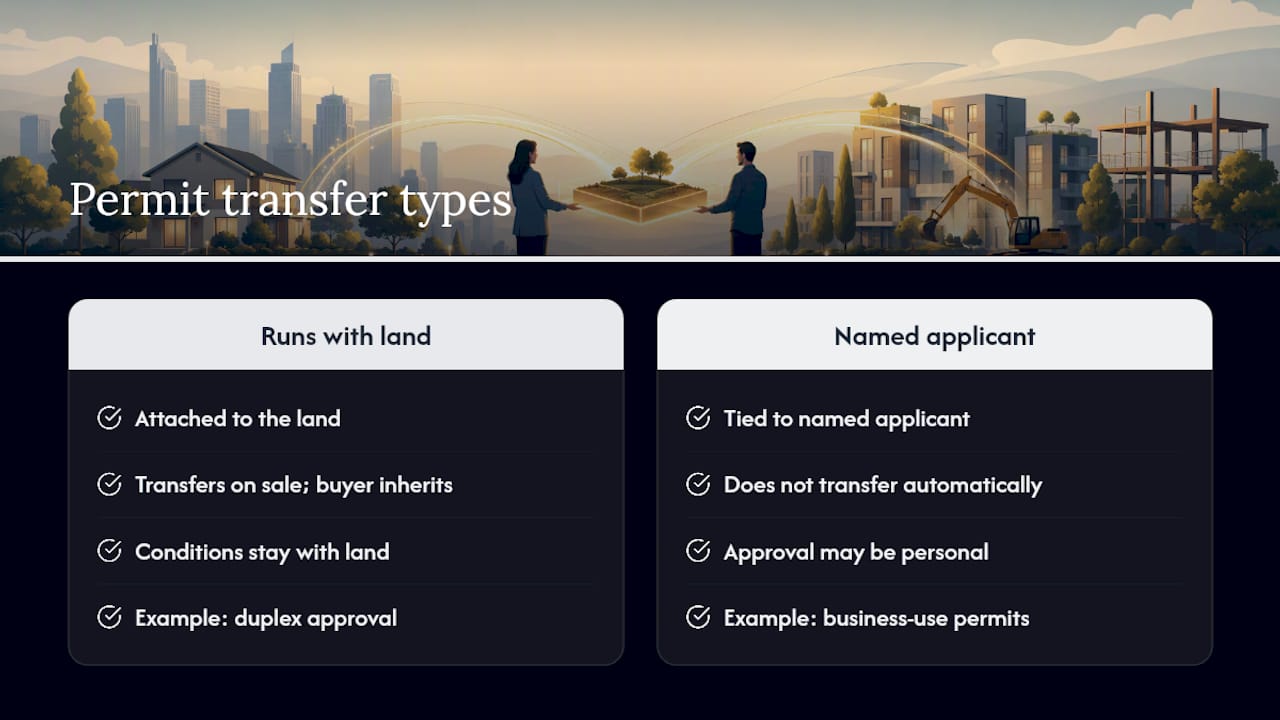
The permit exists to enforce policy goals that go beyond one property line: zoning consistency, neighborhood character, heritage protection, and environmental safeguards. A permit might approve a new duplex but limit construction noise to weekday daytime hours, require a landscaped buffer along the boundary, or mandate a traffic study before work begins.
Pro Tip: Before you buy a property that comes with an existing permit, confirm whether the approval runs with the land or was granted only to a named applicant. Some permits for business uses are personal to the operator and don’t transfer automatically to a new owner.
Not every project needs the same permit, and knowing which category applies saves time before you even talk to a planner.
Most small residential projects, an extension, a granny flat, a minor subdivision, fall into the development permit or change-of-use categories. Larger or commercial projects tend to stack multiple approvals at once.
The local council is almost always the consent authority that issues planning permits, though some proposals get referred to state or regional bodies depending on scale or sensitivity.
Carrying out development that needs a permit without one can be treated as an offense under most planning laws, so skipping this step isn’t just risky, it can be illegal.
Most readers want a quick gut check: does my project need this or not?
The town planning process follows a fairly predictable sequence, even though the paperwork varies by council.
A properly made application generally includes:
Council planners aren’t rubber-stamping anything. They’re weighing your proposal against a specific set of criteria.
Approval isn’t automatic, and it isn’t a checklist exercise either. Councils routinely balance competing goals, like housing density against preserving local character, which means two similar applications in different suburbs can get different outcomes.
Pro Tip: Read the council’s own decision guidelines for your zone before you submit anything. Generic supporting material rarely persuades a planner who’s working from a specific local policy checklist.
Timeframes swing wildly depending on complexity. A straightforward, code-compliant application might clear in a matter of weeks under a fast-track stream, while a discretionary or contested proposal can stretch past six months.
One thing extends almost every timeline: the “stop clock.” When a council requests more information, the statutory clock pauses entirely and only resumes once you’ve supplied everything asked for.
Submitting a complete application the first time is the single biggest lever you control over both cost and speed.
Getting approved isn’t the finish line, and getting refused isn’t necessarily the end of the road either.
Most rejected or delayed applications fail for avoidable reasons, not because the project itself was a bad idea.
Pro Tip: Only pay for a traffic, arborist, or environmental report if the council flags it as necessary or your zone’s policy signals it as high risk. Ask first, spend second.
Buyers and small developers often lean on a local adviser for pre-application input, document coordination, and council liaison. A good adviser interprets permit conditions in plain terms and flags information gaps before they trigger a stop clock, which shaves real time off a process that punishes guesswork.
Planning rules shift block by block, and a permit that sailed through approval next door might hit a completely different set of conditions on your parcel. That’s where local, on-the-ground knowledge beats generic advice every time. Yigal-realty works directly in Beit Shemesh and the surrounding area, which means the guidance you get reflects what’s actually happening at the local council level right now, not a textbook version of planning law.

If you’re evaluating a residential development or considering buying off-plan, reach out to Yigal-realty for personalized project guidance before you commit. For rules specific to your parcel, your local council’s planning department remains the authoritative source.
Always confirm project-specific rules directly with the source that actually enforces them.
This article is general information, not a substitute for advice from a qualified lawyer. Consult a qualified legal professional about your own circumstances before acting on anything here.