%20(4).png)
![[background image] image of cityscape background (for an architect firm)](https://cdn.prod.website-files.com/68961ade6feff9cbdffc080d/69384e066e0e9a310b6817f8_061f6bac-48bf-44b8-a689-078dacd8009f.avif)
TL;DR:
- Residential development involves planning and building housing to meet community needs, influenced by zoning laws and market demand.
- Ownership types like condos, co-ops, and fee-simple land affect financing, legal rights, and daily life for buyers.
- Understanding zoning, lifecycle stages, and ownership forms helps investors make better choices and avoid common pitfalls.
Residential development is the systematic process of planning, designing, and constructing housing to meet the demographic needs of a community. It covers everything from a single custom home to a 500-unit high-rise, and it is governed by zoning laws, local regulations, and market demand. Whether you are buying your first home or evaluating a real estate investment, understanding what residential development means, how it is structured, and what drives its value will change how you read every listing and every project brochure.
A residential development is any project where land is prepared and structures are built specifically for people to live in. The industry term is residential property development, and it covers a wide spectrum of housing forms and densities. Single-family subdivisions in suburban Beit Shemesh, condominium towers in Tel Aviv, and townhome clusters in New Jersey all qualify.
The scale varies dramatically. Moderate-density zones typically allow 5–15 units per acre, while urban districts can permit 20–100+ units per acre. That range explains why two parcels on the same street can produce radically different projects and radically different returns. The defining feature is always the same: the end use is residential, meaning people sleep, live, and build their lives there.
Residential property types include single-family detached homes, townhomes, condominiums, co-ops, and multifamily apartment buildings. Each carries a different ownership structure, and confusing the building style with the legal form is one of the most common mistakes buyers make.
Here is how the main types break down:
Pro Tip: Before you sign anything, ask the developer or agent to specify the legal ownership form, not just the building type. “Condo-style townhome” is a marketing phrase, not a legal category.
The ownership form directly affects your financing options and tax treatment. A co-op purchase, for example, requires board approval and limits your ability to sublet. A condominium comes with HOA bylaws that can restrict renovations, pets, and short-term rentals. These are not minor details. They shape your daily life and your exit strategy as an investor.
Zoning is the single most critical factor in determining what can be built on a piece of land and how much it is worth. R1 zoning restricts land to single-family detached homes. R2 typically allows duplexes. R3 opens the door to mid-density apartments. R4 permits high-density residential towers.

The financial gap between these designations is significant. Properties zoned for higher density can be worth 2–5 times more than R1-zoned land in the same location under the same market conditions. That multiplier is why experienced investors spend serious time on zoning due diligence before they ever make an offer.
Zoning also controls setbacks (how far a building must sit from the property line), building height, parking requirements, and permitted uses. A parcel zoned R3 in one municipality might allow 40 units per acre. The same R3 designation two towns over might cap density at 20. The label is not enough. You need to read the actual zoning ordinance.
Approval timelines vary just as much. Fast-track permits typically take 10–20 days. Full council applications can stretch to 40–90 days. That difference matters because every extra month of approval time adds carrying costs, delays construction draws, and compresses your return window.
Pro Tip: Pull the zoning certificate for any property you are seriously considering. It is a public document and takes minutes to request. It tells you exactly what the land can legally become.
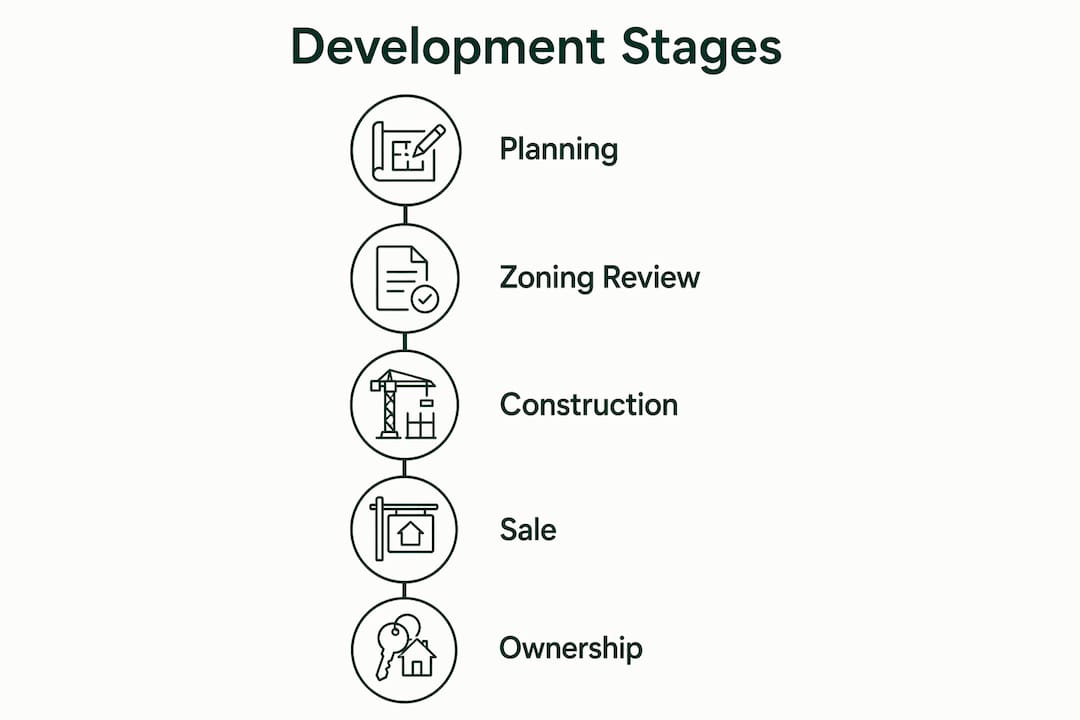
The residential development process moves through distinct phases, and each one carries its own costs, risks, and decision points. Understanding the lifecycle helps you ask better questions and spot red flags early.
The major stages are:
Successful residential development projects focus not only on buildings but also on common areas, maintenance access, and utility planning. The projects that hold their value long-term are the ones designed for how people actually live, not just for how units look in a brochure.
The community design and long-term functionality of a project are factors that buyers routinely underweight. A development with poor parking, no green space, and deferred maintenance obligations will lose value faster than its neighbors regardless of construction quality. You can explore how new projects are accessed at different stages to understand what early-stage entry actually means for your timeline and risk.
Residential and commercial development share the same basic process: land, permits, construction, and sale. The goals, design priorities, and regulatory frameworks are fundamentally different.
| Factor | Residential development | Commercial development |
|---|---|---|
| Primary purpose | Housing for permanent or long-term residents | Business operations, retail, office, or industrial use |
| Design priority | Privacy, comfort, livability | Customer access, operational flow, visibility |
| Zoning category | R1 through R4 (residential) | C1, C2, industrial, mixed-use |
| Financing | Residential mortgages (up to 4 units) | Commercial loans, different underwriting standards |
| Regulatory focus | Building codes, HOA rules, habitability | Fire codes, ADA compliance, signage, parking ratios |
The financing distinction matters most to investors. Residential loans for properties with up to four units carry lower interest rates and require smaller down payments than commercial loans. A duplex and a five-unit building can sit on the same block, but they live in completely different financing universes.
Pro Tip: If you are evaluating a mixed-use project, ask specifically which portion is classified residential and which is commercial. The classification affects your loan type, your tax treatment, and your exit options.
Community integration is another key difference. Residential developments must account for schools, parks, traffic patterns, and neighborhood character in ways that commercial projects do not. A community’s role in property value is a direct output of how well the development was planned around the people who will live there, not just the buildings themselves.
Residential development is a structured process governed by zoning, ownership type, and lifecycle stage, and buyers who understand these three factors make measurably better decisions than those who focus only on price per square foot.
| Point | Details |
|---|---|
| Definition is precise | Residential development means housing built for people to live in, governed by zoning and market demand. |
| Ownership form drives obligations | Condos, co-ops, and fee-simple ownership each carry different financing rules, HOA exposure, and legal rights. |
| Zoning determines value | Higher-density zoning can make land worth 2–5x more than R1-zoned land in the same location. |
| Development lifecycle has real risk | Raw land can take 6–24 months to become build-ready; early-stage buyers carry more timeline risk. |
| Residential and commercial are different universes | Financing, zoning, and design priorities diverge sharply once a property crosses the four-unit threshold. |
I have watched buyers spend weeks comparing kitchen finishes and floor plans while spending zero time on the zoning certificate or the HOA bylaws. Those two documents tell you more about a property’s future value than any sales brochure ever will.
The ownership form issue is particularly underappreciated. Many buyers treat “condo” as a description of a building style rather than a legal structure with real consequences. I have seen buyers genuinely surprised to learn they cannot rent out their unit for the first two years, or that a special assessment just added $15,000 to their annual costs. Reading the bylaws before you sign is not optional. It is the job.
The other thing I would push back on is the assumption that newer developments are automatically better investments. A well-planned older development with strong community infrastructure, maintained common areas, and a healthy reserve fund will outperform a shiny new project with deferred maintenance and an underfunded HOA every single time. The types of real estate investments that hold value over decades are the ones where the developer thought about livability, not just sellability.
Do your zoning homework. Read the ownership documents. And pay attention to what happens to the project after the last unit sells.
— Spiros
Yigal-realty specializes in residential properties in Beit Shemesh and surrounding areas, with a focus on communities built for observant and religious families. Their team provides project guidance, local market insights, and support throughout the buying process, from early-stage access to final closing. Whether you are a first-time buyer or an experienced investor evaluating a new development, Yigal-realty offers direct access to current listings, luxury enclaves, and pre-release projects. Their New York office also serves international clients looking to invest in the Israeli residential market. Visit Yigal-realty’s property listings to explore available developments and connect with an agent who knows the market.
A residential development is a planned project where land is prepared and housing units are built for people to live in. It includes single-family homes, townhomes, condominiums, and multifamily buildings, all governed by local zoning and building regulations.
Residential zoning is a legal designation that controls what type of housing can be built on a parcel of land, including density, height, and setbacks. R1 through R4 classifications determine whether a site can support one home or hundreds of units, directly affecting land value and investment potential.
The main types are single-family detached homes, townhomes, condominiums, co-ops, and multifamily apartment buildings. Each type carries a different ownership structure, financing requirement, and set of legal obligations for the buyer.
The timeline varies by project scale and jurisdiction. Raw land preparation alone can take 6–24 months before construction begins, and permit approvals add another 10–90 days depending on the approval track chosen.
A condo gives you legal ownership of the airspace inside your unit, while a co-op gives you shares in a corporation that owns the building. Co-ops are harder to finance and often require board approval for purchase, subletting, and renovations.