%20(4).png)
![[background image] image of cityscape background (for an architect firm)](https://cdn.prod.website-files.com/68961ade6feff9cbdffc080d/69384e066e0e9a310b6817f8_061f6bac-48bf-44b8-a689-078dacd8009f.avif)
Off-plan property means purchasing real estate before construction is complete, often from architectural drawings, digital renderings, and a show unit alone. You commit early, typically with a reservation deposit followed by staged payments tied to construction milestones, and take possession on completion, which can be anywhere from 12 months to four years out.
The core reasons buyers consider this route come down to a handful of concrete advantages:
None of these advantages are guaranteed. Each depends on the market moving favorably and the developer delivering. That tension between opportunity and risk is exactly why understanding off-plan property investment fully, before signing anything, is the only responsible starting point.
Developers sell off-plan for reasons that are straightforwardly financial, and understanding their motivation helps buyers negotiate from a position of knowledge rather than assumption.
The practical implication for buyers is that developers have a genuine incentive to offer attractive launch pricing. That discount is real, but it is compensation for the uncertainty you are accepting in return.
Off-plan buying suits investors with a medium to long-term horizon who want to maximize capital growth and are comfortable with some uncertainty around timing. That profile is specific, and buyers who do not fit it often regret the purchase.
Off-plan is less suitable for cashflow-focused buyers who need rental income to begin immediately, for highly leveraged buyers who cannot absorb a delay, and for anyone who needs to move in on a fixed timeline. There is nothing wrong with buying a completed property. You pay a premium for that certainty, and for some buyers, that premium is worth every dollar.
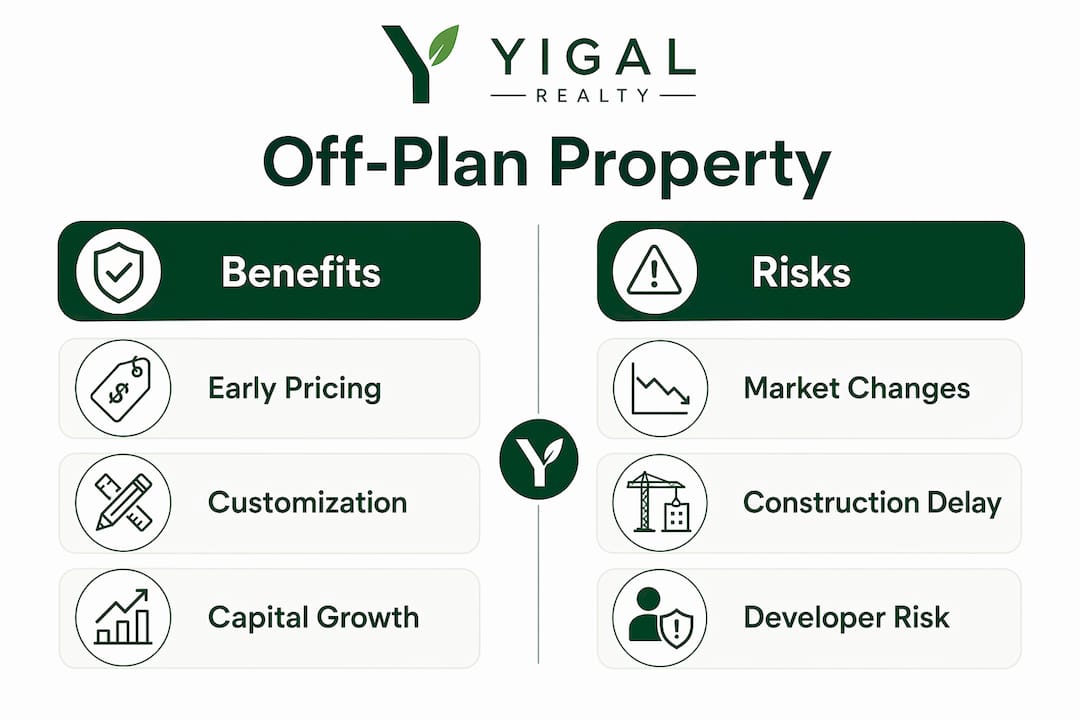
The case for off-plan, when it works, rests on several concrete advantages that go beyond the headline discount.
Statistic callout: In Dubai’s off-plan market, off-plan accounted for a significant majority of residential sales, reflecting investor appetite for pre-completion pricing and phased payment structures globally.
Pro Tip: The capital appreciation advantage only materializes if the market rises during construction. Always model a flat or declining market scenario before committing, so you know exactly what you are signing up for if conditions shift.

A balanced view of off-plan property investment requires looking at the risks with the same clarity as the benefits. These are not edge cases. They happen regularly, and buyers who ignore them pay for it.
Statistic callout: Dubai’s Real Estate Regulatory Agency (RERA) has cancelled more than 200 projects since 2008, refunding buyers from escrow, illustrating that even in one of the world’s most active off-plan markets, project cancellation is a genuine risk, not a theoretical one.
The mitigation for most of these risks is structural: strong legal protections, escrow accounts, and a thorough review of the contract before any money moves. Skipping that step because the renderings look impressive is how buyers end up in the worst outcomes.

The U.S. off-plan market operates under a patchwork of state and local regulations rather than a single federal framework, which means buyer protections vary considerably depending on where you are purchasing. Understanding the specific rules in your target market is not optional.
International examples offer useful benchmarks for what strong buyer protection looks like. Spain’s Ley 57/1968 ensures 100% deposit recovery plus statutory interest if a property is not delivered as contracted, a standard that U.S. buyers should use as a reference point when evaluating the protections in their own purchase contracts.
Pro Tip: Before signing any off-plan contract in the U.S., verify in writing that your deposit is held in a regulated escrow account, confirm the exact conditions under which any sunset clause can be triggered, and have an independent attorney review the binding specification schedule. These three steps address the majority of common pitfalls.
For buyers new to the process, a complete off-plan purchase guide covers the financial and legal steps in detail, including how to assess valuation risk and developer reliability before committing.
Understanding the timeline before you start helps you plan financing, manage expectations, and avoid the surprises that catch unprepared buyers off guard.
The process typically begins with a reservation agreement and a deposit, often ranging from 5% to 20% of the purchase price depending on the developer and jurisdiction. This secures your chosen unit and locks in the agreed price. At this stage, the deposit should move into a regulated escrow account, not directly to the developer.
The Sale and Purchase Agreement is the most important document in the entire transaction. It defines the completion date, the payment schedule, the binding specification, permitted variations, exit rights, and the conditions under which either party can terminate. Have an independent attorney review it before you sign. This is not a formality.
Payments are typically tied to verified construction milestones rather than calendar dates, which is a meaningful protection. As each phase of construction is certified, the corresponding payment is released from escrow to the developer. Keep your mortgage broker informed throughout this period, particularly as the projected completion date approaches.
Most contracts give buyers the right to inspect the property before final settlement, often called a “snagging” inspection. Use it. Document every defect in writing and confirm in writing which items the developer will rectify before handover. Do not complete the purchase until agreed snagging items are resolved or formally committed to in writing.
At completion, the remaining balance is paid, title transfers to the buyer, and you take possession. If you are financing with a mortgage, the lender’s valuation at this point determines how much they will lend. If the valuation comes in below the agreed purchase price, you will need to cover the shortfall in cash.
The full timeline from reservation to handover typically runs 12 months to four years. Build a buffer of at least six months beyond the developer’s projected completion date into your financial planning.
The developer is the single most critical factor in any off-plan purchase. The asset does not yet exist, so you are really doing diligence on the people and the contracts behind it.
Ask how many projects the developer has completed, on time, and to the contracted specification. Then visit those completed buildings. Do not rely on the sales suite or the brochure. Talk to residents if you can. Look for patterns: consistent delays, quality complaints, or disputes with buyers on prior schemes are warning signs that rarely appear in marketing materials.
A developer who is funding construction primarily from buyer deposits rather than from their own capital or committed bank financing is a higher-risk counterparty. Ask directly how the project is being financed. A financially sound developer will be able to answer that question clearly. One who deflects or provides vague answers deserves more scrutiny, not less.
Due diligence on an off-plan purchase is fundamentally diligence on the people and the paper, because the asset itself does not yet exist. The SPA should include a clear completion date, penalties for developer delay, defined exit rights, and a binding specification schedule that specifies materials, dimensions, and finishes with permitted variation limits. If the specification schedule is vague or missing, that is a red flag.
Confirm that your deposit will be held in a regulated escrow account and that funds are released only against verified construction milestones. Pay into escrow, never directly to a developer. If a developer asks for funds outside a regulated escrow or trust account, treat it as a serious warning sign.
Check whether the developer has any outstanding regulatory actions, litigation, or complaints filed against them in the relevant jurisdiction. In the U.S., state contractor licensing boards, the Better Business Bureau, and court records are all publicly accessible starting points. For international purchases, equivalent regulatory bodies exist in most active markets.
Family buyers considering off-plan for the first time will find that a 2026 guide for family buyers addresses many of the developer evaluation questions specific to residential purchases.
Location has always driven property values, but in off-plan purchases, the future trajectory of a location matters as much as its current state. You are buying into what an area will become, not just what it is today.
Planned infrastructure, including new transit lines, highway expansions, schools, hospitals, and commercial hubs, tends to lift surrounding property values as it materializes. Buying off-plan in an area where major infrastructure is under construction or recently approved can position you ahead of the price movement that follows completion. The key word is “planned.” Verify that infrastructure commitments are funded and approved, not just proposed.
City-center regeneration projects, waterfront redevelopments, and expanding employment hubs create the conditions where off-plan buyers can capture meaningful appreciation during the construction period. The attraction is getting in before the area is fully established, when prices still reflect current conditions rather than the future state. Real estate market analysis tools can help you assess off-plan pricing against secondary market comparables in target regeneration areas.
One factor buyers frequently overlook is how much competing inventory is scheduled to complete around the same time as their purchase. A wave of simultaneous handovers in the same submarket can suppress both sale values and rental yields at exactly the moment you are trying to exit or let your property. Check the local development pipeline before committing.
Brochure projections for rental yields and capital growth are marketing materials, not financial advice. Ground your expectations in what completed units in the same area actually sell and rent for today, then apply a conservative assumption about how conditions might change during the construction period. That discipline separates buyers who make money from those who are disappointed.
First-time buyers navigating location selection for the first time should also review common homebuyer mistakes that affect off-plan purchasers, particularly around overestimating future value growth in unproven locations.
Off-plan property offers genuine advantages for growth-focused buyers, but the returns depend entirely on the developer’s track record, the strength of legal protections, and the market conditions at completion.
| Point | Details |
|---|---|
| Early pricing advantage | Off-plan properties frequently launch below equivalent completed properties, creating an immediate equity buffer for buyers. |
| Staged payment flexibility | Phased payments tied to construction milestones free up liquidity and reduce the upfront capital barrier compared to buying completed stock. |
| Valuation and financing risk | Lenders value properties at completion; a market decline during construction can require buyers to fund a shortfall in cash. |
| Developer due diligence is decisive | The SPA, developer financial standing, and escrow structure matter far more than renderings or marketing projections. |
| Yigal-realty guidance | Yigal-realty provides personalized project guidance, early access to developments, and professional support through every stage of the off-plan purchase process. |
Most articles about off-plan property frame the decision as a simple risk-reward calculation: accept more uncertainty, get a better price. That framing is too clean, and it leads buyers to underestimate where the real danger actually sits.
The pricing discount is real. The staged payment flexibility is real. But the variable that determines whether an off-plan purchase works or fails is almost never the market. Markets move in both directions, and most buyers who go in with a long-term horizon can absorb moderate price fluctuations. The variable that actually destroys outcomes is the developer.
Construction company financial distress is not a rare event. Developers who rely heavily on buyer deposits to fund construction, rather than committed bank financing, are structurally fragile. When sales slow or costs rise, those developers face a cash squeeze that buyers have no visibility into until the project stalls. By that point, the legal process of recovering deposits, even from a regulated escrow, takes time and money that buyers did not budget for.
The U.S. market has improved its protections considerably, but they are not uniform. State-level escrow requirements, sunset clause regulations, and buyer recourse options vary enough that the same purchase structure can carry very different risk profiles depending on the jurisdiction. Buyers who assume federal-level protection exists are often wrong.
What actually works is the approach that experienced buyers take: treat the developer as the primary due diligence target, not the property. Visit completed buildings. Review the SPA with an independent attorney. Confirm escrow in writing. Model a flat market scenario. And be honest with yourself about whether you can genuinely wait four years without needing the capital or the income.
Off-plan can be a powerful growth strategy when aligned with well-researched projects and financially sound developers. The buyers who get hurt are almost always the ones who let the renderings do the convincing.
Securing an off-plan unit at launch pricing is only valuable if you know what you are buying into. Yigal-realty works with buyers who want the early-access advantage of off-plan purchasing without navigating developer due diligence, contract review, and market analysis alone. With a focus on residential developments in Beit Shemesh and surrounding areas, and a New York office serving international clients, Yigal-realty offers direct access to current projects, honest guidance on what each development involves, and professional support from reservation through to handover.
The difference from going it alone is straightforward: you get local market knowledge, transparent project information, and an agent whose job is to represent your interests, not the developer’s. For buyers considering off-plan property in Israel’s growing residential market, that combination of early access and professional guidance is what turns a promising opportunity into a sound investment.
Contact Yigal-realty to explore current off-plan developments and get the project-specific guidance you need before committing.