%20(4).png)
![[background image] image of cityscape background (for an architect firm)](https://cdn.prod.website-files.com/68961ade6feff9cbdffc080d/69384e066e0e9a310b6817f8_061f6bac-48bf-44b8-a689-078dacd8009f.avif)
TL;DR:
- A property developer acquires land, manages all phases of development, and profits from selling or leasing the finished project. Their role involves coordinating design, financing, approvals, construction, and marketing while risking significant capital and regulatory responsibilities. Success depends on rigorous early-stage feasibility, a strong professional network, and disciplined risk management throughout the development process.
A property developer is a professional who acquires land or existing buildings, improves them through planning, financing, and construction, and then sells or leases the finished product for profit. Known formally in the industry as a real estate developer, this role sits at the center of every major residential and commercial project you see built. The developer is not the architect, not the contractor, and not the real estate agent. The developer is the orchestrator who coordinates all of them. If you are exploring a career in real estate development, understanding exactly what this role demands is the clearest first step you can take.
Real estate development is defined as acquiring land or existing property, improving it through planning and construction, and then selling or leasing for profit. That single sentence covers a career that spans finance, law, design, construction, and sales simultaneously. The developer is the person or company responsible for every stage of that process.

What makes the role genuinely complex is the scope. Developers coordinate design teams, secure financing, navigate regulatory approvals, manage construction timelines, and oversee marketing campaigns, all within a single project. The development lifecycle covers concept and site selection, land assembly, planning approvals, design, financing, construction, marketing, and eventual sale or operation. Each phase carries its own risks and requires a different set of decisions.
One distinction worth understanding early: a property developer is not the same as a property builder. The builder executes the construction. The developer decides what to build, where to build it, how to finance it, and who will buy or lease it when it is done. That strategic layer is what separates the two roles and what makes development one of the most demanding careers in real estate.
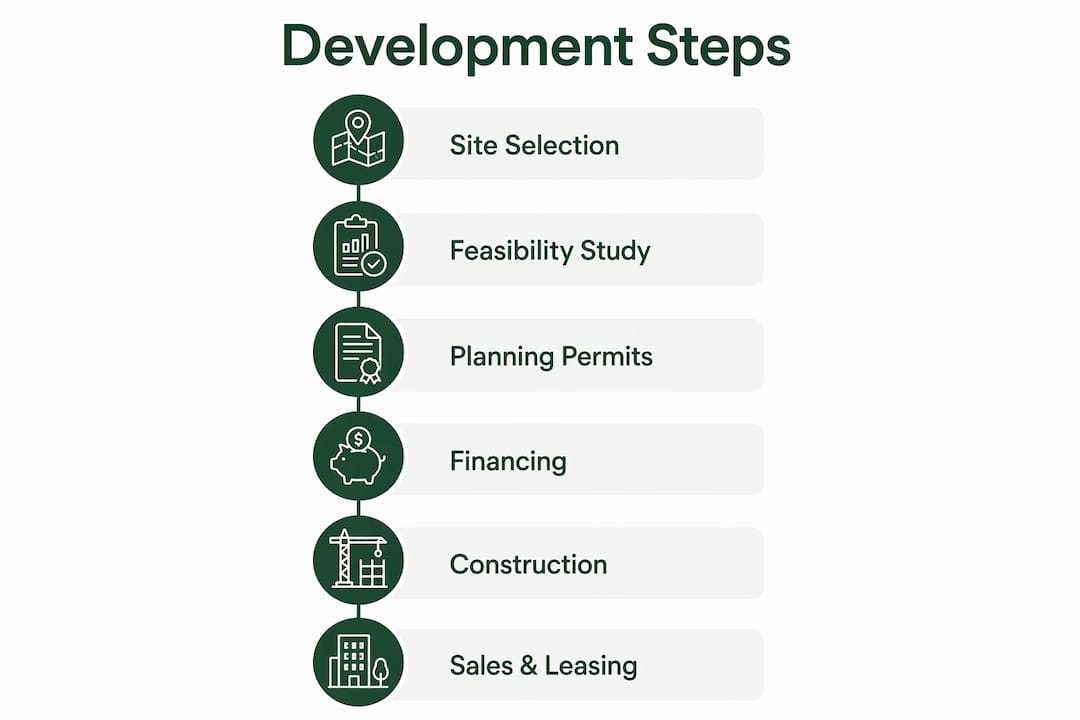
The development process follows a recognizable sequence, though no two projects are identical. Here is how a developer typically moves through a project from start to finish:
Pro Tip: Run your feasibility analysis before you fall in love with a site. The numbers either work or they do not, and no amount of enthusiasm changes that math.
The developer role combines strategic vision, financial expertise, and project management, requiring versatility and negotiating skills to coordinate multiple players including architects, contractors, and banks. That description is accurate, but it understates how broad the skill set really is. Here is what you actually need to develop:
Pro Tip: Build your network before you need it. Your relationships with a good planning attorney, a reliable quantity surveyor, and a well-connected financier are worth more than any single deal.
Aspiring developers often confuse the role with adjacent professions. The differences matter because each role carries different responsibilities, risks, and rewards.
| Role | Primary focus | Financial risk | Regulatory responsibility |
|---|---|---|---|
| Property developer | Commercial viability, capital allocation, and project strategy | High. Developer commits equity before project is proven | Full responsibility for approvals and compliance |
| Construction contractor | Executing building works on time and on budget | Moderate. Risk is tied to contract terms, not market demand | Limited to building code compliance during construction |
| Real estate agent | Marketing and selling completed properties | Low. Earns commission without capital at risk | Minimal. Licensed to transact, not to develop |
| Land developer | Subdividing and servicing raw land for sale or further development | High. Similar capital exposure to property developers | Significant. Must manage subdivision approvals and infrastructure |
The clearest distinction is risk. A real estate agent earns a commission whether the market is strong or weak. A contractor gets paid for work completed under contract. A property developer, by contrast, takes on significant risk for potential returns, with no guarantee of profit until the project is sold or leased. Understanding the role of developer in home buying also clarifies how developers shape the supply side of the market, directly influencing what buyers can access and at what price.
Property development is one of the highest-risk careers in real estate. The rewards can be substantial, but the path to those rewards runs through a series of serious challenges that every developer must manage.
The developers who manage these risks most effectively share a common approach: they do their feasibility and entitlement work with discipline, they maintain conservative capital assumptions, and they build teams they trust before they need them. Diversifying funding sources, including exploring options like real estate syndication, also reduces dependence on any single capital source.
A property developer’s success is determined primarily by the quality of early-stage feasibility work, capital discipline, and the strength of the professional network assembled before construction begins.
| Point | Details |
|---|---|
| Core definition | A property developer acquires land, manages planning and construction, and sells or leases the finished asset for profit. |
| Lifecycle ownership | Developers are responsible for every phase from site selection through marketing, not just construction oversight. |
| Financial exposure | Construction loans cover 60 to 75 percent of project costs, leaving developers to source and manage the remaining equity. |
| Role distinction | Developers carry full financial and regulatory risk, unlike agents or contractors who operate under commission or contract. |
| Early-stage priority | Most deal outcomes are determined during feasibility and approvals, not during construction execution. |
Most people who ask about entering property development focus on the glamorous end: the finished buildings, the sales launches, the returns. What actually separates successful developers from those who lose money is what happens in the first 10 percent of a project’s life.
I have seen developers with strong networks and good instincts fail because they skipped rigorous feasibility work. They fell in love with a site, made optimistic assumptions about approval timelines, and committed capital before the numbers were stress-tested. The early diligence and entitlement work are where most of the profit is made or destroyed, and that is not an exaggeration.
My honest advice to anyone entering this field: treat your feasibility model as a living document, not a one-time exercise. Update it as approvals progress, as construction costs are firmed up, and as market conditions shift. The developers who stay solvent through difficult cycles are the ones who know their numbers cold at every stage of the project.
Build your team before you need them. A planning attorney who knows the local council, a quantity surveyor who gives you honest cost estimates, and a financier who understands development risk are worth more than any single deal. The property development guide for home buyers in Israel offers a useful perspective on how market-specific knowledge shapes development decisions, which applies equally to developers operating in any specialized market.
— Spiros
If you are moving from understanding the developer role to actively participating in real estate projects, access to the right opportunities matters as much as knowledge. Yigal Realty specializes in residential developments in Beit Shemesh and surrounding areas, with a portfolio that includes current projects, luxury enclaves, and early-access listings suited to both investors and developers. Their team provides project guidance, local market insight, and support through the acquisition and financing process. Whether you are evaluating your first development opportunity or looking to expand an existing portfolio, you can access new real estate projects directly through Yigal Realty’s platform. For a broader look at available opportunities, visit Yigal Realty to explore current listings and connect with their advisory team.
A property developer is a person or company that buys land or buildings, improves them through planning and construction, and sells or leases the result for profit. The role covers every stage of a project from site selection to final sale.
In many jurisdictions, a license may not be required to operate as a property developer, but legal obligations under relevant real estate acts still apply. Developers must understand their regulatory responsibilities regardless of licensing requirements in their area.
A property developer creates the supply of real estate by financing and building new projects, while a real estate agent markets and sells completed properties for a commission. Developers carry full financial and regulatory risk; agents do not.
No single qualification is required, but successful developers typically combine formal education in finance, urban planning, or construction management with hands-on experience in deal analysis and project coordination. Building a network of architects, contractors, and lenders is equally important.
A land developer focuses specifically on acquiring raw land, subdividing it, and installing infrastructure such as roads and utilities before selling lots for further development. A property developer typically takes the process further by constructing buildings on the prepared land.