%20(4).png)
![[background image] image of cityscape background (for an architect firm)](https://cdn.prod.website-files.com/68961ade6feff9cbdffc080d/69384e066e0e9a310b6817f8_061f6bac-48bf-44b8-a689-078dacd8009f.avif)
Most people assume that buying a new home directly from a developer is the safest, most straightforward path in Israeli real estate. The property is brand new, the contract is standardized, and the developer seems professional. But that assumption can cost you. Developers in Israel often sell homes off-plan, meaning you sign a contract and hand over money before a single wall is built. Understanding exactly what the developer is responsible for, what the law requires, and what you need to verify yourself is not optional. It is the difference between a smooth purchase and a costly mistake.
| Point | Details |
|---|---|
| Developers sell off-plan | Most Israeli new homes are sold by developers directly to buyers before construction, enabling customization but requiring diligence. |
| Buyer protections exist | Chok HaMakhar mandates guarantees for staged payments, shielding buyers from major financial risk if the developer defaults. |
| Due diligence is critical | Vetting the developer’s reliability, financial health, and permits is essential before signing any agreement. |
| Tailored for religious buyers | Many projects feature amenities to suit observant families, such as synagogues and communal spaces. |
| Understand risks and rewards | Off-plan buying offers potential appreciation but comes with delays and risks that careful planning can help mitigate. |
In Israel, the term kablan refers to a contractor who builds, while izmem refers to a developer who initiates and manages a project from concept to sale. In practice, many companies combine both roles. The developer acquires land, secures permits, hires architects and engineers, markets the project, and sells units directly to buyers.
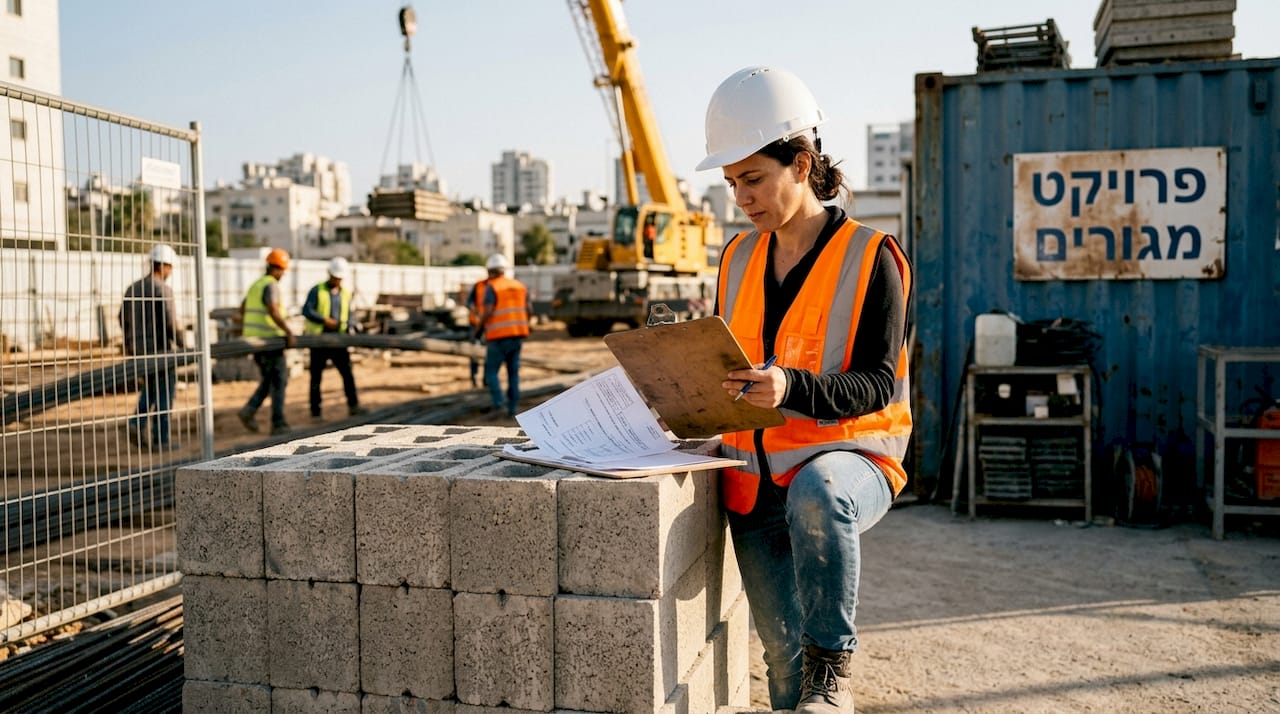
What makes Israeli residential development unique is the widespread use of off-plan sales (known as al ha’niyar, literally “on paper”). You are not buying a finished apartment. You are buying a promise, backed by a contract and legal protections, that an apartment will be built and delivered to spec.
This is very different from buying a resale property, where you see exactly what you are getting before you sign. With new construction, the developer controls the timeline, the materials, the communal spaces, and the final delivery. That is a lot of trust to extend.
Here is what a developer is typically responsible for:
“The developer is not just a seller. They are the project manager, the permit holder, and the party legally bound to deliver your home. Knowing their full scope of responsibility helps you ask the right questions before you sign.”
Israeli law does not leave buyers unprotected. The primary framework is Chok HaMakhar (the Apartment Sales Law), which sets strict rules for how developers can collect money and what guarantees they must provide.
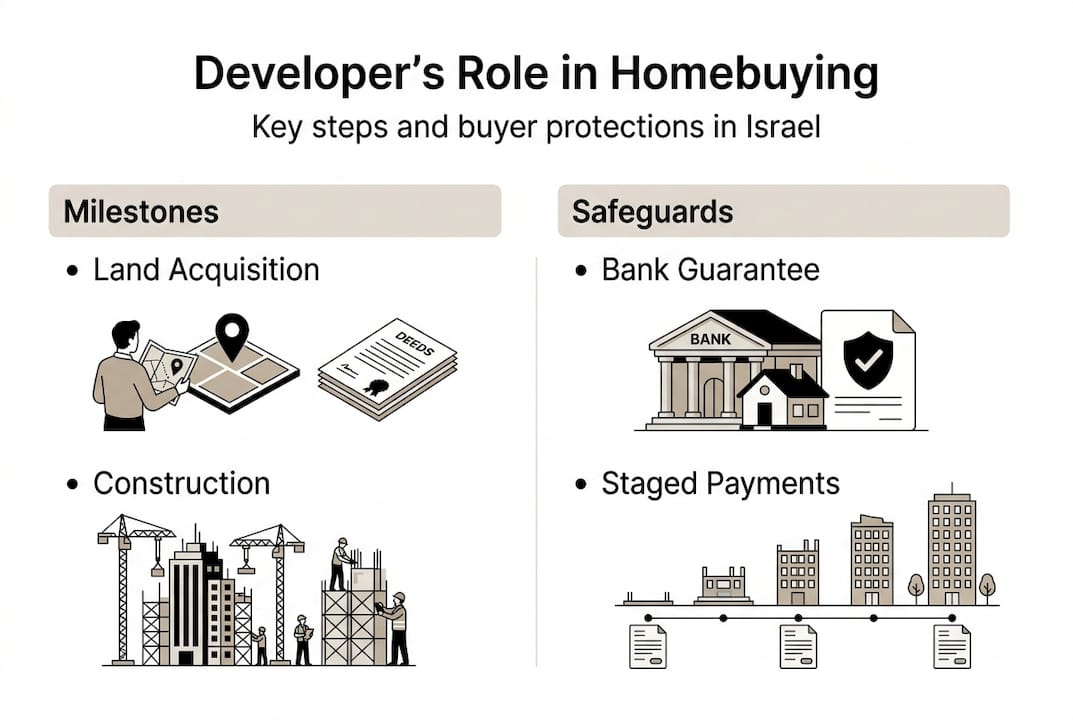
The most important requirement: bank guarantees on payments exceeding 7% of the purchase price. This means the developer cannot simply pocket your money. Payments are tied to construction milestones and secured through a bank guarantee, so if the developer goes bankrupt or fails to deliver, you can recover your funds.
Here is a summary of the key protections under Chok HaMakhar:
| Protection | What it means for you |
|---|---|
| Bank guarantee | Payments above 7% must be secured by a bank |
| Staged payments | Money is released only as construction milestones are met |
| Technical specification | Developer must deliver exactly what is in the contract |
| Defect warranty | Developer must fix defects for a set period after delivery |
| Delay penalties | Compensation is owed if delivery is late beyond the grace period |
Pro Tip: Never rely on the developer’s attorney to protect your interests. Israeli law requires buyers to hire their own independent legal counsel, and choosing an independent attorney is one of the most important decisions you will make in this process. Your lawyer should review the technical specifications, blueprints, and every clause before you sign.
Also review the homebuying checklist for observant buyers to make sure you have covered every legal and community-specific step before committing.
Once you sign with a developer, you enter a structured process that typically spans 2 to 5 years from signing to keys. That timeline depends on the project stage when you buy, local permitting, and construction pace. Here is what the typical journey looks like:
If the developer is late beyond a one-month grace period, Israeli law entitles you to financial compensation. The amount is calculated based on the rental value of a comparable property for each month of delay.
Here is how off-plan purchases compare to resale:
| Factor | Off-plan (developer) | Resale property |
|---|---|---|
| Timeline to move in | 2 to 5 years | Typically 3 to 6 months |
| Price at signing | Usually lower | Market rate |
| Customization | Often possible | Limited |
| Legal protections | Strong (Chok HaMakhar) | Standard contract law |
| Risk of defects | Covered by warranty | Buyer beware |
| Price indexing | Linked to construction index | Fixed at signing |
For a broader view of how these transactions fit into the Israeli market, see our guide on navigating Israeli real estate.
Laws protect you, but they do not replace judgment. Before you sign anything, you need to investigate the developer thoroughly. This is especially true for pre-sale projects and urban renewal deals known as pinui-binui, where existing buildings are demolished and replaced with new ones.
Buyers must examine developer track record, financials, bank backing, and permits, and urban renewal projects carry additional complexity because existing tenants and multiple stakeholders are involved. A developer who looks solid on paper may have hidden liabilities.
Here is your vetting checklist:
Red flags include developers who resist providing bank guarantees, projects where land ownership is disputed, and sales teams who pressure you to sign quickly without allowing attorney review.
Pro Tip: Give strong preference to developers with a clear public record and established bank relationships. Local market insights can also reveal which developers have a strong track record in specific neighborhoods, which is information you simply cannot get from a brochure.
For many buyers in observant and religious communities, a home is not just four walls. It is a lifestyle. The right developer understands this and builds accordingly.
Developers like Amim and Amana build tailored projects with communal facilities designed specifically for religious communities. These include synagogues within walking distance, mikvehs, sukkah balconies, separate entrances where required, and proximity to religious schools (yeshivot and ulpanot).
When evaluating a developer for a religiously oriented project, ask about:
“A developer who has built for observant communities before understands that the communal infrastructure matters as much as the apartment itself. Ask for specifics, not just promises.”
These features also have a direct impact on long-term value. Properties in well-established religious communities with strong infrastructure tend to hold value well and attract a consistent buyer pool. See examples of religious-friendly developments and explore luxury features for religious buyers to understand what the top-tier projects are offering right now.
As lifestyle trends continue to shape housing demand, developers who serve niche communities well are seeing stronger presales and faster sellouts.
Buying off-plan from a developer is not for the impatient or the unprepared. But for buyers who do their homework, it offers real advantages.
Off-plan purchases carry risks like delays, cost escalations, and developer insolvency, but independent due diligence and legal review are your strongest tools for managing those risks.
Here are the main risks to keep in mind:
And here are the rewards that make it worthwhile:
Here is your action plan:
Pro Tip: For long-term investors, patience and legal discipline consistently pay off. The advantages of Israeli real estate for US-based Jewish families are well documented, and buying off-plan in the right project at the right stage is one of the most effective ways to build equity.
Buying from a developer in Israel involves legal frameworks, construction timelines, community considerations, and financial decisions that most buyers encounter for the first time. Getting it right matters. At Yigal Realty, we work exclusively in Beit Shemesh and surrounding areas, with deep knowledge of which developers have strong track records, which projects are right for observant families, and how to protect your interests at every stage. We screen developers, explain contracts in plain language, and connect you with the right legal and financial professionals. Whether you are buying your first home in Israel or expanding an investment portfolio, we give you the clarity and access you need to move forward with confidence.
Buyers are protected by Chok HaMakhar, which mandates bank guarantees on payments exceeding 7% and ties all payments to verified construction milestones.
Review their completed projects, check developer track record and permits, confirm bank backing in writing, and consult an independent attorney before signing.
Yes. Developers like Amim and Amana design projects with integrated synagogues, mikvehs, sukkah balconies, and proximity to religious schools specifically for observant communities.
The main risks include delays, index-linked price increases, defects at handover, and developer insolvency. Independent legal review and bank-backed guarantees are your best protection against all of them.