%20(4).png)
![[background image] image of cityscape background (for an architect firm)](https://cdn.prod.website-files.com/68961ade6feff9cbdffc080d/69384e066e0e9a310b6817f8_061f6bac-48bf-44b8-a689-078dacd8009f.avif)
TL;DR:
- Over 93% of land in Israel is state-owned and leased, impacting property ownership and development.
- Buying off-plan involves legal protections like bank guarantees, staged payments, and delay penalties.
- Observant families should verify occupancy permits, eruv boundaries, and community infrastructure before purchasing.
Over 93% of land in Israel is state-owned and leased rather than sold outright, which means that nearly every apartment you buy, every new project you invest in, and every neighborhood being built sits on public land. That single fact reshapes how property development works here compared to almost anywhere else in the world. For observant and religious families weighing a move to Israel, this reality adds layers of legal complexity, financial considerations, and community planning factors that most guides skip entirely. This article walks you through every major stage, from how developers operate to buyer protections and urban renewal programs, so you can approach any project with real confidence.
| Point | Details |
|---|---|
| Leasehold land norm | Nearly all Israeli residential property sits on government-leased, not privately owned, land. |
| Structured development process | Projects follow regulated steps, from land acquisition to handover, with bank oversight at every stage. |
| Urban renewal offers value | Urban renewal programs can significantly boost property value but require patience and due diligence. |
| Strong buyer protections | Israeli law provides payment guarantees, delay penalties, and legal safeguards for off-plan buyers. |
| Community checks essential | Observant families should verify permits, eruv, and local infrastructure before buying or investing. |
In most countries, a property developer buys private land and builds. In Israel, that starting point is completely different. Because most land is leasehold, developers typically lease it from the Israel Land Authority (ILA, known in Hebrew as Minhal Mekarkei Yisrael) rather than purchasing it outright. This shapes every financial and legal decision that follows.
The Hebrew term for a developer is kablan. A kablan takes on substantial responsibility, including negotiating the land lease, securing planning approval, obtaining permits, managing construction, and ultimately selling units to buyers like you. Understanding developer roles in home buying helps you know what questions to ask and who is accountable at each stage.
Property development in Israel involves acquiring land, planning approvals, permits, financing, construction, and selling units. Each of those phases carries its own timeline, cost structure, and risk profile. For observant families, the planning phase is especially important because it determines whether a project will include community infrastructure like synagogues, an eruv (a symbolic boundary that permits carrying on Shabbat), and schools.
Here are the core responsibilities a kablan carries in any Israeli development:
93% of all land in Israel is public leasehold. This is not a legal footnote. It directly affects how titles are registered, how long developments take to receive approvals, and what rights you have as a buyer.
Pro Tip: Before you commit to any project, verify that the kablan holds valid planning permissions and check the property’s registration on the Tabu (land registry). A legitimate developer will have a Tofes 4 for completed units, or at minimum a clear approval trail for projects still under construction.
Every Israeli development follows a structured sequence, even if timelines vary widely. Understanding each stage tells you exactly where a project stands, what risks you carry at that moment, and when your money is at work.
Key stages include land acquisition, planning/zoning, permits, financing, construction, and handover. Here is how those stages break down in practice:
The typical property development process is significantly longer than many buyers expect, especially for urban renewal schemes. Here is a realistic comparison:
| Development type | Typical total timeline | Buyer risk level |
|---|---|---|
| New build (greenfield) | 2 to 4 years | Moderate |
| TAMA 38 reinforcement | 3 to 7 years | Moderate to high |
| Pinui Binui (demolish/rebuild) | 8 to 15+ years | High |
| Completed resale unit | Immediate | Low |
Families purchasing off-plan should always review essential real estate documents carefully, especially the purchase contract (Heskem Rakhisha) and the bank guarantee letter (Ktovet Bank).

Two programs define much of the Israeli development landscape right now: TAMA 38 and Pinui Binui. Both fall under urban renewal, but they work very differently.
TAMA 38 reinforces older buildings against earthquakes and allows developers to add floors in exchange. Residents receive upgraded units, and developers sell the new floors. TAMA 38 boosts property values by 25 to 40%, making it attractive even for existing owners. Pinui Binui is more dramatic: tenants are temporarily relocated, the building is demolished, and a larger new building replaces it. Residents return to bigger, modern apartments.
For investors and buyers, off-plan units often offer discounts of 10 to 20%, but delays are common and legal disputes can arise. Understanding the risk profile of each type matters before you sign.
| Feature | New build | TAMA 38 | Pinui Binui |
|---|---|---|---|
| Timeline | 2 to 4 years | 3 to 7 years | 8 to 15+ years |
| Price vs. market | At market | 10 to 25% uplift | 20 to 40% uplift |
| Buyer risk | Moderate | Moderate | High |
| Community disruption | Low | Medium | High |
For religious families, urban renewal in established neighborhoods can mean securing proximity to existing synagogues, eruv infrastructure, and schools. That community stability is a genuine advantage worth weighing against longer timelines.
“An off-plan purchase in a well-located religious neighborhood can deliver both financial appreciation and long-term community belonging, but only if you verify the project’s legal standing before signing.”
Major risks and protections to know:
For more on evaluating specific projects and neighborhoods, see the Israeli market success factors guide.
Israeli property law provides meaningful protections for buyers, but only if you know what to demand. The Sales Law (Apartments) is the cornerstone. Sales Law (Apartments) mandates bank guarantees, staged payments, and penalties for delays, giving buyers legal recourse that many other countries simply do not offer.
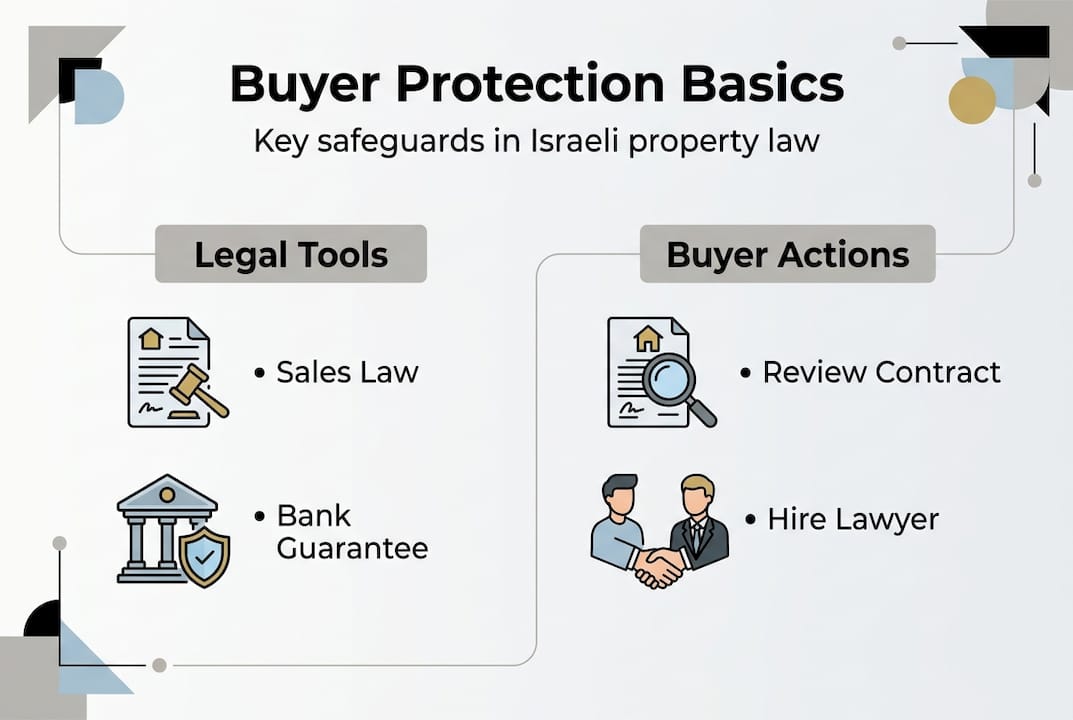
A typical payment schedule looks like this: 20% at contract signing, with the remaining amounts tied to specific construction milestones. Critically, you should not pay more than 50% of the purchase price until the building is close to completion and the bank guarantee is firmly in place.
One financial risk many families overlook is the Madad Tashumot HaBniya, the construction cost index. Contracts often tie part of your remaining payments to this index. If construction costs rise, your total bill rises too. This is legal and very common, but it must be negotiated clearly upfront.
Foreigners face an additional cost: purchase tax (Mas Rechisha) is typically 8% for non-residents who do not own property in Israel. Israeli residents with no other property pay significantly lower rates. Always plan your budget with financing a home in Israel in mind from day one.
Before you sign any contract, confirm all of the following:
Pro Tip: Always hire your own lawyer, separate from the developer’s legal team. Your attorney must verify the Tabu registration, all permits, and the bank guarantee before you transfer any money. This is not optional. Use the buyer due diligence checklist to prepare for that first legal meeting.
Here is something most guides will not tell you: the biggest mistakes observant buyers make are not financial. They are communal. Families focus intensely on price per square meter and payment schedules, then move into a new building only to discover the eruv boundary stops two blocks away, the nearest shul is a 25-minute walk, or the promised community center is still years from opening.
Urban renewal projects and longer-timeline developments can actually suit patient, community-minded families better than fast-turnaround greenfield builds. Why? Because they sit inside existing, functioning religious neighborhoods where the infrastructure is real, not planned.
For observant families, prioritize Tofes 4 occupancy, eruv, and amenities verification above almost everything else. A Tofes 4 means the building is legally habitable, not just structurally finished. No Tofes 4, no move-in, regardless of what the developer promises.
Read our property inspection guide before your first site visit. Then visit the neighborhood on a weekday, a Friday afternoon, and on Shabbat itself. Talk to residents. Ask where they daven (pray), where their children go to school, and whether the eruv is reliable. No document replaces that conversation.
Understanding Israeli property development is the first step. The next is working with people who have navigated this market for years on behalf of families just like yours. Yigal Realty specializes in residential properties in Beit Shemesh and surrounding communities, areas built around observant living with established synagogues, schools, and community infrastructure already in place.
Whether you are buying your first home in Israel, relocating from abroad, or considering a property investment, the team at Yigal Realty brings legal, financial, and community expertise to every step. Work with experienced agents who understand both the Hebrew paperwork and the lifestyle priorities that matter to your family.
New builds offer modern standards and faster delivery, while urban renewal programs like TAMA 38 or Pinui Binui boost values 25 to 40% but take significantly longer to complete, sometimes 15 or more years.
Israeli law requires developers to provide bank guarantees, follow staged payment schedules, and pay penalty compensation for delays. Sales Law mandates these protections, making off-plan purchases safer here than in many other countries.
Foreigners can generally buy residential property in Israel, but purchase tax for foreigners is 8% and some land types, like agricultural land, carry additional restrictions.
About 93% of land is state-owned and leased on long-term arrangements rather than sold privately, a direct result of Israeli land policy established at the country’s founding.
Beyond price and permits, verify the Tofes 4 occupancy certificate, the eruv boundary, proximity to synagogues, and planned community infrastructure. Tofes 4, eruv, and amenities are the three non-negotiables for observant buyers.