

A contractor payment schedule in Israel is a milestone-tied installment plan: a down payment at signing, staged payments as construction advances, and a final payment at handover once form 4 is issued. Israeli law requires those payments to track actual construction progress, not the developer’s cash needs, and buyers should never transfer a shekel without confirming the bank-issued voucher and matching guarantee first. Get that sequence backward and you carry the developer’s financial risk instead of the bank.
TL;DR:
- Most contractor payment schedules in Israel follow a milestone-based structure, with early payments generally ranging from 10% to 20% at signing.
- Israeli law mandates that payments align strictly with verified construction progress, with a legal cap on indexation and the requirement for bank guarantees within 14 business days of voucher issuance.
- Buyers should verify the exact milestone definitions, payment amounts, and bank guarantee details before signing, as well as ensure the voucher matches the project account and is issued by the bank.
- Delays in project completion may incur additional costs but do not automatically cancel indexation, making understanding contractual clauses essential.
- Using a professional service to review payment schedules and verify guarantees reduces the risk of disputes and hidden costs during construction.
A payment schedule, or לוח תשלומים, is the annex attached to your sale contract that turns the purchase price into a series of dated installments. It sits alongside the contract itself and typically references construction stages rather than calendar dates, since building timelines shift.
Most contractor schedules in Israel follow a familiar sequence, even though the exact split varies by project and developer:
Two variants show up often. A linear schedule spreads payments evenly across construction stages, which suits buyers financing with a mortgage since banks release mortgage funds in step with the builder’s progress. A non-linear schedule front-loads or back-loads a chunk of the price, sometimes deferring a large final payment to delivery. That structure can work in your favor if you’re still saving, but it also means a bigger single payment lands right when you’re already juggling moving costs. If you’re financing part of the purchase, coordinate the pre-sale agreement terms with your bank early, since mortgage disbursements almost always follow the same milestone logic as the contractor’s schedule.
The Sale (Apartments) Law (חוק המכר (דירות)) exists specifically because Israeli buyers have historically paid for apartments years before they existed. The law and its accompanying Ministry of Construction and Housing regulations set the framework that keeps that risk from falling entirely on the buyer.
Developers may not collect payments that exceed the percentages set by Ministry regulations, and each payment must correspond to a specific, verifiable construction milestone. If a schedule you’re handed front-loads payments well beyond what construction has actually reached, that’s a signal to push back, not a normal negotiating quirk.
The law’s core design principle is simple: your money should never outrun the building. Payments are supposed to follow the concrete, not the developer’s spreadsheet.
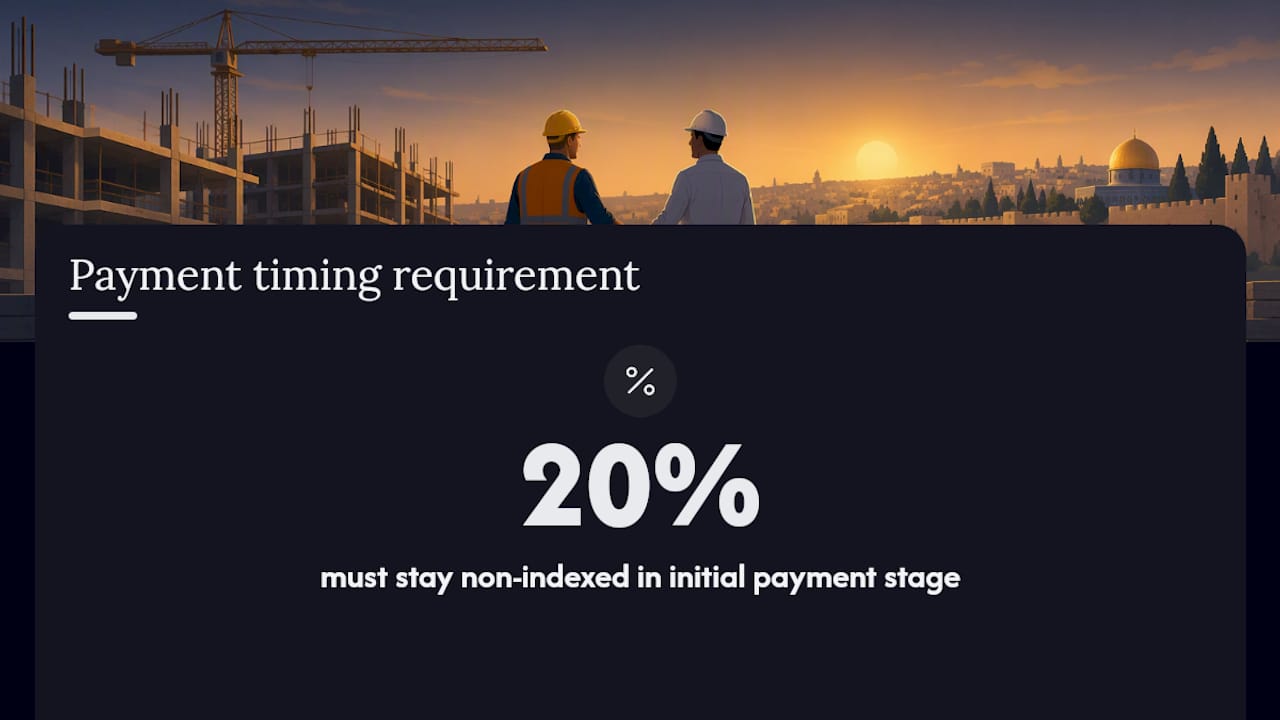
Statistic callout: The 2022 amendment to the Sale (Apartments) Law requires that 20% of the total price stay non-indexed during the initial payment stage, and it caps how much of any single later payment can be linked to the Construction Input Index.
That 20% floor matters because indexation, left unchecked, can quietly inflate your total cost well beyond the number in your original contract. The amendment’s text and the Ministry’s guidance are the two documents worth reading in full if you want the legal detail behind any schedule you’re offered, rather than relying on what a sales office tells you verbally.
Discounted-apartment programs like Mehir LaMishtaken run on a different rhythm than a standard private purchase. Winners of the lottery typically pay a small registration deposit, commonly NIS 2,000, at the moment they select their unit. That figure surprises a lot of first-time buyers who expect a standard deposit percentage right away.
The rest of the schedule isn’t standardized across the country. It’s set by the specific tender the project falls under, so two Mehir LaMishtaken buildings in different cities can carry different payment timelines even though both use the same discount program.
Before you sign anything, check these tender-specific details:
Read the tender document itself, not just the sales brochure. The tender is the legal source for your specific payment terms.
Most new-construction projects in Israel run under financial accompaniment (ליווי פיננסי), meaning a bank oversees the project’s finances and channels buyer payments into a dedicated project account instead of the developer’s general account. This is the mechanism that keeps your deposit safe if the contractor runs into financial trouble mid-build.
Payments in accompanied projects move through a payment voucher (שובר תשלום), a document issued by the financing bank that directs your money into the project account rather than anywhere the contractor chooses. The Bank of Israel’s guidance sets a firm clock on this: once a payment is made via voucher, the bank must issue a guarantee or other valid security within 14 business days.
Before transferring anything, confirm these three things:
Pro Tip: Never wire money to a contractor’s personal or general operating account, even if the sales office insists it’s “just this once” for a small fee. That single transfer sits entirely outside the protections the voucher system was built for.
Red flags worth walking away from: no voucher offered at all, a voucher referencing an account that doesn’t match the bank’s own records, or a verbal promise of a guarantee with nothing in writing.
Contracts commonly link part of the price to the Construction Input Index, the consumer price index, or occasionally a foreign currency. Indexation protects the developer against rising material and labor costs, but left uncapped, it can also quietly raise your total bill well past the number you signed for.
The law limits this exposure in two ways:
Statistic callout: That 20% non-indexed threshold is a statutory floor, meaning no contract can legally push a larger share of your early payments into indexed territory, whatever the sales agreement says.
Delays add another layer. If the contractor misses the delivery date, you may have compensation rights that offset costs, but indexation on outstanding payments often keeps accruing regardless of the delay. Read your contract’s indexation clause specifically for what happens during a delay period before assuming compensation cancels out the extra cost.

Before you sign a schedule or make a first payment, get clear, written answers on each of these points:
Pro Tip: If you’re financing with a mortgage, get your bank’s disbursement schedule and the contractor’s payment schedule side by side before you sign anything. Mismatched timing between the two is one of the most common sources of last-minute cash scrambles buyers report.
A real estate lawyer’s review at this stage is worth the fee. It’s far cheaper than discovering a milestone definition dispute two years into a delayed project. Background on how developers structure their broader obligations is covered in this overview of developer responsibilities.
Working alongside buyers on projects across Beit Shemesh and the surrounding area, a recurring pattern shows up: buyers who ask for a sample voucher and the accompanying bank’s direct phone number before signing rarely run into payment disputes later. Buyers who skip that step, and simply trust the sales office’s verbal assurances, are the ones who end up calling six months later asking why a guarantee never arrived.
A small but real negotiating win we see often: pushing a large mid-construction payment back by one milestone stage when a buyer’s mortgage approval is still in process. Developers are frequently open to this shift when a buyer asks early, before the schedule is finalized, rather than after signing. For buyers exploring local flexible arrangements, it’s worth reviewing how flexible payment plans work for Beit Shemesh purchases specifically.
Buyers under pressure to “lock in” a unit before someone else does often skip the voucher and guarantee verification step, treating it as paperwork that can happen later. That’s backward. A signed contract with an unverified payment mechanism is worth less than an unsigned one with everything confirmed, because the paper protections only work if you’ve actually checked they’re real before money moves. Slowing down by a day or two to call the accompanying bank directly costs you nothing except a small delay, and it’s the single step most likely to catch a problem before it becomes expensive. Local familiarity with how specific banks and developers in your area typically structure these vouchers shortens that verification window considerably.
— Spiros
Reading a tender document or chasing down a bank’s accompaniment officer isn’t something most buyers want to do alone, especially while juggling a mortgage application and a move. A concierge project guidance service can help buyers through that process: verifying voucher and guarantee details, coordinating timing with lenders, and translating milestone language in the contract into plain terms before signing. Early access to new developments can be important because well-structured payment schedules often belong to the first release phase of a project rather than later units. If you’re evaluating a specific development, project pages like Neve Amim show how payment schedules play out in real local buildings. Reach out through Yigal Realty’s concierge guidance to get a schedule reviewed before you commit to anything in writing.
This article is general information, not a substitute for advice from a qualified financial advisor. Consult a qualified financial professional about your own circumstances before acting on anything here.
The law requires that payments to a contractor correspond to actual construction milestones, and developers cannot collect sums beyond the percentages set by Ministry regulations. It also requires bank guarantees or equivalent security to protect buyer funds throughout construction.
Buyers in programs like Mehir LaMishtaken typically pay a small registration deposit, often NIS 2,000, when they select their unit. The remaining schedule is defined by that specific project’s tender conditions, so it varies by development.
Banks handling financial accompaniment must issue a guarantee or valid security within 14 business days of receiving a payment made through the authorized voucher. If that window passes without documentation, contact the accompanying bank directly.
No. The Sale (Apartments) Law ties payment amounts to construction progress, and the 2022 amendment requires the initial 20% of the price to remain non-indexed, which limits how aggressively early payments can be structured. Any schedule demanding a disproportionate sum before groundbreaking is worth challenging.
Yes. Yigal Realty’s concierge project guidance includes reviewing voucher and guarantee details, coordinating timing with lenders, and clarifying milestone language for buyers in Beit Shemesh and surrounding areas. Current details on this service are available through Yigal Realty’s site.