%20(4).png)
![[background image] image of cityscape background (for an architect firm)](https://cdn.prod.website-files.com/68961ade6feff9cbdffc080d/69384e066e0e9a310b6817f8_061f6bac-48bf-44b8-a689-078dacd8009f.avif)
If your contractor handed over your apartment late, you are entitled to statutory compensation under Section 5A of the Sale (Apartments) Law, and you don’t need to prove you suffered a specific loss to collect it. Compensation accrues automatically, month by month, once the grace period passes.
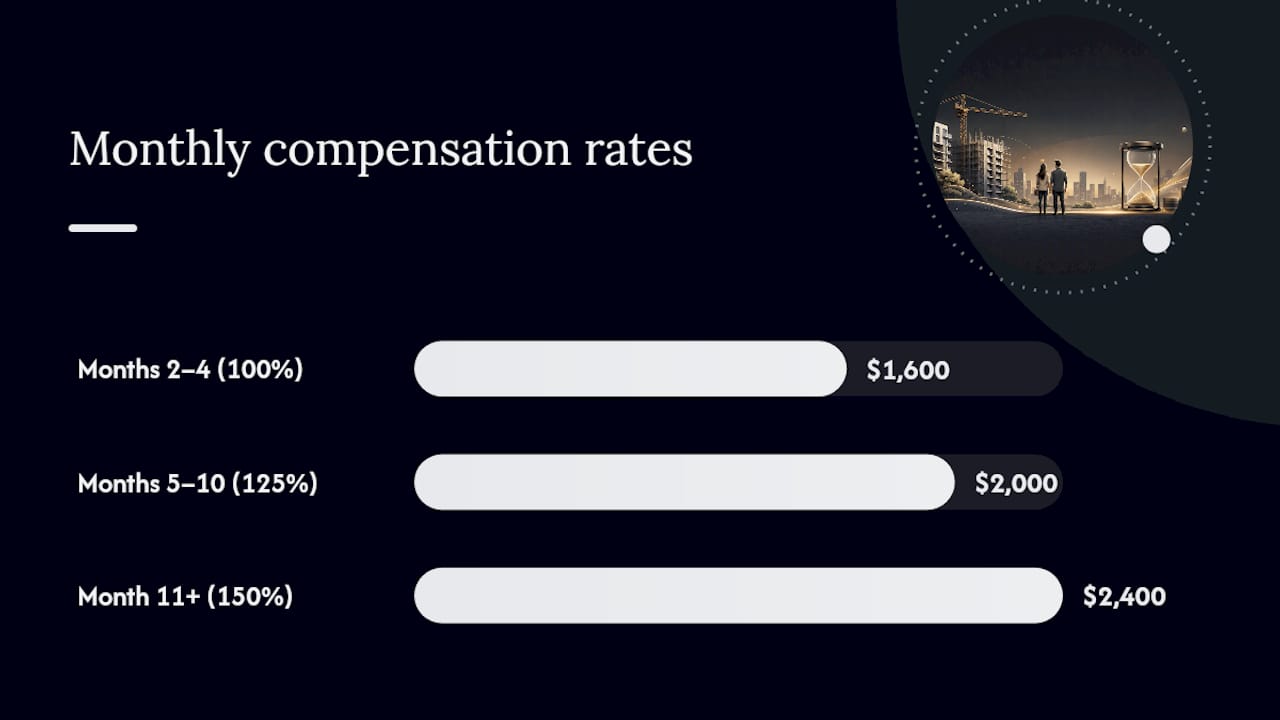
For contracts signed after July 7, 2022 (post Amendment 9), the tiers are:
Your first move is simple: pull your contract, confirm the exact delivery date written in it, start saving every email and text from the developer, and if the delay is dragging on, get a licensed appraiser to establish the fair rent figure your calculation will rest on.
Statutory compensation for delayed apartment delivery in Israel accrues monthly under Section 5A, requires no proof of damage, and pays more the longer the delay drags on.
| Point | Details |
|---|---|
| Confirm your contract’s signing date | Contracts before July 7, 2022 use a 60-day grace period; contracts after use 30 days and the current tiers. |
| Know the tier structure | Months 2–4 pay 100% of fair rent, months 5–10 pay 125%, month 11 onward pays 150%. |
| Get an independent appraisal early | Fair market rent is the most disputed number in any claim, so a licensed appraisal protects your calculation. |
| Document everything monthly | Save contracts, correspondence, and receipts as they happen rather than reconstructing them later. |
| Don’t attempt a DIY set-off | Bank accompaniment often blocks unilateral deductions; pursue formal demands or legal claims instead. |
This article is general information, not a substitute for advice from a qualified lawyer. Consult a qualified legal professional about your own circumstances before acting on anything here.
Section 5A of the Sale (Apartments) Law works as a floor, not a ceiling. It guarantees a minimum payout tied to the apartment’s fair rental value, and it applies automatically once the grace period is crossed, with no need to prove you lost money on a specific expense. If your contract happens to specify a higher penalty for delay, that higher figure controls instead. The statute exists precisely so buyers aren’t left arguing over damages from scratch every time a project slips.
Amendment 9 rewrote the mechanics in a buyer-friendly direction. Before the amendment, buyers got a 60-day grace period and a different tier structure. After it, the grace period shrank to 30 days, and the tiers above took effect. According to the government’s own Amendment 9 summary, the change entered into force in July 2022 and applies to contracts signed from that date forward. Older contracts still run under the previous rules, which is why checking your signing date matters more than most buyers realize.
A few points worth pinning down before you calculate anything:
For anyone who wants the primary legislative record rather than a summary, the Knesset’s legislative file on Amendment 9 lays out exactly which contracts the amendment covers and when it took effect.
The math is not complicated once you know your inputs. You need three things: the contractual delivery date, the actual handover date, and the fair market rent for a comparable apartment in the same building or neighborhood.
Fair market rent is the figure courts and lawyers lean on most, and it is usually established by a licensed appraiser who looks at comparable rentals nearby, similar size, similar condition, similar location. Buyers and contractors frequently disagree on this number, which is why appraisal-backed calculations hold up far better in a dispute than a number pulled from a rental listing site.
Here’s the calculation sequence:
Pro Tip: Run this calculation the moment your grace period expires, not after the project finally hands over keys. Compensation accrues whether you’re tracking it or not, but a month you forgot to document is a month you may struggle to collect later.
Say fair market rent for a comparable apartment runs $1,600 a month, and delivery slips five months past the grace period.
That’s roughly $6,800 owed for a four-month delay past the grace period, before anyone even discusses actual out-of-pocket losses like a bridge rental. If the delay stretches to month 11 and beyond, the multiplier jumps again, so the cost of a long delay compounds fast for the developer, not just for you.
Your contract’s signing date decides which version of the law governs your claim, and the difference between the two regimes is significant.
Contracts signed before July 7, 2022 fall under the older framework: a 60-day grace period, and a tier structure that differs from the current one. Contracts signed on or after that date get the shorter 30-day grace period and the 100/125/150 percent tiers described above.
The practical consequences are real. A buyer under the old regime waits twice as long before compensation starts. Under the new regime, compensation kicks in sooner and climbs to its highest multiplier faster, since the tiers step up at month 5 and month 11 rather than later benchmarks under the prior law.
Before you calculate anything, do this:
Statutory compensation is not unconditional. The law carves out two main exceptions: delay caused by the buyer (a late mortgage approval, requested design changes that pushed the schedule) and genuine force majeure under general contract law principles.

The burden of proof sits with the contractor, not you. If a developer wants to avoid paying, they have to demonstrate the delay falls into one of these categories, and courts read force majeure narrowly. A supply-chain hiccup or a general labor shortage rarely qualifies on its own; contractors need detailed evidence that the event was genuinely unforeseeable and outside their control, not just an assertion that “everyone was delayed that year.”
Three disputes come up again and again:
Pro Tip: Commission an independent appraisal the moment a delay looks likely to stretch past a few months. A number you paid for and can defend in a negotiation carries far more weight than a figure a contractor’s lawyer can dismiss as speculative.
Collecting what you’re owed is mostly a documentation exercise, not a courtroom drama, at least until a dispute forces the issue.
One detail trips up a lot of buyers: bank accompaniment. When a project runs through an escrow arrangement with a bank overseeing payments, courts have consistently upheld the bank’s priority over a buyer’s attempt to unilaterally deduct owed compensation from the final installment. Withholding payment on your own initiative can put you in breach of your own obligations under the sale agreement. The safer path is a formal demand followed by a claim or, if necessary, an injunction, not a DIY deduction at closing. Reviewing your contract’s escrow and bank-accompaniment terms before you’re anywhere near this situation saves a lot of stress later.
Legal compensation is one track. The other is making sure you’re not caught off guard operationally when handover finally happens, and that’s where a broker who knows the local development pipeline earns their keep.

Before any client nears a scheduled handover date, Yigal-realty walks through a short checklist: confirm the exact contractual delivery date against the final signed agreement, verify the project’s bank-accompaniment or escrow status, and make sure every bank letter and guarantee tied to the purchase is on file and accounted for. Missing paperwork at this stage is a common, avoidable headache.
When a delay does happen, Yigal-realty helps clients organize the documentation, that ledger of dates, receipts, and correspondence, so a lawyer can move quickly instead of starting from a blank file. A due diligence checklist built before you sign anything makes this process far smoother if a delay does show up later.
One practical note on negotiating with developers directly: it’s fine to discuss a settlement or a goodwill gesture (upgraded finishes, a small credit) while a delay is unfolding, but put in writing that any such gesture doesn’t waive your statutory rights under Section 5A. Developers sometimes offer a modest concession hoping it closes the door on a larger claim later. It shouldn’t, unless you sign something that says so.
Pro Tip: Ask for your bank-accompaniment documentation in writing before you sign anything at handover, not after. If a set-off dispute ever comes up, you want to already know exactly what the escrow terms allow.
Most guidance on delayed delivery treats the statutory tiers as the whole story and stops there. That’s a mistake. The tiers are a floor the legislature built specifically so buyers don’t have to litigate damages from zero, but plenty of buyers are owed more than the floor and never ask for it because nobody told them the statute doesn’t cap their claim.
The bigger failure I see in how this topic gets discussed is timing. Buyers wait until the project finally delivers, then try to reconstruct months of delay from memory and scattered texts. The research on this consistently points the same direction: compensation accrues whether or not you’re tracking it, and a monthly paper trail built in real time beats a reconstruction built under pressure, every time.
If I had to name the single highest-leverage move a buyer can make, it’s commissioning the fair-rent appraisal early rather than waiting for a fight. It turns an abstract entitlement into a specific number you can put in a demand letter on day one of month two.
— Spiros