%20(4).png)
![[background image] image of cityscape background (for an architect firm)](https://cdn.prod.website-files.com/68961ade6feff9cbdffc080d/69384e066e0e9a310b6817f8_061f6bac-48bf-44b8-a689-078dacd8009f.avif)
TL;DR:
- Flexible payment plans in Beit Shemesh allow buyers to spread costs over construction milestones, reducing upfront financial pressure. However, they often come with a 2 to 5 percent cost premium and halachic considerations, requiring careful review of contract details and religious compliance. Knowing what triggers each payment and consulting experts ensures a financially sound and faith-appropriate property transaction.
Buying a home in Beit Shemesh does not have to mean writing a massive check before construction even begins. Many buyers from observant and religious communities assume that full upfront payment is the only path to owning property, but flexible payment plans have quietly transformed how families and investors approach real estate transactions in Israel. These staged arrangements let you spread the financial commitment over months or years, keeping cash flow manageable while your future home takes shape. This guide breaks down exactly how these plans work, what they really cost, and what every religiously observant buyer must review before signing anything.
| Point | Details |
|---|---|
| Staged payments are common | Payment plans for new homes in Beit Shemesh usually split costs over construction milestones. |
| Factor in all costs | Flexible payment options often include extra charges or higher prices, so review full financial details. |
| Align with halachic needs | Religious buyers should structure contracts to avoid forbidden interest and seek expert guidance. |
| Fits varied cash flow | Flexible plans help buyers who need more time or need to assemble funds progressively. |
| Scrutinize contract terms | Carefully check what triggers each payment and flag any complicated or unclear clauses. |
A flexible payment plan, in real estate terms, is a staged installment method where the buyer does not pay the full purchase price at once. Instead, you pay a series of predetermined amounts tied to specific events or calendar dates throughout the purchase process. This structure is especially common with new construction or off-plan purchases, meaning properties you buy before or during the building process.
The basic mechanics look like this:
Stage-based payment structures tied to construction milestones or possession are standard across newly developed properties, and flexi options can further customize the timing and amount. What matters is knowing exactly what event triggers each payment. A milestone labeled “structural completion” can mean different things to different developers, and vague language in contracts creates real financial risk.
The home buying process in Beit Shemesh follows many of these same principles, though local market customs and religious contract norms add layers of detail that buyers need to understand before committing.
“Flexibility in a payment schedule is an advantage only when you understand what each trigger actually demands from you. Read every appendix, not just the main contract.”
Pro Tip: Before you sign anything, request a written schedule showing the exact event or documentation required to trigger each payment installment. Verbal explanations from sales agents are not binding.
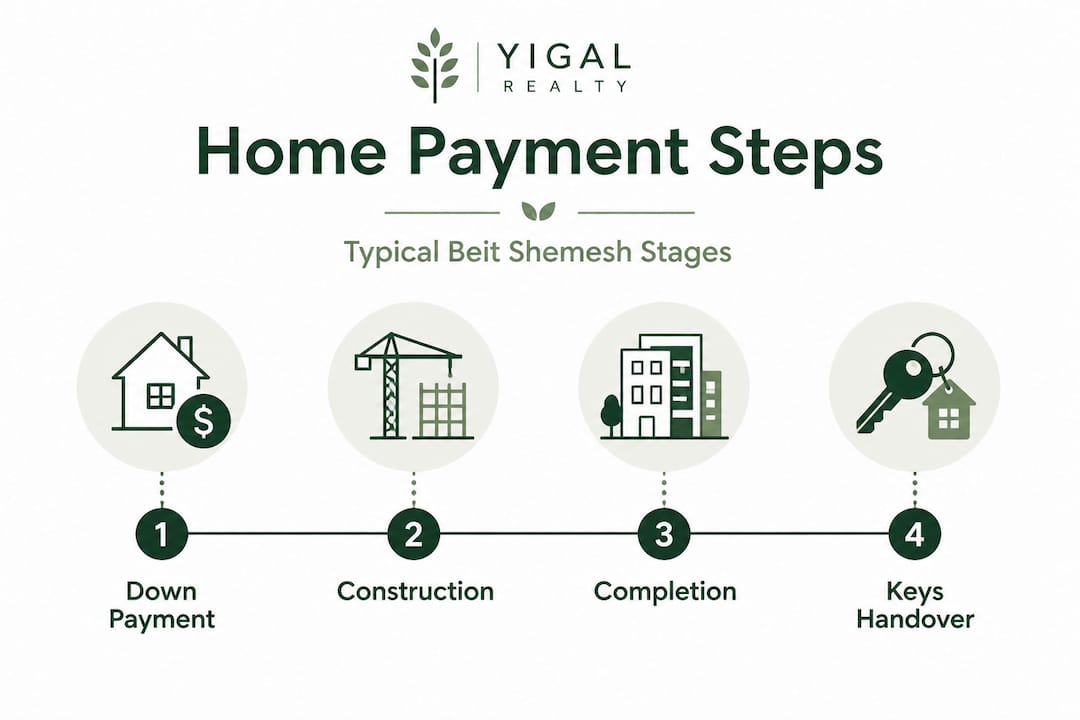
In Beit Shemesh and surrounding areas, local developers have adapted the flexible payment concept to serve the specific needs of observant and religious communities. Developer-backed flexible payment arrangements in these communities commonly let buyers spread payments over construction, with a down payment followed by scheduled installments and a final balance at possession. The structure feels familiar, but the details and the community expectations around it are distinctive.
Here is what a typical Beit Shemesh transaction looks like, step by step:
The following table summarizes the common payment breakdown for off-plan properties in Beit Shemesh:
| Payment Stage | Typical Percentage | Trigger Event |
|---|---|---|
| Down payment | 10 to 15% | Contract signing |
| First milestone | 15 to 20% | Foundation/framing complete |
| Second milestone | 20 to 25% | Floors/interior rough work |
| Pre-completion | 10 to 15% | Certificate of occupancy issued |
| Final possession | 20 to 30% | Key handover |
The homebuying workflow for families in this community involves more than financial planning. Religious buyers often bring a family rabbi or halachic (Jewish law) advisor into the contract review process. This is not unusual or excessive. It is a standard part of how major financial commitments are handled in observant households.
Here is where many buyers underestimate the true cost of choosing flexibility. Developers are businesses, and they price in the risk of waiting for your money. A 2 to 5 percent price premium is common with flexible plans compared to full upfront payment, and delay-related interest provisions can add further costs if you miss a scheduled payment date.

On a 2 million Israeli shekel property, a 3 percent uplift means paying an extra 60,000 shekels simply for the convenience of staged payments. That is real money. Add potential documentation fees and you can see why comparing the total cost, not just the monthly or installment amount, is essential.
| Feature | Upfront payment | Flexible payment plan |
|---|---|---|
| Base price | Lower | 2 to 5% higher typically |
| Cash flow demand | High at signing | Spread over construction |
| Interest risk | None | Possible delay penalties |
| Documentation fees | Minimal | May apply at each stage |
| Flexibility for buyer | Low | High |
Before you sign, ask these questions directly and in writing:
Exploring how to approach financing property investments in Beit Shemesh will also give you a clearer picture of how mortgage options and developer payment plans can be layered together to optimize your total cost.
For observant Jewish buyers, flexible payment plans introduce a specific set of halachic considerations that go beyond standard financial due diligence. The central concern is ribbis, the Torah prohibition against paying or receiving interest in transactions between Jewish parties. When a buyer prepays for a property that does not yet exist, or makes advance payments before possession, there is a question about whether any built-in premium or financial arrangement crosses into prohibited interest territory.
One widely used solution is the isska structure. An isska is a halachically valid business partnership arrangement where advance funds are treated as an investment rather than a loan. Prepayments for a house “on paper” may be structured as investment or isska rather than loans, which is a specific nuance for observant buyers negotiating payment timing and contract language with respect to ribbis prohibitions. Knowing this option exists is the first step. Having it correctly written into your contract is what actually protects you.
Best practices for observant buyers navigating flexible payment contracts:
Getting solid expert buyer guidance early in the process means these issues are addressed before you are emotionally invested in a specific property or unit. Trying to renegotiate contract terms after you have chosen your apartment is much harder, and some developers will resist changes once the sales process is underway.
Pro Tip: Flag any clause that adjusts the purchase price based on payment timing. Even if it is described as a “discount for early payment” rather than interest, it may still require halachic review.
Flexible payment plans genuinely serve certain buyers very well. The key is knowing whether your specific situation is one of them. Developers market payment flexibility to improve affordability and conversion rates, often using low upfront amounts with deferred balances tied to later documentation or possession certificates.
This approach works best when:
However, there are situations where the extra cost of flexibility is simply not worth it:
“The right payment structure is the one that fits your actual cash flow, not the one the developer presents as the headline deal.”
Use the first-time buyer checklist to map your financial readiness before committing to any payment structure. Buyers who work through that kind of systematic review make far fewer costly mistakes.
After working with many families purchasing in Beit Shemesh and nearby communities, one pattern is clear. Buyers focus intensely on the size of the monthly or installment payment, and almost completely ignore the total cost over the full transaction and the contractual triggers that govern every stage.
The installment schedule is often buried in a technical appendix to the main contract. Buyers read the main document carefully, sometimes with their lawyer, and skim the appendix as if it contains only irrelevant boilerplate. In reality, that appendix is where the developer defines what “structural completion” means, what happens if a government inspection is delayed, and what interest rate applies if you are late by even one day on a scheduled payment.
There is also a timing problem specific to religious communities. Many observant buyers wait until they have chosen and fallen in love with a specific apartment before asking whether the contract can be structured to meet halachic requirements. At that point, they are negotiating from a position of emotional attachment rather than calm evaluation. Developers know this and are less willing to make changes.
The smarter approach is to establish your halachic and financial requirements before you begin property tours, and to filter projects based on whether developers are willing to accommodate those requirements from the start. Reviewing property buying tips curated specifically for Beit Shemesh families can help you build that framework before you walk into any sales office.
The uncomfortable truth is that flexible payment plans reward prepared buyers and cost unprepared ones more than any other transaction structure. If you know what to ask for and when to ask for it, flexibility is genuinely valuable. If you do not, you are paying a premium for a structure you do not fully understand.
Navigating both the financial and halachic dimensions of a Beit Shemesh property purchase requires more than a good contract template. It requires advisors who understand the local market, the specific developers active in the area, and the religious community’s standards for ethical real estate transactions. Yigal Realty’s team specializes in exactly this kind of structured, observant-friendly guidance, with experience supporting buyers from both Israel and North America. From current Beit Shemesh projects with flexible payment options to personalized support through every stage of the transaction, the team is equipped to help you find a payment structure that works for your timeline, budget, and religious requirements. Reach out directly to get a clear look at what is available right now.
A flexible payment plan lets you spread payments over construction stages, often with a small upfront amount followed by scheduled installments and a final balance at possession, as is standard in observant-community homebuying workflows in the Beit Shemesh area.
Yes, developers often add a 2 to 5 percent price uplift or may include delay-related fees to offset the flexibility they are offering; always request a clear total cost comparison before committing.
Religious buyers verify that contracts avoid forbidden interest (ribbis) and may structure advance payments as investments under an isska arrangement; the requirement to treat prepayments as isska rather than loans is a specific nuance that requires a qualified halachic advisor before you sign.
Flexible options provide real cash-flow relief but typically cost more in total; flexible plans carry a price premium plus potential delay penalties, so compare the full financial picture, not just the installment size, before deciding.