%20(4).png)
![[background image] image of cityscape background (for an architect firm)](https://cdn.prod.website-files.com/68961ade6feff9cbdffc080d/69384e066e0e9a310b6817f8_061f6bac-48bf-44b8-a689-078dacd8009f.avif)
TL;DR:
- A pre-sale agreement is a binding early contract that specifies property, price, and terms before final ownership transfer. Its enforceability in Israel relies on precise wording, with some documents being legally binding even without a formal purchase agreement. Buyers should consult legal experts, verify deposit protections, and carefully review clauses to avoid costly disputes.
A pre-sale agreement is a written, early-stage contract where a buyer and seller commit to completing a future real estate transaction on agreed terms, before ownership legally transfers. Known in formal legal contexts as a preliminary purchase agreement, this document locks in the property, price, payment structure, and contract deadlines well before the final closing. In Israeli real estate, understanding this contract type is not optional. Buyers who sign without reading carefully can find themselves legally bound to terms they assumed were flexible. This article explains exactly how a pre-sale agreement works, what it contains, and where the real legal risks hide.
A pre-sale agreement is defined as a preliminary contract that documents key deal terms before the final transfer of ownership takes place. It is not a deed. It is not a title transfer. It is a binding roadmap that tells both parties exactly what they have agreed to and what happens if either side walks away.
The typical pre-sale agreement covers six core elements:
Earnest money deposits often serve as a performance guarantee, regulating financial obligations if one side cancels. In practice, this means a buyer who backs out without a valid legal reason typically forfeits the deposit, while a seller who cancels may owe double the deposit back to the buyer.
| Element | Purpose |
|---|---|
| Property description | Identifies exactly what is being sold |
| Purchase price | Fixes the agreed amount to prevent renegotiation |
| Earnest money | Creates financial accountability for both parties |
| Contract deadline | Sets a firm date for signing the final agreement |
| Binding clauses | Specifies which terms are immediately enforceable |

Pro Tip: Before signing, ask your attorney to mark every clause as either binding or non-binding. Unsigned assumptions about which terms are flexible have cost Israeli buyers significant deposits.
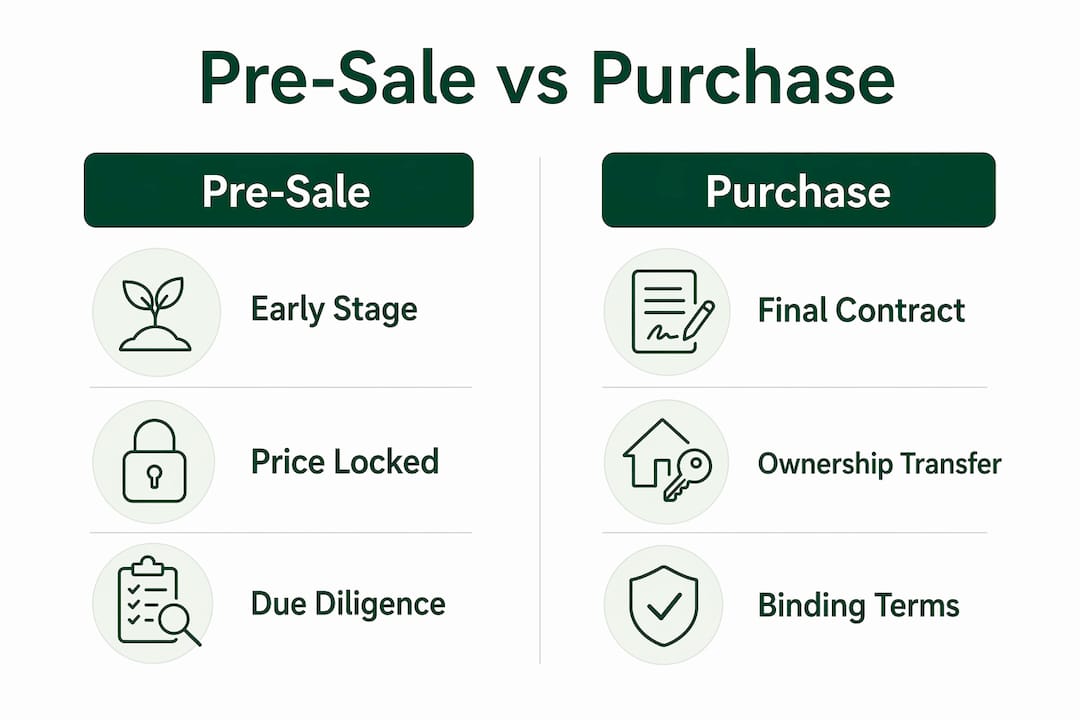
The pre-sale agreement and the purchase agreement are not interchangeable. They serve different legal purposes at different stages of the transaction.
A pre-sale agreement is preliminary. It secures the deal terms early and gives both parties time to complete due diligence, arrange financing, and prepare for closing. A purchase agreement, by contrast, finalizes ownership transfer and requires notarization in Israel. The purchase agreement triggers title registration with the Israel Land Registry (Tabu). The pre-sale agreement does not.
| Feature | Pre-Sale Agreement | Purchase Agreement |
|---|---|---|
| Timing | Early stage, before due diligence completes | Final stage, at or near closing |
| Notarization required | No | Yes, in Israel |
| Triggers title registration | No | Yes |
| Primary purpose | Lock in terms, secure the deal | Transfer legal ownership |
| Binding status | Varies by wording and intent | Fully binding upon execution |
The timing distinction matters for investors especially. A pre-sale agreement on a new development in Beit Shemesh, for example, might be signed 18–24 months before the building is complete. The purchase agreement follows only when the unit is ready for handover. Buyers who treat these two documents as equivalent often miss critical protections they should have negotiated at the preliminary stage.
Pro Tip: Never assume the pre-sale agreement is just a formality. The terms you accept there will carry directly into the final purchase agreement. Negotiate hard at the pre-sale stage, not after.
Whether a pre-sale agreement is binding depends on its wording and intent. This is the single most misunderstood aspect of preliminary contracts in Israeli real estate. Many agreements are hybrid documents: commercial terms like price may be non-binding pending final negotiation, while protective clauses like confidentiality or deposit forfeiture are immediately enforceable.
In Israel, buyers also encounter two specific reservation-type documents that carry serious legal weight.
“Treat any signature as potentially binding until confirmed by legal counsel.” — The Jerusalem Post
International buyers in Israel face heightened risk here. Unfamiliarity with Hebrew legal language, cultural pressure to sign quickly, and the assumption that reservation documents are informal have all led to costly disputes. A properly drafted pre-sale agreement will clearly distinguish binding from non-binding parts to preserve negotiating leverage for both sides. If yours does not, that is a red flag worth addressing before you sign.
For a full breakdown of which Israeli real estate documents carry binding weight at each transaction stage, review the legal document guide before your next signing.
Pre-sale agreements offer real advantages for buyers who understand how to use them. They also carry specific risks that catch unprepared buyers off guard.
The core benefits include:
The risks require equal attention:
Pro Tip: For any off-plan purchase, request a bank guarantee (known in Israel as a bank guarantee or aval) that protects your deposit if the developer fails to complete the project. This is a legal right for buyers of new construction in Israel under the Sale Law.
For buyers navigating the transaction steps in Israel for the first time, understanding where the pre-sale agreement sits in the full process is the difference between a smooth purchase and an expensive lesson.
A pre-sale agreement is a legally significant preliminary contract that locks in deal terms before final ownership transfer, and its binding force in Israel depends entirely on how it is worded.
| Point | Details |
|---|---|
| Pre-sale agreement definition | An early written contract fixing price, property, and terms before final closing. |
| Binding status varies | Wording and intent determine enforceability; never assume a document is non-binding. |
| Pre-sale vs. purchase agreement | Pre-sale is preliminary and non-notarized; purchase agreement transfers title and requires notarization. |
| Reservation documents carry risk | Sichron devarim and tofes harshama can be legally binding even without a formal follow-up contract. |
| Inspections protect buyers | For new builds, insist on construction inspections before the final agreement is signed. |
After years of working with buyers in the Israeli market, the pattern I see most often is not greed or bad faith. It is speed. Buyers get excited, a developer or seller creates urgency, and a document gets signed before anyone has read it carefully.
The sichron devarim is the most dangerous document in Israeli real estate for this reason. It looks informal. It is often handwritten or a short typed page. Buyers assume it is just a summary of what was discussed. Israeli courts have treated it as a full contract. I have seen buyers lose deposits because they signed a sichron devarim at a meeting, then tried to renegotiate terms they thought were still open.
My strong advice: engage a licensed Israeli real estate attorney before you sign anything, including a reservation form. The cost of a legal review is a fraction of what a deposit forfeiture or forced transaction will cost you. For US buyers especially, the contract terms for US buyers in Israel differ significantly from what you are used to at home. Do not assume the process works the same way.
Insist on inspections for new builds. Insist on bank guarantees for off-plan deposits. And read every clause before you sign, not after.
— Spiros
Yigal-realty works with homebuyers and investors purchasing properties in Beit Shemesh and surrounding communities, including many international clients navigating the Israeli market for the first time. The team provides guidance on pre-sale agreements, developer contracts, and the full transaction process from reservation to final closing. If you are evaluating a new development or trying to understand what you are being asked to sign, Yigal-realty can connect you with the right legal and transactional support before you commit. Visit Yigal-realty’s property listings to explore current projects and get in touch with an agent who understands both the legal framework and the local market.
A pre-sale agreement is an early contract where a buyer and seller agree on the key terms of a real estate deal before the final purchase agreement is signed and ownership transfers.
It depends on the document’s wording and the parties’ intent. Some clauses are immediately enforceable while others are not, which is why legal review before signing is critical.
A sichron devarim is a short preliminary memorandum summarizing agreed terms. Israeli courts have ruled it can be binding as a full contract, while a purchase agreement is the formal, notarized document that transfers legal title.
Canceling without a valid legal reason typically results in forfeiture of the earnest money deposit. If the seller cancels, they may owe double the deposit back to the buyer, depending on the contract terms.
Sign only after a licensed Israeli real estate attorney has reviewed the document, confirmed which clauses are binding, and verified that your deposit is protected. For new builds, also confirm that a bank guarantee covers your payments.