

Before any deposit changes hands, require three things: an active license on Rasham HaKablanim, current insurance certificates, and at least two recent client references for comparable work. Gather three bids built to one identical brief, then verify the license number directly on gov.il. Nothing else matters until a written contract spelling out scope, milestones, and change orders exists, because that document is what protects your money once work starts.
TL;DR:
- Verify every contractor’s license through Rasham HaKablanim, ensuring the name matches the proposal and the license is active and scope-appropriate.
- Obtain at least three bids based on an identical scope, with detailed itemization of materials, labor, allowances, and clear payment milestones.
- Check references by speaking directly with previous clients and review past permit filings and project photos to confirm real experience.
- Insist on a written contract that clearly states scope, exclusions, payment schedule, change procedures, permits, warranty terms, and insurance certificates issued by the insurer.
- Avoid contractors demanding large upfront deposits, offering vague scope language, or with references that cannot be verified; prioritize scope and licensing over low price.
Hiring the wrong contractor rarely announces itself upfront. It shows up three weeks into demolition, when the crew disappears for two weeks, or six months later when the municipality flags unpermitted work and orders it torn out. Process and paperwork beat the lowest bid almost every time, because a contractor who documents scope, pulls the right permits, and communicates on a schedule gives you predictability. A contractor who wins your trust with charm and a cheap number gives you none.
The failure pattern is consistent across renovation and new-build projects in Israel:
Every one of these is preventable with vetting done before you sign anything.
You cannot compare bids fairly if every contractor is pricing a different job in their head. A tight brief forces apples-to-apples pricing and reveals which contractors actually read what you sent them.
Before contacting anyone, write down:
Send this identical document to every contractor you contact. If a bid ignores half of it, that’s your first signal.
Start with people who have already paid for the work and lived with the result. Personal referrals from neighbors, family, or coworkers who finished a similar project in the last two years carry more weight than any online listing.
Beyond referrals, build your shortlist through:
Watch for warning signs in any listing: no project photos beyond stock images, references that can’t be reached, or vague, evasive answers to direct questions about past work. A contractor with nothing to show usually has a reason for showing nothing.
This is the step people skip because it feels bureaucratic. It is also the one that protects you legally and financially if something goes wrong mid-project.
Verify every contractor through Rasham HaKablanim (Ministry of Construction) — contractor registry, which is the official body maintaining license status for contractors operating in Israel. Cross-check the same details on the Gov.
When you pull the record, confirm:
If the contractor plans to bring in subcontractors, require their license numbers too, along with a written clause making the general contractor responsible for subcontractor work and compliance.
Pro Tip: A mismatch between the name on the license and the name on your proposed contract is one of the clearest risk signals in the entire vetting process. Don’t sign until that discrepancy is explained.
Renderings and mood boards tell you what a contractor hopes to build. Completed projects tell you what they actually deliver.
Ask for:
On a site visit or in photos, look past the paint job. Check corner details, how clean the site stays during active work, and whether trim lines and fixture placement look deliberate rather than rushed. Ask how they handle subcontractor turnover, which suppliers they’ve used for years, and how they document the handover at project completion. A contractor who has a consistent answer for handover paperwork has done this enough times to have a system.
A proposal that just states a total price and a start date is not a bid you can evaluate. It’s a placeholder.
Demand that every proposal itemizes:
Score each bid on scope completeness, clarity on what’s excluded, whether the schedule looks realistic given the scope, and what the warranty actually covers. Comparing at least three bids built to an identical scope is the minimum standard for catching a lowball number that’s quietly missing half the work.
Red flags worth walking away from: allowances so large they could hide anything, a demand for a large upfront deposit before any work begins, or scope language that says finishes will be “to be agreed” later.
Verbal agreements do not survive disputes. Everything that matters goes in the contract, in plain language both sides sign.
Your contract needs:
On insurance, request insurer-issued certificates directly, not a PDF the contractor typed up themselves, and ask to be named as an additional insured where appropriate. Confirm general liability coverage and the equivalent of workers’ compensation for anyone working on your site.
Pro Tip: Keep a single folder, physical or digital, with every signed change order, inspection report, and the final handover package. If a dispute ever surfaces, this folder is your entire case.
For projects involving significant financial commitments upfront, it’s also worth understanding contractor financial capacity and equity requirements before signing anything.
Ask these in order and listen for specifics, not reassurance:
A contractor who answers with specifics thinks like a partner. One who answers with reassurance and no detail is selling, not planning.
Contractor vetting gets more complicated when it’s tied to a new-build purchase or a larger development project rather than a straightforward renovation. In the Beit Shemesh area, local permitting timelines and municipal inspection schedules directly affect which contractors can realistically deliver on the dates a project promises.
Some real estate firms offer concierge project guidance that draws on local knowledge of how developments in the region move from permit to handover. If you’re weighing a purchase alongside contractor decisions, or want a second set of eyes on a project timeline before committing, reach out through Yigal Realty for guidance tailored to your specific situation.
The rule that survives every project I’ve looked at closely: verify the license and insurance first, collect three comparable bids second, and refuse to start work without a signed contract third. Skip any one of those and you’re negotiating from behind after the money’s already spent.
Print this before decision day:
— Spiros
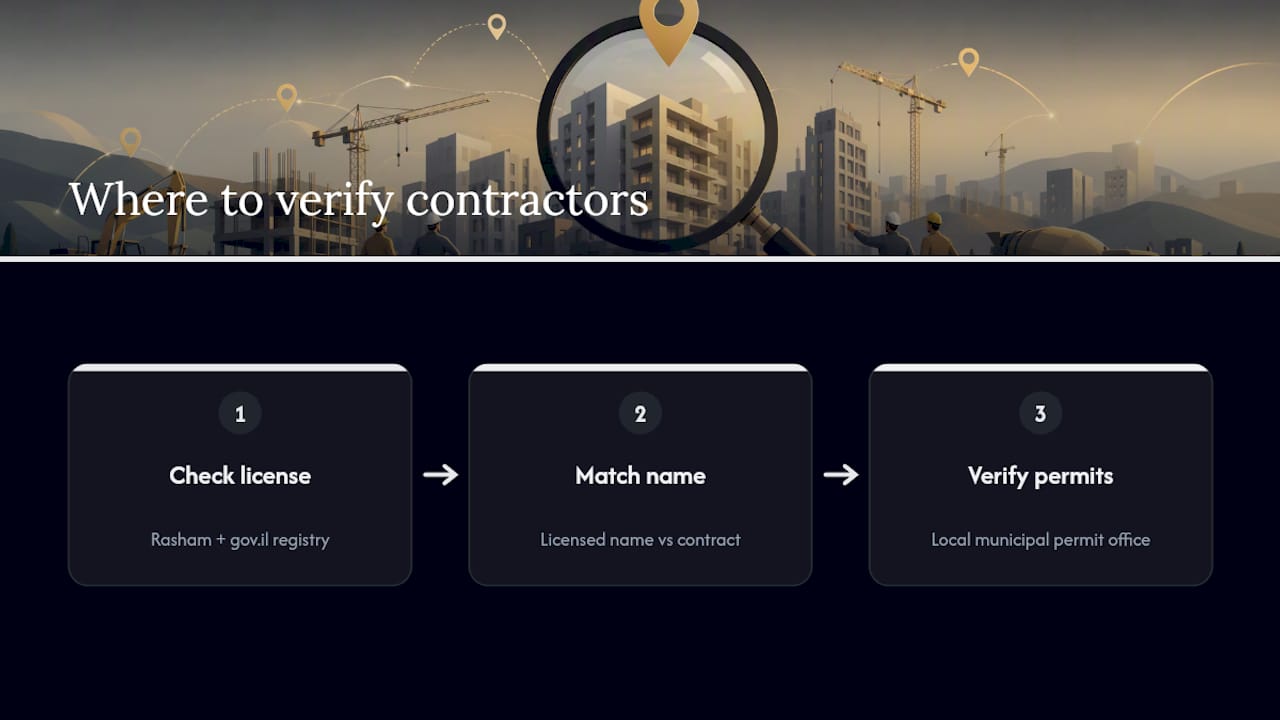
Confirm license status through Rasham HaKablanim and the gov.il construction registry. For permit history, contact your local municipal permit office directly.
Reviews online are noisy. A direct phone call to a past client is not.
When you call a reference, ask specifically:
Beyond references, check whether your municipality keeps any public complaint or enforcement record tied to the contractor’s name. For larger projects, request copies of completion paperwork or a lien release confirming subcontractors and suppliers were paid in full. Local guides on vetting contractors consistently point to documented references and past-project verification as the difference between an educated guess and a confirmed hire.
Search the contractor’s name or license number on Rasham HaKablanim, the Ministry of Construction’s official registry. Confirm the legal entity name, license class, and expiration date match exactly what appears on your proposed contract.
Collect at least three bids built to the same identical project brief. Comparing three comparable proposals is the minimum needed to spot a lowball price that’s quietly missing scope.
A reliable contractor carries general liability coverage and worker injury coverage equivalents, backed by insurer-issued certificates rather than a document the contractor typed up themselves. Ask to be named as an additional insured for larger projects.
Watch for a large upfront deposit demand, vague allowances that could hide costs, and scope items left as “to be agreed” instead of written into the contract. Evasive answers about past projects or unreachable references are equally serious warning signs.
No. A bid that’s dramatically lower than the others usually means missing scope, unlicensed subcontractors, or corners that get cut later at your expense. Score bids on scope completeness, clarity on exclusions, and realistic scheduling before comparing price.