%20(4).png)
![[background image] image of cityscape background (for an architect firm)](https://cdn.prod.website-files.com/68961ade6feff9cbdffc080d/69384e066e0e9a310b6817f8_061f6bac-48bf-44b8-a689-078dacd8009f.avif)
TL;DR:
- Escrow in Israel is a lawyer-controlled trust account that holds buyer funds and releases them only after milestones are met. It includes layered protection through staged payments, attorney oversight, and bank guarantees for off-plan purchases. The system relies heavily on the competency of the buyer’s attorney to enforce legal conditions and verify documentation.
Escrow in Israel is defined as a lawyer-managed trust account called a Ne’emanut, where buyer funds are held by a neutral trustee and released only after specific contractual milestones are met. This system sits at the center of every Israeli property transaction, protecting buyers from losing money if a seller or developer fails to perform. The Sale (Apartments) Law caps buyer payments at 7% before bank guarantees must be issued for off-plan purchases. Understanding what is escrow in Israel, and how it differs from escrow in other countries, is the first step toward protecting your investment.
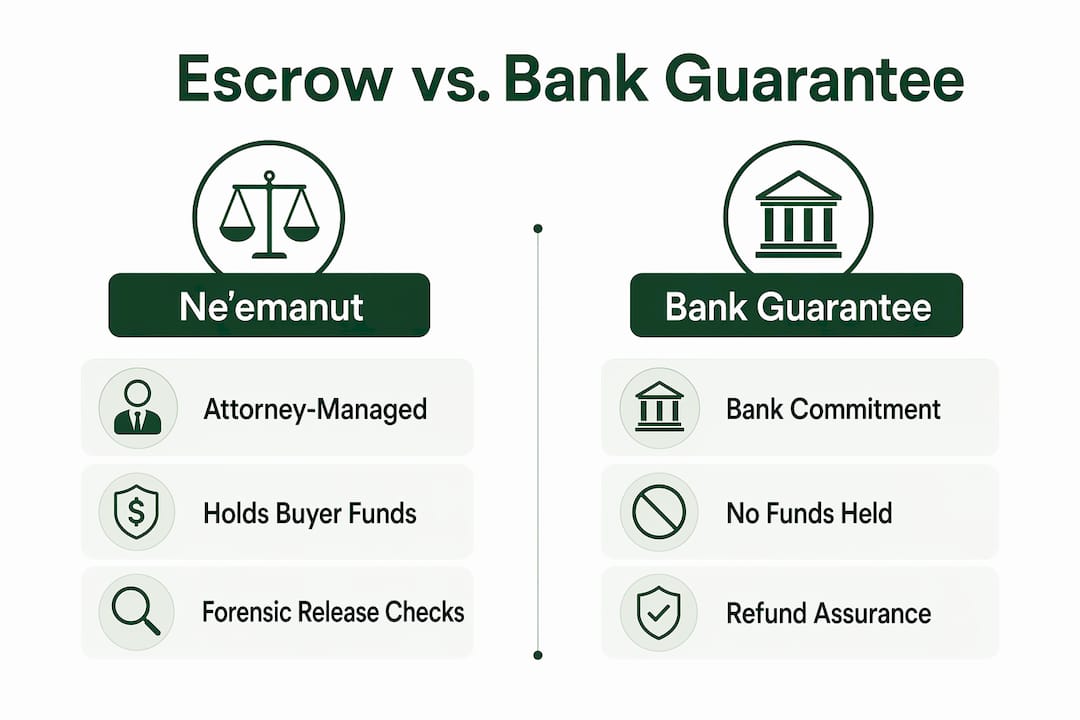
The Ne’emanut account is managed by the buyer’s attorney, who acts as a neutral trustee throughout the transaction. That attorney holds your funds and controls when they move to the seller. No payment leaves the account until the attorney confirms that each contractual condition has been satisfied.

Payments into the escrow account follow a staged schedule written into the purchase contract. Each stage corresponds to a legal or physical milestone. This structure prevents sellers or developers from accessing your money before they have earned it.
The release triggers differ depending on whether you are buying a resale property or an off-plan apartment.
For resale (second-hand) transactions, the release sequence typically looks like this:
For off-plan (new development) transactions, the sequence follows construction milestones:
The buyer’s attorney does not simply hold money passively. That attorney performs forensic due diligence at each release point, confirming the absence of liens and verifying that all registration steps are complete before authorizing any transfer.
Pro Tip: Ask your attorney to include a written release checklist in the purchase contract. Each payment stage should name the exact documents required before funds move. This removes ambiguity and gives you a clear record if a dispute arises.
The Sale (Apartments) Law is the primary statute protecting buyers of new apartments in Israel. It does not leave buyer protection to contract negotiation alone. The law mandates specific financial instruments that developers must provide before they can access your payments.
A bank guarantee, known in Hebrew as an Arvut Bankit, is a written commitment from a licensed Israeli bank to refund your staged payments if the developer defaults or fails to deliver the apartment. The bank guarantee is indexed to the Consumer Price Index, so your refund keeps pace with inflation. This matters because Israeli construction projects often span several years.
The guarantee remains valid until a defined release event occurs, such as apartment registration in the Tabu or formal delivery with a certificate of occupancy. Until that event happens, the bank stands behind your money independently of the developer’s financial health.
Buyers often treat these two mechanisms as the same thing. They are not. The Ne’emanut is an account that holds your money. The bank guarantee is a separate instrument that gives you a direct claim against a licensed bank if the developer becomes insolvent. Together, they create two layers of buyer protection that operate independently.
| Feature | Ne’emanut escrow account | Bank guarantee (Arvut Bankit) |
|---|---|---|
| What it holds | Actual buyer funds | A bank’s promise to repay |
| Who controls it | Buyer’s attorney | Issuing bank |
| Activated when | Milestones are met or missed | Developer defaults or project fails |
| Indexed to CPI | No | Yes |
| Applies to | All transactions | Off-plan purchases above threshold |
Pro Tip: Request the original bank guarantee document at each payment stage, not just a copy. You need the original to file a claim against the bank if the developer defaults. Store it in a secure location separate from your other transaction documents.
The Sale (Apartments) Law was designed specifically to prevent developers from using buyer payments as operating capital. The law forces developers to earn each payment by hitting defined milestones, and it gives buyers a direct financial claim against a bank rather than against a developer who may have no remaining assets.
Israeli escrow is attorney-managed, not handled by a title company or a neutral escrow firm. That distinction changes everything about how the system works and who bears responsibility for protecting your money.
In the United States, for example, a title company or a dedicated escrow company typically holds funds and follows mechanical instructions. The process is largely administrative. In Israel, the buyer’s attorney performs independent checks on liens, taxes, and registration progress before authorizing any payment release. That attorney is an active gatekeeper, not a passive holder.
Key differences buyers from other countries should understand:
The Israeli system places more responsibility on the buyer’s attorney than systems elsewhere. That is a feature, not a flaw. It means your attorney’s competence directly determines how well you are protected. Choosing an experienced real estate attorney is not a formality. It is the most consequential decision you make in an Israeli property purchase.
Understanding real estate contracts for buyers in Israel helps you see exactly how these protections are written into the purchase agreement from day one.
Knowing how the escrow process works is only useful if you act on that knowledge. These steps give you concrete control over your protection at each stage of the transaction.
Pro Tip: For off-plan purchases, ask your attorney to confirm in writing that each bank guarantee is valid before you authorize the corresponding payment. A brief written confirmation at each stage creates a paper trail that protects you if a dispute arises later.
Understanding the legal basics of Israeli real estate gives you the foundation to ask the right questions at every stage of your purchase.
Escrow in Israel is a legally mandated, attorney-managed system that protects buyer funds through staged payments, independent legal oversight, and bank-backed guarantees at every step of the transaction.
| Point | Details |
|---|---|
| Ne’emanut is attorney-managed | Your buyer’s attorney holds and controls funds, not a passive third party. |
| Payments follow contractual milestones | Funds release only after legal clearances, tax proof, and registration are confirmed. |
| Bank guarantees add a second layer | Off-plan buyers get a direct claim against a licensed bank if the developer defaults. |
| Tax clearance protects final payment | Withholding the last tranche until Mas Shevach clearance prevents post-sale liability. |
| Attorney choice determines protection | The competence of your real estate attorney directly controls how well the system works for you. |
I have worked with buyers who arrived in Israel expecting escrow to function the way it does in the United States, where a neutral company holds money and follows instructions mechanically. That expectation creates real risk. The Israeli Ne’emanut system puts your attorney in an active decision-making role, and the quality of that attorney’s work determines whether the protections actually hold.
The Sale (Apartments) Law was not written as a technicality. It was written because developers historically used buyer payments as operating capital, leaving purchasers exposed when projects stalled. The bank guarantee requirement was the legislature’s answer to that problem. It creates a direct financial claim against a licensed bank, completely independent of the developer’s solvency. That is a genuinely strong protection, but only if the guarantee is verified at each payment stage.
What I see most often go wrong is not a flaw in the law. It is buyers who do not insist on seeing the original bank guarantee, or attorneys who release funds before Mas Shevach clearance arrives. The system works when every party treats each milestone as a hard gate, not a suggestion. Buyer education on these mechanics is not optional in the Israeli market. It is the difference between a protected transaction and an expensive lesson.
— Spiros
Yigal-realty coordinates the full escrow process for buyers purchasing property in Beit Shemesh and surrounding areas, including guidance on contract milestones, bank guarantee verification, and Tabu registration. The team works directly with experienced real estate attorneys who manage Ne’emanut accounts and perform the due diligence required at each payment stage. Whether you are buying a resale property or an off-plan apartment, Yigal-realty provides the local knowledge and professional coordination to make sure your escrow protections are in place from contract signing to final registration. Contact Yigal-realty through the property buying guide to get personalized support for your transaction.
A Ne’emanut is a lawyer-managed trust account that holds buyer funds during a property transaction and releases them only after contractual milestones are satisfied. It is the standard escrow mechanism used in Israeli real estate purchases.
For off-plan purchases, the Sale (Apartments) Law requires developers to provide a bank guarantee for staged payments above a minimal initial threshold. The guarantee supplements the Ne’emanut by giving buyers a direct claim against a licensed bank if the developer defaults.
The seller must provide Mas Shevach (capital gains tax) clearance and proof of municipal debt settlement before the buyer’s attorney releases the final payment. Tabu registration confirming the buyer as legal owner is also required.
Israeli escrow is managed by the buyer’s attorney, who performs active legal due diligence at each payment stage. The American model typically uses a neutral title company or escrow firm that follows mechanical instructions without independent legal oversight.
Your attorney controls when funds are released and performs the checks that protect you at each stage. An attorney without specific Israeli real estate experience may miss tax liens, skip guarantee verification, or release funds before registration is complete. You can learn more about hiring a real estate lawyer for Israeli transactions to understand what to look for.