%20(4).png)
![[background image] image of cityscape background (for an architect firm)](https://cdn.prod.website-files.com/68961ade6feff9cbdffc080d/69384e066e0e9a310b6817f8_061f6bac-48bf-44b8-a689-078dacd8009f.avif)
TL;DR:
- Israel’s land ownership includes private and leasehold categories, impacting buying and transfers.
- Hiring a lawyer before viewing is essential for legal due diligence and negotiating strategies.
- The purchasing process typically takes 2 to 6 months, with specific steps for registration and financing.
Buying property in Israel is genuinely unlike purchasing a home anywhere else in the world. The combination of dual land-ownership systems, Hebrew-language contracts, community-specific due diligence, and tax structures that differ sharply between Israelis, olim, and foreign nationals creates a process where a single missed detail can cost tens of thousands of shekels. For observant families, the stakes feel even higher because the right neighborhood is not just a lifestyle preference. It is a spiritual and practical necessity. This guide walks you through every phase of the Israeli real estate transaction process using 2025 and 2026 regulations, with specific attention to religious communities and international buyers.
| Point | Details |
|---|---|
| Unique Israeli process | Transactions require specific steps, legal oversight, and community fit decisions especially for religious and international buyers. |
| Legal and agent support | Hiring a lawyer early is essential for contracts, taxes, and due diligence, while local agents help with community and negotiation. |
| Financing and tax planning | Olim and foreigners face distinct mortgage and tax rules; knowing your options can save tens of thousands of shekels. |
| Special regional challenges | Buying in yishuvim, Judea/Samaria, or off-plan developments adds extra legal and social steps—be prepared for admissions and approvals. |
| Patience pays off | Mindful planning and professional guidance make all the difference between a stressful process and a successful, community-focused purchase. |
Before you tour a single apartment, you need to understand what you are actually buying. Israel has two primary categories of land ownership: private land (Tabu) and land managed by the Israel Land Authority (ILA), also called leasehold. Private land gives you full ownership rights registered in the Tabu (Land Registry). ILA land, which covers roughly 93% of Israel, means you hold a long-term lease, usually 49 or 98 years, and certain transfers require ILA approval. For religious and international buyers, this distinction matters enormously because ILA land in settlements or yishuvim can carry extra approval steps.
Price data shows just how resilient religious-community markets have been. Jerusalem prices average NIS 2.9M, up 6.3% year over year, while Ramat Beit Shemesh averages NIS 2.1M with a striking 9.2% annual gain. These numbers outperform many areas that saw softening demand in 2025. Buyers can also review 2025 property trends for a broader national picture.
What do observant buyers prioritize? The list is consistent across families:
On the international side, foreign buyers concentrate in select cities and religious hubs rather than spreading across the country. Areas like Beit Shemesh, Jerusalem, and Ramat Bet Shemesh Aleph and Bet attract disproportionate interest from American, British, and French buyers. The Beit Shemesh market analysis highlights why this corridor continues to outperform national cooling trends.
| Area | Average Price (NIS) | YoY Change |
|---|---|---|
| Jerusalem | 2,900,000 | +6.3% |
| Ramat Beit Shemesh | 2,100,000 | +9.2% |
| Tel Aviv metro | 3,400,000 | +1.8% |
| National average | 1,850,000 | +2.1% |
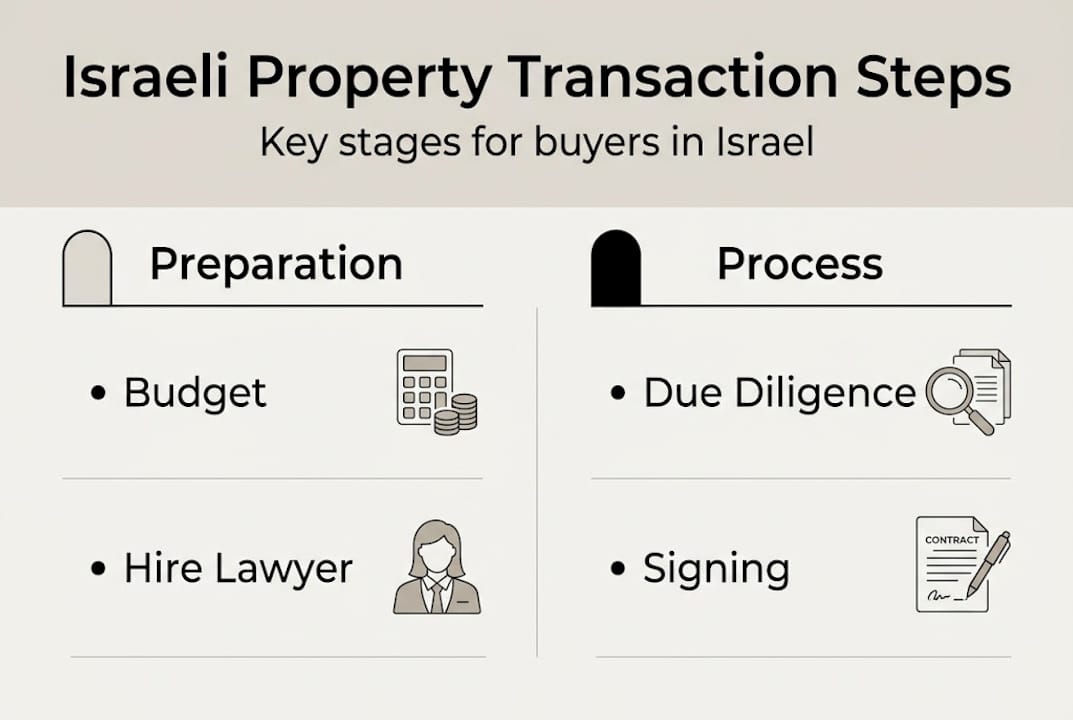
Preparation separates buyers who close smoothly from those who scramble at every turn. Start with your budget, and not just the purchase price. Factor in purchase tax, lawyer fees, agent commissions (typically 2% each side plus VAT), mortgage costs, and moving expenses. A realistic total acquisition cost often runs 8 to 12% above the listed price.

The most critical professional you will hire is your real estate lawyer. This is non-negotiable. A lawyer handles due diligence, drafts or reviews the Hebrew contract, manages tax filings, and coordinates title registration. Hiring a lawyer before you view homes is not overcautious. It is the smartest financial move you can make. You will want advice on offer structure before you fall in love with a property.
Understanding the Israeli real estate lawyer benefits goes beyond paperwork. A good lawyer will flag encumbrances (debts attached to the property), zoning restrictions, and ILA approval requirements you would never catch on a viewing.
Here is a side-by-side comparison of the core professionals you need:
| Professional | Role | When to hire |
|---|---|---|
| Real estate lawyer | Legal review, contracts, taxes, registration | Before first offer |
| Buyer’s agent | Property search, negotiation, local knowledge | At the start of search |
| Mortgage advisor | Financing, bank comparison, application | Once budget is confirmed |
| Structural inspector | Property condition assessment | Before signing contract |
For olim and overseas buyers, additional considerations apply. If you are making aliyah, timing your purchase to coincide with your aliyah date can unlock significant tax benefits, sometimes worth over NIS 50,000. Many international buyers also use a Power of Attorney (POA) to allow a local representative to sign documents on their behalf. The role of agents in buying property explains how a qualified agent who understands overseas transactions can bridge the gap between your location and the local market.
Pro Tip: Hire your lawyer before you attend a single open house. You will ask better questions, avoid verbal commitments that feel binding, and enter negotiations with a clear legal strategy.
The standard purchase process involves 8 to 10 key steps and typically takes 2 to 6 months from accepted offer to possession. Here is how it flows:
“For foreign buyers and olim, the contract, all tax filings, and registration documents are in Hebrew. Your lawyer is not just helpful. They are legally and practically essential.”
Pro Tip: If you are purchasing from overseas, execute a POA early. It authorizes your lawyer or a trusted representative to sign documents in Israel without requiring you to fly in for each step, saving both time and expense.
View detailed process steps or download the full property purchase checklist to track each phase. For a more personalized breakdown, the step-by-step acquisition tips resource covers edge cases for religious and international buyers.
Getting financing wrong is one of the costliest errors buyers make, especially because Israel’s mortgage rules differ based on your residency status.
Israeli mortgages (mashkanta) are available to Israeli residents and olim at up to 75% loan-to-value (LTV). Foreign nationals who are not making aliyah are capped at 50% to 70% LTV and must provide proof of foreign income. Debt-to-income limits apply across all categories, typically 33% to 40% of gross monthly income.
| Buyer Type | Max LTV | Key Requirement |
|---|---|---|
| Israeli resident | 75% | Standard income proof |
| New oleh | 75% | Aliyah documentation |
| Foreign national | 50-70% | Foreign income verification |
On taxes, the numbers vary widely by buyer category. Purchase tax rates for 2025 and 2026 break down as follows. Foreign buyers pay 8% on the value up to approximately NIS 6 million and 10% above that. Olim benefit from a drastically reduced rate of 0% to 0.5% on the first NIS 6 million, with the 7-year benefit window starting from aliyah date. An oleh buying a NIS 2.1 million apartment could save over NIS 56,000 in purchase tax compared to a foreign buyer paying full rates.
Common financing mistakes to avoid:
Explore financing options overview and 2026 mortgage tips to plan around current rates and incentives.
Not every purchase follows the standard urban apartment script. Religious buyers in particular are often drawn to communities in yishuvim, settlements, or areas under different legal jurisdictions. These purchases come with additional steps and risks that demand extra preparation.
Yishuvim and properties in Judea and Samaria require acceptance by an admissions committee before a purchase can be finalized. These committees assess community fit, lifestyle alignment, and sometimes financial standing. Preparation matters. Know the community’s criteria in advance and approach the process as you would a job interview, not a formality.
Off-plan purchases (known in Hebrew as al haniyar, meaning “on paper”) are popular because they allow buyers to lock in prices before construction completes. However, they carry risks: delays of 12 to 36 months are common, developer insolvency is a real concern, and specifications sometimes change.
| Purchase Type | Key Risk | Mitigation |
|---|---|---|
| Yishuv resale | Admissions committee rejection | Pre-screen eligibility early |
| Off-plan new build | Delays, spec changes | Bank guarantee required by law |
| Judea/Samaria | Civil Admin registration, not Tabu | Lawyer with regional expertise |
| ILA leasehold | Transfer approval delays | Budget extra time |
Common challenges and how to address them:
Pro Tip: If you are purchasing in a legally complex zone, ask your lawyer whether a corporate purchase structure (buying through a company) offers any legal or tax advantage. It does not work in every case, but it is worth the conversation. Find guidance tailored to your profile in observant community buying tips.
Here is something most guides will not tell you plainly: the Israeli real estate market rewards patience far more than speed. We have seen buyers rush a purchase because they feared missing out, only to discover later that the property had an ILA encumbrance, a building violation, or a committee process that could not be resolved. The deal collapses, and they are out legal fees and months of stress.
The community fit question is equally underestimated. Families sometimes prioritize price per square meter over neighborhood dynamics and find themselves in a community that does not match their religious or social needs. That mismatch is expensive to fix.
Real-world deals also differ from online guides on paperwork timelines. Committees reschedule. Banks delay mortgage approvals. Tax offices require additional documentation. Build at least 30 extra days into any timeline you plan around.
Tracking market trends for observant buyers before you search gives you pricing intuition that protects you during negotiation. Our honest view is this: a successful purchase means more than a closed deal. It means finding a home that fits your family’s spiritual life, financial reality, and long-term plans.
Navigating Israel’s real estate market, especially as an observant family or an international buyer, requires more than a checklist. It requires advisors who have closed deals in communities like Ramat Beit Shemesh, who understand the timing of aliyah tax benefits, and who know how to guide a family from a first call in New York to a set of keys in Israel. Yigal Realty specializes in exactly this kind of support, with deep roots in religious communities and a dedicated international client track. Speak with Israel property specialists on our team today and get guidance that is specific to your family, your timeline, and your community goals.
![CTA Image]
Yes. Foreign buyers can purchase both private Tabu-registered and ILA leasehold properties, but they pay higher purchase tax rates and may face additional mortgage restrictions compared to Israeli residents or olim.
A 10% deposit is standard upon contract signing, and the full transaction process from accepted offer to possession typically takes between 2 and 6 months depending on financing, registration, and any committee approvals.
The 8 to 10 key steps are: budgeting, hiring professionals, searching, due diligence, negotiating, signing a contract, securing financing, paying taxes, registering title, and taking possession.
Yes. Beyond standard due diligence, religious buyers face admissions committees in yishuvim, must assess eruv boundaries and school proximity, and often require agents who specialize in observant community markets.
Olim pay reduced rates of 0% to 0.5% on properties up to NIS 6 million within their 7-year benefit window, while foreign nationals who are not olim pay 8% up to approximately NIS 6 million and 10% on amounts above that threshold.