

If you own an apartment in Israel but live abroad, your rent is still taxed in Israel. Israeli law taxes income that arises in Israel, and rent from Israeli property is Israeli-source income, whatever your passport or residence. What you actually pay depends on three things: whether you count as a nonresident, how much rent you collect each month, and which tax route you choose. This guide walks through each one with a worked example, so you can plan before you buy or before you sign a lease.
The label matters because it decides which tax regime applies to your worldwide income. Israel does not use a single day-count rule. It asks where your “center of life” is, looking at the whole picture of family, economic and social ties.
There are rebuttable presumptions based on time spent in the country. According to the Israeli residency information filed with the OECD, you are presumed to have your center of life in Israel if you spent 183 days or more in Israel in the tax year, or 30 days or more in the tax year provided that your total stay in the current and two preceding years reaches 425 days. A presumption can be rebutted, but the burden is on you.
In practice, a US family that keeps a home in New Jersey, works there, has children in school there and visits Israel for holidays is a typical nonresident. A family that spends most of the year in Israel while “officially” living abroad is where disputes start. If you are close to the thresholds, read our overview of the residency requirements in Israel and our note on the difference between a resident and a foreigner before you decide how to file.

A nonresident is taxed only on Israeli-source income. Rent from an apartment in Beit Shemesh or Jerusalem falls squarely within that. Your salary in Brooklyn or your US investment income does not become Israeli taxable income because you own an apartment here.
Social security is separate. Nonresidents generally owe no Bituach Leumi contributions on rental income from Israeli property, unless they are classed as Israeli residents for social-security purposes. That is one real advantage over a local landlord who earns the same rent while working in Israel.
Your home country will usually want to know about the income too. A US citizen, for example, reports worldwide income to the IRS and normally claims credit for tax paid in Israel. That side of the picture belongs with a cross-border accountant, and we do not give advice on it here.
For an individual who rents out a home for living, Israeli law offers three paths. You choose the one that fits the rent and your other income.
The Income Tax (Exemption on Income from Renting a Residential Apartment) Law of 1990 exempts an individual’s rent from residential apartments in Israel, up to a monthly ceiling and subject to conditions. For 2026, the Israel Tax Authority’s booklet lists the ceiling at NIS 5,654 per month, and PwC’s Israel summary gives the same figure. The ceiling is indexed, so look up the current number each January.
The conditions that trip people up:
The tenant’s signed confirmation is not a formality. Keep it with the lease. If you build your own paperwork, even a clean tenant application template and signed digital forms give you a tidy record to show a tax assessor later.
A caution for nonresidents: lawmakers have floated removing tax benefits from nonresidents on selling and renting out homes. A 2022 explanatory note, for example, proposed denying nonresidents the rental exemption. We could not rely on that page to describe a rule in force, so treat it as a signal that the exemption could be narrowed, and confirm current eligibility with a CPA before you count on it.
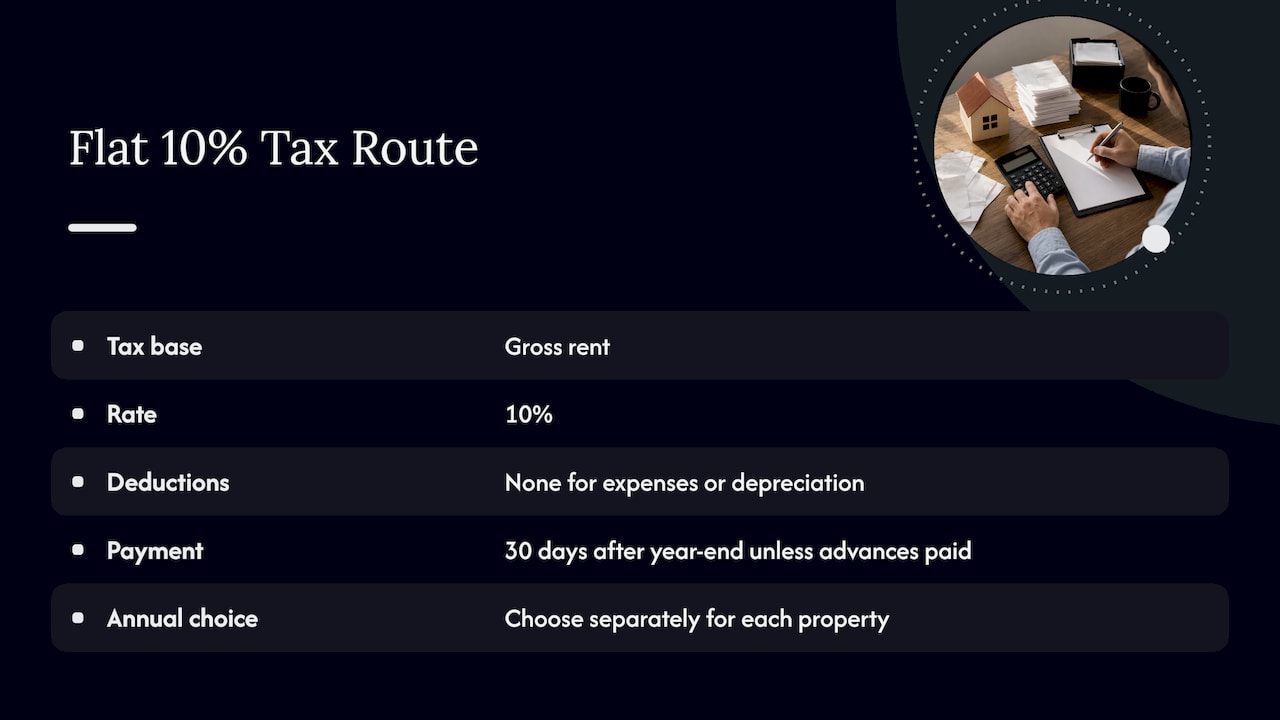
If you do not use the exemption, or your rent is above it, the second route is a flat tax. Under section 122 of the Income Tax Ordinance, the 10% tax is due within 30 days after the end of the tax year, unless you already paid advance payments during the year.
The tax applies to gross rent. According to an Israeli law firm’s guide for nonresidents, the landlord pays 10% with no deduction for expenses or depreciation, and the choice is made annually for each property. Because there are no deductions, this route favors apartments with low running costs and no mortgage interest to offset. Confirm every figure in the next section with your accountant before you file.
The 2024 Knesset research paper on rental taxation also describes the residential exemption and a 10% route for rental income that is not business income, which matches this structure.
The third route taxes your rent like ordinary income, after deductible expenses. A nonresident choosing it pays the same rates as an Israeli resident, but generally gets no personal tax credit points (nekudot zikui). That lifts the effective minimum tax. This route can make sense when expenses are large: interest on an Israeli mortgage, property management fees, repairs, municipal property tax paid by the owner, and similar costs.
Take a nonresident who owns a four-room apartment rented at NIS 7,000 a month, or NIS 84,000 a year. These numbers are illustrative, not a quote.
| Route | What is taxed | Rough tax outcome |
|---|---|---|
| Exemption | Rent up to NIS 5,654 a month is exempt, but at NIS 7,000 the ceiling is exceeded, so the exemption is not a clean fit | Check with a CPA how the excess is handled |
| Flat 10% | Gross rent of NIS 84,000, no deductions | NIS 8,400 a year |
| Marginal rates | Rent minus documented expenses, no credit points | Depends on expenses and the bracket the net income falls into |
The lesson is the order of questions. First ask whether rent stays under the exemption ceiling. If it does and the conditions are met, the tax can be zero. If it is above, compare the flat 10% against the marginal route using your actual annual expenses. The flat route wins when expenses are low. The marginal route can win when you carry interest and fees.
Compare this with the net yield picture in our guide to rental yield in Israel, where tax is one line among several.
The mechanics are where most nonresident landlords get stuck.
On reporting, the Knesset’s 2024 report describes mandatory-reporting changes as proposed amendments to the Income Tax Ordinance. It notes that rent up to NIS 5,654 a month was not subject to a reporting requirement under the rules then in force. Researchers there also point out that rental income carries a relatively light tax burden compared with other investments, which is why tighter reporting keeps returning to the agenda. Expect more transparency over time, not less.
We did not find a settled, official answer we can safely quote on whether a tenant must withhold tax from rent paid to an overseas landlord, or when you must appoint an Israeli representative. These cases depend on the structure: an individual or a company, a long lease or a short one, a single apartment or several. Ask an Israeli CPA who files for nonresidents, and ask before the first rent payment, not after the first tax notice.
Most overseas buyers we meet ask about price per square meter first and tax second. We would flip that order. A flat 10% on gross rent, or a zero-tax exempt month, changes what a given apartment is worth to you, and so does the way you hold it. So we encourage buyers to run the rent and tax numbers before they fall in love with a floor plan.
We also see that tax is the lightest part of the landlord’s load. The heavier parts are a reliable tenant, a local who can handle a leak at 9 p.m., and clean paperwork from day one. A modest apartment in a well-run religious-community neighborhood, with long-term tenants who value quiet and stability, often serves a nonresident better than a higher-yield unit that needs constant attention. We do not give tax advice, and we work alongside your accountant. What we do is make sure that the property, the lease and the paperwork are set up so your accountant has little to fix. For the legal side of buying from abroad, see our guide on Israeli real estate laws for US buyers.
— Spiros
If you are still choosing the apartment, tax planning starts earlier than most people think. Our team in Beit Shemesh and our New York office help international buyers shortlist new developments, understand the process and line up the right professionals. See how our concierge project guidance works, or look at specific projects such as Olmaya and Neve Amim. If you are buying from outside Israel for the first time, buying an apartment as an expatriate is a good place to begin.
For wider investment context, our investment tips for international buyers and the piece on why residential real estate in Israel remain a good companion to this guide.
Yes, in principle. Israel taxes income from sources in Israel, and rent from an Israeli property is one. Whether you actually pay depends on the exemption ceiling, the 10% route and your expenses.
The Tax Authority’s 2026 booklet lists the residential-rent ceiling at NIS 5,654 a month. The conditions still apply, including residential use and the tenant’s signed confirmation. The ceiling is updated, so check the current figure.
No. The flat route taxes gross rent with no deduction for expenses or depreciation, according to an Israeli law firm’s guide for nonresidents. If you have significant costs such as mortgage interest, compare it with the marginal-rate route.
Generally no, as long as you are not an Israeli resident for social-security purposes. The state revenues report says nonresidents owe no contributions on rental income from Israeli property.
That depends on the route and your circumstances. Under the 10% route you can pay the tax without filing a full return in some cases, but nonresident files are specific. Ask a CPA who files for nonresidents before the first April deadline.