%20(4).png)
![[background image] image of cityscape background (for an architect firm)](https://cdn.prod.website-files.com/68961ade6feff9cbdffc080d/69384e066e0e9a310b6817f8_061f6bac-48bf-44b8-a689-078dacd8009f.avif)
TL;DR:
- Foreigners can buy private property in Israel without restrictions on purchase rights.
- However, tax residency status greatly impacts property taxes, mortgage options, and income reporting obligations.
Foreign nationals can buy private residential property in Israel with the same legal rights as Israeli citizens. No residency permit, minimum stay, or government quota applies to the purchase itself. What does matter, and what catches most U.S. buyers off guard, is how Israel’s tax residency rules interact with purchase tax rates, mortgage eligibility, and ongoing income reporting.
**Before you sign anything, do these four things: **
Three separate legal concepts all use the word “residency,” and conflating them is the most expensive mistake U.S. buyers make.
Purchase law residency is simple: foreigners can buy private residential property in Israel. Full stop. A handful of Jewish National Fund plots carry restrictions, but standard residential transactions are open to any foreign national.
Immigration residency (Law of Return / Aliyah) is a completely separate track. Buying property does not grant residency, work permits, or citizenship. There is no Israeli “Golden Visa” tied to property ownership. Aliyah eligibility runs through the Ministry of Aliyah and Integration and the Population and Immigration Authority, not through a real estate contract.
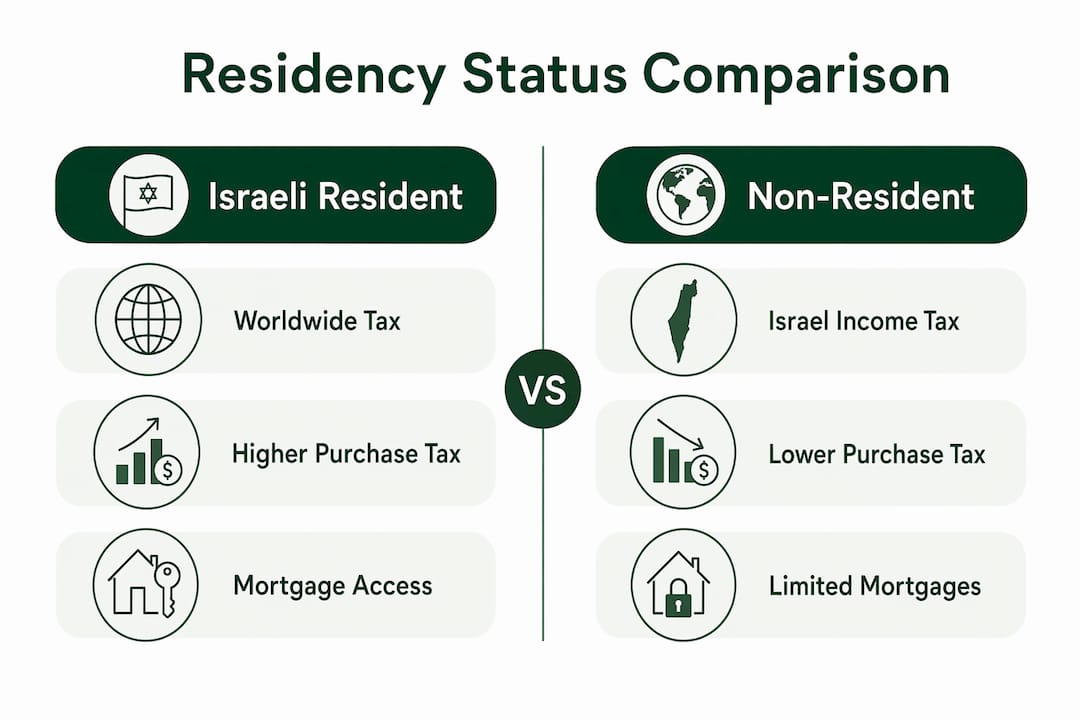
Tax residency is where the real complexity lives. Israel uses a “center of life” test, with numeric presumptions, to decide whether you owe Israeli tax on worldwide income or only on Israel-sourced income. This classification directly affects your purchase tax rate and your mortgage options.
Pro Tip: Get a written opinion from an Israeli tax lawyer on your likely residency classification before you make an offer. Changing that classification after closing is far harder than planning for it upfront.
The Israel Tax Authority treats residency as a facts-and-circumstances question, not a simple day count. The primary standard is the “center of life” test, which weighs your family location, permanent home, regular place of work, active economic interests, and organizational ties.

Two numeric presumptions sit alongside that test: spending more than approximately half a year in a single Israeli tax year triggers a presumption of Israeli tax residency; similarly, spending a substantial number of days across three consecutive tax years, including some time in the most recent year, triggers the same presumption.
Both are rebuttable. The party challenging the presumption carries the burden of proof.
| Presumption | Threshold | Rebuttable? |
|---|---|---|
| Single-year | 183+ days in one tax year | Yes |
| Three-year | 425+ days over 3 years, 30+ in year 3 | Yes |
| Center of life | Fact-based (family, home, work, economic ties) | Primary test |
Day counts are a starting point, not the finish line. The Israel Tax Authority can and does look at school enrollment records, Israeli bank accounts, employment letters, and family location to build or contest a residency case. A U.S. buyer who spends summers in Israel with family enrolled in Israeli schools may face a residency argument even without hitting 183 days.
The difference in tax treatment is material enough to change deal math entirely.
Israeli tax residents owe Israeli tax on worldwide income. That includes U.S. rental income, U.S. dividends, and U.S. capital gains. The U.S.–Israel tax treaty provides relief from double taxation, but the reporting obligations under IRS rules (FBAR, Form 8938) still apply on the U.S. side.
Non-residents owe Israeli tax only on Israel-sourced income: Israeli rental income, Israeli dividends, and Israeli capital gains. That scope is narrower, but the rates and exemptions are less favorable.
| Tax Item | Israeli Resident | Non-Resident |
|---|---|---|
| Income taxed | Worldwide | Israel-sourced only |
| Purchase tax (Mas Rechisha) | Reduced/exempt tiers for first home | 8% up to the statutory threshold, 10% above; for some oleh (new immigrants), reduced rates apply if within the eligibility window |
| Primary-residence capital gains exemption | Available under conditions | Less favorable; plan exit with counsel |
| Rental income | Subject to Israeli tax | Subject to Israeli tax (Israel-sourced) |
The purchase tax gap alone is significant. A non-resident buying a property above the statutory threshold pays 10% on the excess. An Israeli resident buying a first home can qualify for full or partial exemption depending on price. For a ₪3,000,000 apartment, that difference can run into hundreds of thousands of shekels.
A mistaken residency classification can trigger unexpected tax liabilities and affect mortgage eligibility after closing. Get the classification right before you sign.
Work through this list before you make any offer. For a deeper walkthrough of the Israeli real estate laws that apply to U.S. buyers, review that resource alongside this checklist.
The oleh purchase-tax track offers substantially lower rates, and the timing window runs from one year before Aliyah to seven years after. For Aliyah completed after August 15, 2024, a sole-residence condition applies, meaning the property must be your only Israeli residential property to qualify for the reduced rate.
Buying before Aliyah means paying the non-resident purchase tax rate upfront, then applying for a refund once you immigrate within the eligible window. Buying after Aliyah means you may qualify for the reduced rate directly at closing, but your tax residency status shifts immediately, and worldwide income becomes taxable in Israel from that point.
Neither sequence is automatically better. The right answer depends on your income sources, the property price, and how quickly you plan to immigrate.
Pro Tip: Coordinate the timing of your purchase and your Aliyah with both an Israeli tax lawyer and a local broker before you commit to either. The purchase-tax savings from getting the sequence right can be substantial, and the window is unforgiving if you miss it.
Yigal-realty works specifically with international buyers targeting Beit Shemesh and surrounding areas, which means the firm’s contacts, project access, and process knowledge are built for exactly this situation.
Services for international buyers include early access to new development projects, local due diligence on listings, introductions to Israeli real estate attorneys and mortgage advisors, POA logistics support, and Tabu follow-up after closing. For buyers who cannot travel to Israel for every stage, that coordination layer is what keeps a transaction on track.
A typical Beit Shemesh purchase for a U.S. buyer runs through several months from initial project selection to Tabu registration. Yigal-realty’s team helps buyers prepare the right documents before the process starts, which is where most delays actually originate.
Pro Tip: Before your first call with Yigal-realty, gather your passport, six months of bank statements, and a rough sense of your financing capacity. That preparation cuts the initial consultation time in half and gets you to a real project conversation faster.
Non-residents can buy Israeli residential property freely, but tax residency status determines purchase tax rates, mortgage access, and ongoing income reporting obligations.
| Point | Details |
|---|---|
| No residency required to buy | Foreign nationals purchase Israeli property with the same legal rights as citizens. |
| Tax residency is fact-based | The center-of-life test and day-count presumptions determine tax status, not citizenship. |
| Non-resident purchase tax | Non-residents pay 8% up to the statutory threshold and 10% on the excess above the threshold, with no first-home exemption. |
| Aliyah timing matters | The oleh purchase-tax window runs from one year before to seven years after Aliyah; sole-residence rules apply post-August 2024. |
| Yigal-realty for Beit Shemesh | Yigal-realty coordinates attorney introductions, project access, and Tabu follow-up for U.S. buyers. |
Most buyers focus on the property itself and treat the legal and tax structure as paperwork to handle later. That sequence is backwards. The purchase tax rate you pay, the mortgage terms you qualify for, and the capital gains treatment you get on exit are all set by your residency classification at the time of purchase. Changing course after closing is expensive and sometimes impossible.
The buyers who come to Beit Shemesh with a tax lawyer already engaged, a realistic financing picture, and a clear sense of their Aliyah timeline are the ones who close without surprises. The ones who skip that preparation often discover the gap between what they expected to pay and what they actually owe only after they have signed.
Israel’s residency rules are not designed to trap foreign buyers. They are designed to be fact-based and contestable. That is actually good news: with the right counsel, you can plan your classification, document it properly, and structure the purchase to match your real situation.
Buying in Beit Shemesh from the U.S. is entirely achievable, and Yigal-realty’s team has guided international buyers through every stage, from first project inquiry to Tabu registration. The firm offers market access to new developments, local due diligence, attorney and mortgage advisor introductions, and closing support for remote buyers using POA.
For an initial consultation, prepare your passport, six months of bank statements, a sense of your financing capacity, and any questions about Aliyah timing. A typical purchase timeline runs several months, and starting the legal and financing groundwork early is what keeps that timeline realistic.
Contact Yigal-realty to request a consultation and get matched with the right Beit Shemesh projects for your budget and timeline.
This article is general information, not legal or tax advice. Confirm your specific residency classification, purchase tax obligations, and reporting requirements with a qualified Israeli tax lawyer and, for U.S. obligations, a U.S. tax advisor familiar with the U.S.–Israel tax treaty.