%20(4).png)
![[background image] image of cityscape background (for an architect firm)](https://cdn.prod.website-files.com/68961ade6feff9cbdffc080d/69384e066e0e9a310b6817f8_061f6bac-48bf-44b8-a689-078dacd8009f.avif)
Yes, foreign residents can buy residential property in Israel. Expect to pay purchase tax at the higher additional-property rates unless you qualify for a narrow documentary exception. The next move is practical: run a purchase-tax estimate for your target price and start gathering your proof-of-residence paperwork now, since that alone can shift your total cost by tens of thousands of shekels.
TL;DR:
- Proving no property ownership in your home country could qualify you for lower tax rates, but this process is complex and requires official certification and translation.
- Foreign buyers typically face lower mortgage-to-value ratios, around 40% to 50%, and must provide extensive documentation for AML compliance, which can delay closing.
- Buying remotely involves preparing notarized powers of attorney, escrow accounts, and precise documentation; most transactions take two to six months to complete.
- Ongoing property costs include municipal taxes and possible Israeli tax obligations on rental income or capital gains, which depend heavily on your residence status and filing obligations.
Israeli tax law doesn’t care about your passport. It cares about where your life actually happens. Tax residence turns on two tests: the 183-day rule (physical presence in Israel across a tax year) and the “center of life” test, which weighs where your family lives, where you work, and where your economic ties sit. Statutory definitions and any recent amendments live on official Knesset pages, worth checking before you assume anything about your own status.
This distinction produces some counterintuitive outcomes for a תושב חוץ קניית דירה בישראל scenario:
Your residence classification doesn’t just set your purchase tax bracket. It also follows you forward, shaping how capital gains get taxed when you eventually sell.
Purchase tax, known in Hebrew as mas rechisha, is calculated on the property’s contract price plus any qualifying extras like parking or storage rights bundled into the deal. For foreign residents, the tax authority generally applies the same brackets used for Israeli residents buying a second or additional home, which are steeper than the single-home rates citizens get on their primary residence. There’s no separate “foreign resident” tax table. You simply lose access to the preferential first-home brackets that a qualifying resident enjoys.
The gap is not small.
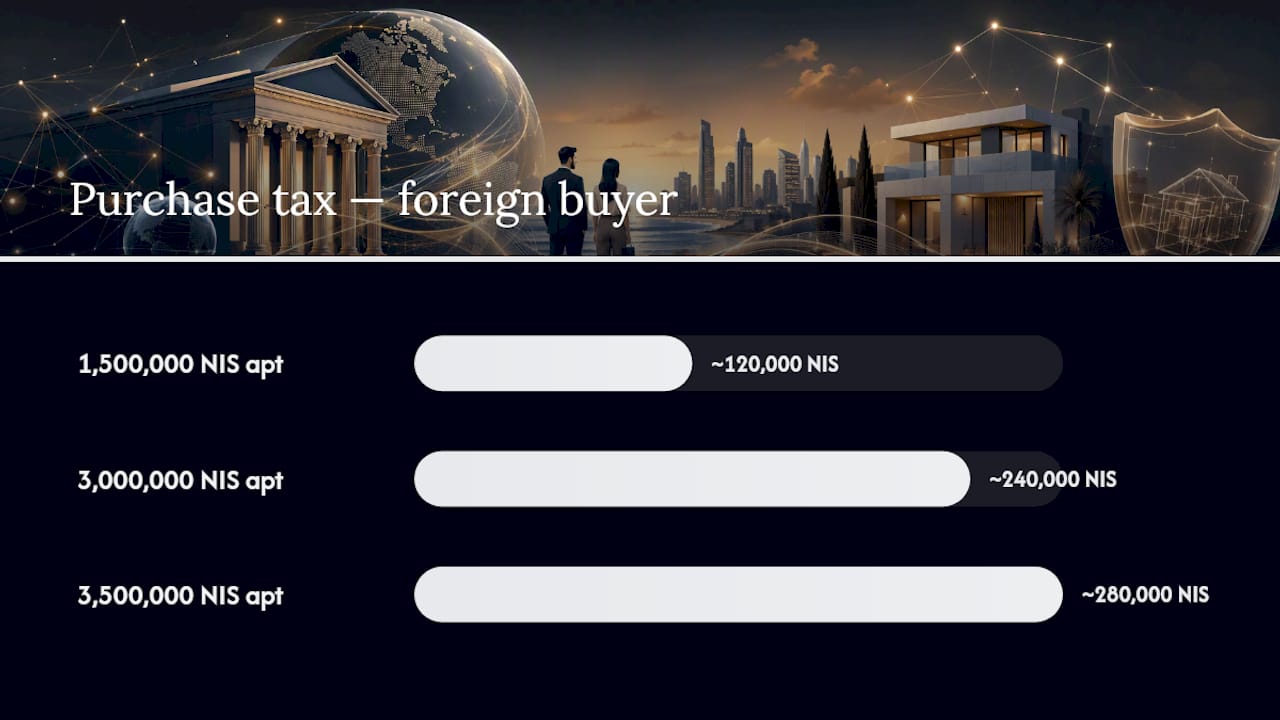
The tax gap in numbers: On a 3,500,000 NIS apartment, a foreign resident buying under the additional-property brackets pays roughly 8% at that price point, close to 280,000 NIS in purchase tax — compared to closer to 70,538 NIS for a resident buying it as a single home under the lower graduated bands.
Here’s how that plays out across a few common price tiers, using illustrative additional-property rates:
These figures move whenever brackets get updated, and purchase-tax thresholds change periodically, so always request a calculation using the rates in force on your actual signing date, not last year’s numbers.
There is a real path to single-home treatment for a foreign buyer, but it’s narrow and paperwork-heavy. It generally applies when you can prove you own no residential property in your country of residence, which lets you argue this Israeli home functions as your only home under the law.
The typical route looks like this:
Some buyers also explore aliyah or a return to Israel within a defined window, since a residence status change can retroactively affect the applicable tax treatment. This route depends heavily on timing and individual circumstances, so it’s not a shortcut to bank on without professional review.
Pro Tip: Never sign a purchase agreement assuming you’ll qualify for the reduced rate. Run both tax scenarios in advance, because approvals are fact-specific and the tax authority’s review can take longer than your closing timeline allows.
Israeli lenders treat foreign buyers as a higher-risk category, and the financing terms reflect it. Where an Israeli resident might secure 60% to 75% loan-to-value, foreign nationals commonly see LTV caps closer to 40% to 50%, meaning you’ll need substantially more cash up front.
Banks also ask for more paperwork, and they ask early:
Anti-money-laundering compliance checks are the part buyers underestimate most. Banks won’t move quickly on this, and AML review is consistently the biggest procedural bottleneck in cross-border Israeli property purchases.
If Israeli mortgage terms don’t work for your situation, a larger down payment, private financing, or a specialized lender for international borrowers can fill the gap. Our guide on what a mortgage in Israel actually involves walks through lender requirements in more depth, and programs like ITIN and foreign national investment loans offer an alternative route when a standard Israeli mortgage isn’t practical.
Pro Tip: Start your bank documentation the same week you start property hunting, not after you find the apartment. AML clearance alone can add weeks to a timeline that’s already tight.
Buying from abroad without setting foot in Israel is routine, but it depends on getting a handful of documents exactly right. The core package includes a notarized power of attorney (POA), a passport copy, a tax-residence certificate, and certified translations of anything not already in Hebrew.
The mechanics work like this:
Read the POA text carefully before signing it. A vague or overly broad POA gives your attorney more authority than you may intend, while one that’s too narrow can stall the transaction when an unexpected signature is needed. Our checklist for U.S. buyers navigating Israeli real estate law covers the eligibility and documentation side in more detail.
Most remote transactions run two to six months from signed agreement to final registration at the Israel Land Registry (Tabu). Delays usually trace back to the same culprits: slow apostille processing in the buyer’s home country, bank AML reviews, or translation backlogs during busy periods.
Beyond purchase tax, budget for these recurring costs:
On a mid-range apartment purchase, buyers routinely see 3% to 6% of the property price consumed by these combined non-tax costs before purchase tax is even factored in.
For a fuller cost breakdown across different budget tiers, see our investment tips for international buyers.
Buying the property isn’t the end of your paperwork. Once you own real estate in Israel, you step into an ongoing set of obligations that differ from what you’d face as a resident owner.
Municipal property tax, arnona, applies regardless of residency status and gets billed based on the property’s size and location. You’ll pay it whether the unit sits empty, houses your family, or gets rented out. If you rent the property, rental income earned by a foreign resident is generally subject to Israeli income tax, though the specific rate and available deductions depend on your overall filing situation and any tax treaty between Israel and your country of residence. This is worth reviewing with a tax professional who understands both jurisdictions, since double-taxation treaties can meaningfully change your actual liability.
Capital gains treatment when you eventually sell also ties back to your residence status at the time of both purchase and sale. A foreign resident selling an Israeli property typically faces capital gains tax on the appreciation, calculated against the original purchase price and any documented improvement costs. The exemptions available to resident sellers on a primary residence generally don’t extend the same way to foreign owners, which is another reason your residence status matters well beyond the closing table.
Filing obligations don’t disappear just because you live abroad. Depending on your rental income and gains, you may need to file annual returns with the Israeli tax authority, and missing these deadlines can trigger penalties that compound over time. Our guide to Israeli property taxes for buyers breaks down the ongoing obligations in more detail.
Foreign residents can rent out Israeli property they own, and plenty do, treating the purchase as a straightforward investment property rather than a home they’ll occupy. There’s no blanket legal restriction preventing a non-resident owner from leasing a residential unit to tenants.
That said, the practical limitations tend to show up in three places. First, rental income triggers Israeli tax filing obligations, as covered above, and foreign owners sometimes underestimate how much administrative overhead that creates from abroad. Second, managing tenants, maintenance, and lease renewals from another country is genuinely harder without someone local you trust, whether that’s a property manager or a broker who stays involved after closing. Third, some newer developments or specific building bylaws include restrictions on short-term rentals (think Airbnb-style stays), so it’s worth confirming a building’s house rules before assuming you can list the unit for nightly rentals.
Mortgage terms can also affect your rental plans. If you financed the purchase, check whether your loan agreement includes any conditions tied to owner-occupancy versus investment use, since Israeli banks sometimes price these differently. A property bought purely as a rental investment, disclosed as such from the start, tends to create fewer surprises than one that quietly shifts from “future home” to “rental unit” after the mortgage is already in place.
For buyers whose primary goal is rental income rather than eventual personal use, working with a firm that understands the local rental market from the outset, not just the sale, makes ongoing management considerably less stressful once you’re back in your home country.
Foreign residents can generally purchase residential property in Israel on the same legal footing as citizens, with one meaningful exception: land classification matters. The vast majority of land in Israel falls under state ownership and is administered through long-term leases rather than freehold sale, and transactions involving Israel Land Authority leaseholds can carry additional approval steps that a straightforward private freehold sale wouldn’t.
For most standard apartment purchases in established residential buildings, this rarely becomes a serious obstacle. Registered condominium units (the common structure for apartments) transfer relatively cleanly regardless of buyer residency. Where it gets more complex is with certain agricultural land conversions, specific leasehold arrangements, or properties tied to Israel Land Authority allocations that carry residency-linked conditions. If a listing sounds unusually cheap for its location, that’s often the reason, and it’s worth having a local attorney confirm the land status before you get emotionally attached to the property.
There is no requirement for a foreign resident to obtain special government permission simply to buy an ordinary apartment. The restrictions that do exist are property-specific rather than buyer-specific, tied to how that particular parcel of land is classified and leased rather than to your citizenship or residence status. This is exactly the kind of detail a local buyer’s agent should flag before you make an offer, not after your attorney finds it during due diligence.
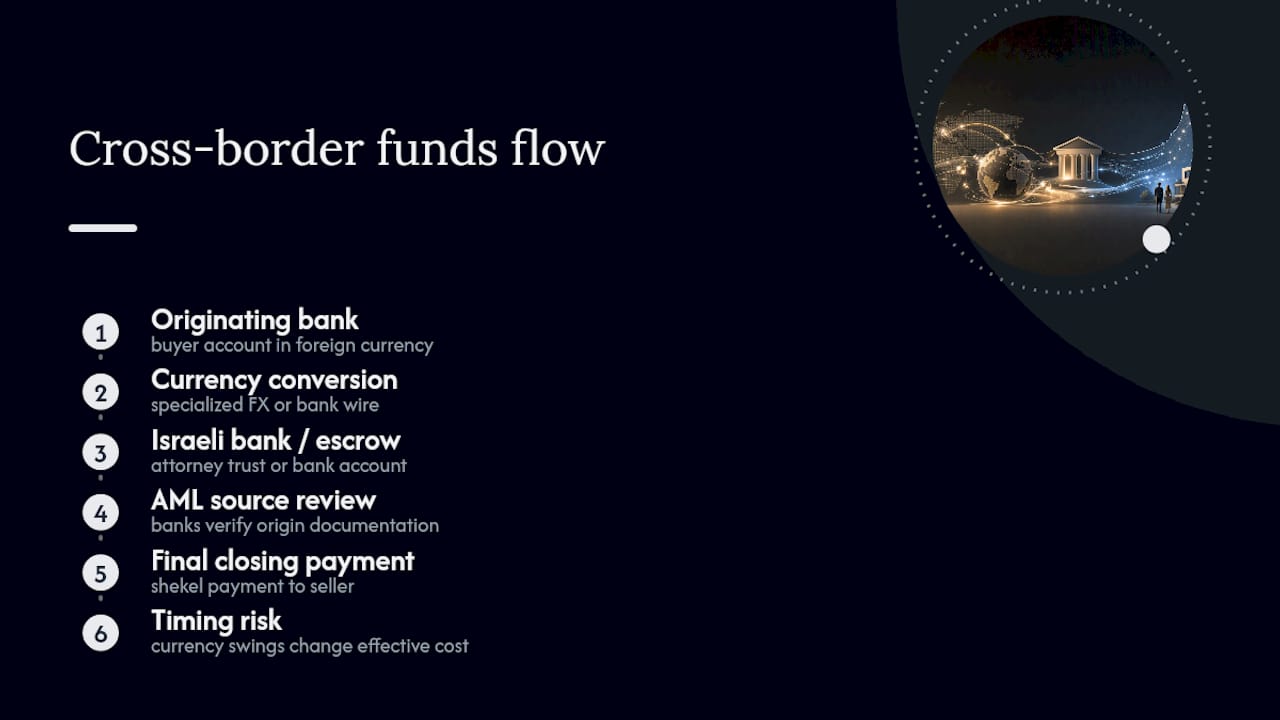
Every foreign resident buying property in Israel eventually faces the same question: how do you move a large sum of money across borders without losing a meaningful chunk of it to fees and unfavorable exchange rates?
Standard bank wire transfers work, but they’re rarely the cheapest option for six or seven-figure transactions. Currency exchange spreads on ordinary retail bank transfers can be wide, and on a multi-million shekel purchase, even a small percentage difference in the exchange rate translates into a real dollar (or euro, or pound) amount lost. Specialized foreign exchange services built for real estate transactions often offer tighter spreads than a standard retail bank, along with the ability to lock in a rate ahead of your closing date, which matters if currency markets are moving while your transaction is in progress.
Timing also carries risk. If your purchase price is fixed in shekels but your funds sit in dollars, euros, or another currency, currency swings between contract signing and final payment can change your effective cost. Some buyers hedge this by transferring funds into shekels earlier and holding them in an escrow or trust account rather than waiting until the final payment deadline, though that decision depends on your own read of currency movement and risk tolerance.
Whatever transfer method you choose, make sure the funds are traceable and well-documented. Israeli banks’ AML compliance checks will scrutinize where the money came from, and an opaque transfer path, cash conversions, third-party transfers, unclear origin, is one of the fastest ways to stall your own closing. Clean, documented, bank-to-bank or attorney-escrow transfers move much faster through compliance review than anything that looks improvised.
A local real estate firm coordinates the pieces that trip up remote buyers most: POA and apostille logistics, escrow account setup, local property inspections, and purchase-tax estimates run before you commit. That local, hands-on focus is what separates a smooth remote closing from a stressful one.
— Spiros
Everything above points to the same conclusion: the numbers on a foreign resident’s Israeli property purchase depend entirely on your specific situation, your residence status, your price point, your financing needs, and running those numbers before you sign is the difference between a smart purchase and an expensive surprise. Real estate professionals experienced with international buyers coordinate the POA, escrow setup, and tax calculation pieces so you’re not managing four different professionals across two time zones.
Reach out through the Yigal Realty site for a preliminary purchase-tax estimate based on your target price range, along with a remote-closing checklist covering the documents you’ll need from your home country. It costs nothing to find out where you actually stand before you fall in love with a listing.
For current statutory text, check the Knesset official site. For tax rate examples, see the Israeli tax guide for foreign residents.