%20(4).png)
![[background image] image of cityscape background (for an architect firm)](https://cdn.prod.website-files.com/68961ade6feff9cbdffc080d/69384e066e0e9a310b6817f8_061f6bac-48bf-44b8-a689-078dacd8009f.avif)
TL;DR:
- Foreigners can freely buy property in Israel without needing citizenship or residency.
- The homebuying process in Israel takes 2 to 6 months, requiring careful legal and financial prep.
- Community fit and neighborhood choice are crucial for long-term happiness in Beit Shemesh.
Buying a home in a foreign country is already nerve-racking. Buying one in Israel, from thousands of miles away, with an unfamiliar legal system and a language barrier thrown in, can feel overwhelming. For observant families from the US, the stakes are even higher because you are not just searching for square footage. You are searching for a community where your children will grow, your Shabbos table will have guests, and your daily life will feel natural and meaningful. Beit Shemesh, and specifically its Ramat Beit Shemesh neighborhoods, has become one of the most sought-after destinations for Anglo and religious families making that leap. This guide gives you a practical, expert-informed roadmap to do it right.
| Point | Details |
|---|---|
| Foreigners can buy freely | International buyers, including US citizens, can purchase property in Israel with no residency required. |
| High down payments required | You’ll need at least 50 percent down payment and proof of funds to secure financing for a home in Israel. |
| Unique legal process | Buying property in Israel involves binding contracts early and critical pre-contract due diligence. |
| Community fit matters | Success in Beit Shemesh depends on finding a neighborhood that matches your religious and lifestyle needs. |
| Factor all costs and taxes | Budget for 30-40 percent closing costs, including taxes, legal, and agent fees, beyond the purchase price. |
Before diving into the step-by-step process, it’s crucial to understand what you can buy and what’s required of you as a non-resident.
The good news is that the door is wide open. US citizens can freely purchase residential properties in Israel on private land without needing citizenship or residency status. You do not have to be Jewish, you do not need an Israeli ID card, and you do not need to live there full time. For most observant families, this is a genuine relief because it means your dream of owning in Beit Shemesh is legally straightforward.
That said, the financial requirements are stricter than what most Americans are used to:
The property types most appealing to observant Anglo buyers tend to be 4 to 5 room apartments in Ramat Beit Shemesh, though townhouses and luxury villas are also available. Understanding the land ownership type matters too. Private land (not Israel Land Authority leasehold) offers the clearest title and is what most buyers should prioritize. You can find a solid overview of the foundational legal framework in this guide to real estate law basics.
“Start building your financial paper trail at least six months before you plan to make an offer. Israeli banks and tax authorities will want clean documentation of every dollar you intend to use.”
Pro Tip: Open your Israeli bank account before you even start shopping seriously. The account takes time to set up for non-residents, and you do not want a delay in wiring funds to cost you a deal.
Once you’ve clarified what’s possible, it’s time to map out the entire journey ahead.
The Israeli homebuying process runs 2 to 6 months from initial research through Tabu (land registry) registration. That timeline is shorter than many buyers expect, but it requires moving decisively once you identify a property. Delays after contract signing can cost you money through index linkage on new builds.
Here is how the process breaks down:
The mechanics are meaningfully different from US norms. In the US, you can walk away from a deal after contract if financing falls through. In Israel, once the contract is signed, there are no financing contingencies. If your mortgage falls apart, you risk losing your deposit. This is why having your financing solidly in place before signing is non-negotiable.
| Feature | Israel | United States |
|---|---|---|
| Financing contingency | Rare to none | Standard |
| Contract binding date | At signing | After all contingencies clear |
| Land registry system | Tabu (Israel Land Registry) | County deed registry |
| Attorney involvement | Required and essential | Varies by state |
| Typical closing timeline | 2 to 6 months | 30 to 60 days |
For a complete, annotated breakdown of every phase, the transaction steps in Israel resource is worth bookmarking, and the property acquisition guide walks you through each document in practical terms.
Pro Tip: Never rely on the seller’s lawyer to protect your interests. Israeli attorneys represent one party only. Hire your own lawyer from day one, and ensure they specialize in real estate, not just general practice.
Knowing the major process steps, let’s break down what these choices mean for your actual financial commitment.
The total cost of buying in Israel is significantly higher than the list price alone. You should realistically plan for closing costs of 30 to 40% of the purchase price when you factor in your down payment, taxes, legal fees, and agent commissions. Beit Shemesh has also shown strong historical appreciation, with annual gains of 4 to 9% making it an attractive long-term investment alongside its lifestyle appeal.
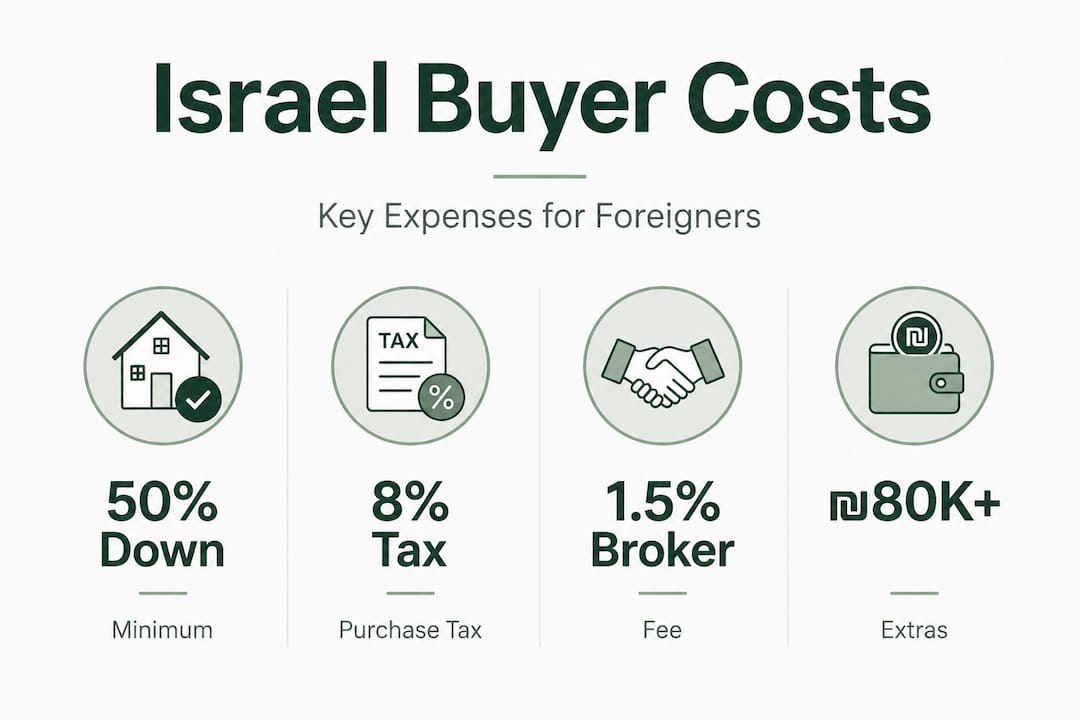
Here is a realistic cost breakdown for a typical 4-room apartment in Ramat Beit Shemesh priced at approximately ₪2,500,000:
| Cost item | Estimated amount | Notes |
|---|---|---|
| Down payment (50%) | ₪1,250,000 | Required for foreign buyers |
| Purchase tax (foreign buyer) | ₪200,000+ | 8% up to ~₪6M threshold |
| Lawyer fee (~1%) | ₪25,000 | Negotiate; can vary |
| Agent commission (~2%) | ₪50,000 | Both sides sometimes share |
| Inspection and misc. | ₪5,000 to ₪10,000 | Structural engineer, etc. |
| Total cash needed | ~₪1,530,000+ | Before mortgage portion |
The tax situation deserves special attention. Foreign buyers pay 8% in purchase tax (mas rechisha) on amounts up to approximately ₪6 million, and 10% above that. This tax must be paid within 60 days of signing the contract. It is a large number, but there is a meaningful way to reduce it.
New immigrants, called Olim Chadashim, receive dramatically reduced purchase tax rates ranging from 0% to 5%. Even better, Olim rates apply retroactively if you make aliyah within 1 to 7 years of your purchase. This means you can buy now as a foreign buyer, make aliyah later, and claim a tax refund on the difference. For families on the aliyah path, timing this purchase thoughtfully can save tens of thousands of dollars.
You can find a thorough breakdown of all these costs in the home purchase costs guide, which includes worked examples specific to Beit Shemesh.
Pro Tip: Keep your purchase tax payment funds liquid and accessible before signing. The 60-day window feels long until it isn’t, especially when coordinating international wire transfers.
Your budget and process plan in hand, it’s time to zoom in on the most important element: which area will truly feel like home.

Beit Shemesh is not a single, uniform community. It is a collection of distinct neighborhoods, each with its own religious character, school ecosystem, and price range. Getting this choice right matters enormously for your quality of life and your family’s long-term happiness.
Here is a practical breakdown:
Choosing between these depends heavily on religious orientation and the type of school environment you want for your children. An RBS A family that accidentally buys in a strongly Chareidi part of RBS B may find the shul culture and school options a poor match for their lifestyle.
“The best neighborhood for your family is not necessarily the one with the newest kitchen or the best price per square meter. It is the one where your children will have friends, your spouse will feel comfortable walking to shul, and you will feel at home on Shabbos.”
The Anglo network in Beit Shemesh is one of its greatest assets. Dozens of shiurim, chesed organizations, and English-language parent groups make the transition significantly smoother than in other Israeli cities. Use the homebuying checklist for observant buyers to make sure you are evaluating every community factor before committing.
Pro Tip: Spend at least one Shabbos in the specific street or building you are considering before signing. Walking the neighborhood on a Friday night tells you more about community character than any brochure will.
Even a well-planned purchase can be derailed by a few missed details. Let’s look at how to avoid the most common traps.
The Israeli system has several mechanisms that catch foreign buyers off guard. Knowing them in advance is the difference between a smooth deal and a costly mistake.
Before signing any contract, run through a complete due diligence checklist and cross-reference it with a dedicated checklist for US buyers that accounts for the specific documentation differences between the two systems.
“Remote buyers have successfully completed purchases in Beit Shemesh without ever stepping foot in Israel before closing. It requires rigorous document management, trusted local contacts, and exceptional legal counsel. It is possible, but it demands more preparation, not less.”
After years of helping Anglo families navigate the Beit Shemesh market, one pattern is clear: the buyers who struggle most are not the ones who missed a tax deadline or didn’t know about the construction index. They are the families who chose the wrong neighborhood for their lifestyle.
Checklists and legal guides are necessary, but they measure the transaction, not the fit. A family that prioritizes price and ends up in a community where the school system doesn’t match their religious hashkafa, or where no one speaks English on their block, will feel the cost of that decision every single day. No amount of square footage makes up for feeling like an outsider in your own home.
We have seen buyers rush through the neighborhood research because they were excited about a specific apartment. That excitement faded within months when they realized the community culture wasn’t aligned with their own. Conversely, we have seen buyers pay a premium to be on a specific street in RBS A because their children’s friends were already there, and those families are thriving years later.
Remote buying adds another invisible layer of risk. When you cannot walk a neighborhood, knock on a neighbor’s door, or attend a local shiur before committing, you lose important, irreplaceable information. Technology helps. Video calls, virtual tours, and WhatsApp groups with local residents fill in some gaps. But nothing replaces a one-week visit where you live as a local, daven at the shuls, and eat Shabbos meals with actual neighbors.
The sharpest advice we can offer is this: the best deal in real estate combines process, people, and place. Nail the legal and financial process, yes. But invest equal energy in verifying that the community is authentically right for your family. Understanding Israeli real estate laws for US buyers is step one. Understanding whether you and your family will thrive in that specific block, building, and shul is the step that matters more in the long run.
If you’ve made it this far, you’re serious about making Beit Shemesh your home, and you deserve guidance that actually understands what you’re looking for. Yigal Realty specializes in exactly this intersection: Anglo and observant buyers from the US navigating the Israeli property market. From identifying the right neighborhood in Ramat Beit Shemesh to managing remote transactions through trusted POA arrangements, our team provides personalized, hands-on support at every stage. We offer early access to new developments, transparent cost breakdowns, and introductions to vetted legal and financial professionals. Visit Yigal Realty to schedule a tailored consultation and explore current listings that match your community and budget needs.
Yes, foreigners can freely purchase residential property in Israel, including Beit Shemesh, without citizenship or residency status of any kind.
Most Israeli banks require a minimum 50% down payment for foreign buyers, plus documented proof of funds and an active Israeli bank account.
The full homebuying process typically takes 2 to 6 months from initial research to Tabu registration, depending on deal complexity and due diligence findings.
Yes, new immigrants can claim retroactive reduced rates of 0% to 5% in purchase tax if they make aliyah within 1 to 7 years of the original purchase date.
Beit Shemesh offers large religious communities with established Anglo networks, diverse shuls, strong school options, and price ranges from under ₪3M to luxury units above ₪10M, making it a uniquely accessible and welcoming destination for observant families from abroad.