%20(4).png)
![[background image] image of cityscape background (for an architect firm)](https://cdn.prod.website-files.com/68961ade6feff9cbdffc080d/69384e066e0e9a310b6817f8_061f6bac-48bf-44b8-a689-078dacd8009f.avif)
TL;DR:
- Most home buyers overlook total costs such as taxes, legal fees, and ongoing expenses. Purchase tax is the largest upfront cost and varies by buyer type, with incentives for new immigrants. Additional costs include legal, brokerage, inspection fees, mortgage expenses, and recurring municipal and maintenance charges.
Purchase tax alone can add up to 10% to the total cost of buying a home, yet most buyers only think about the sticker price. If you are purchasing in or around by how many separate cost layers stack up before you get your keys. In a city like the one in Israel, the reality is that a home listed at one price can end up costing significantly more once taxes, legal work, financing, and ongoing municipal fees are counted. Understanding every line item before you sign anything is not just smart planning. It is the difference between a smooth purchase and an expensive surprise.
| Point | Details |
|---|---|
| Purchase tax is major | Even first-time buyers pay tens of thousands in tax, making budgeting essential. |
| Hidden fees add up | Legal, brokerage, and inspection charges often total 1-3% of the purchase price. |
| Financing costs can rise | Index linkage and insurance may increase monthly payments beyond initial estimates. |
| Ongoing ownership expenses | Arnona, community fees, and repairs significantly impact annual home budget. |
| Strategic moves save money | Using incentives like the 18-month upgrade window and Olim discounts can reduce costs. |
Purchase tax is the single largest upfront cost beyond the property price itself, and it catches more buyers off guard than almost anything else. The tax is progressive, meaning the rate increases as the property value rises. For 2026, first-time buyers who are Israeli residents pay 0% on the first bracket of the home’s value, then roughly 3.5% to 5% on amounts above it. The exact brackets adjust periodically, so checking the current Israel Purchase Tax — 2026 rates is always a good first step.
Let’s make this real with an example. If you are purchasing a home in the popular neighborhoods of the city for ₪3,000,000, a first-time Israeli resident would pay approximately ₪80,000 to₪100,000 in purchase tax, depending on current bracket thresholds. That is not a small amount, and it is due at the time of registration, not in installments.
Here is how the rates break down by buyer type:
| buyer type | effective rate range | notes |
|---|---|---|
| First-time Israeli resident | 0% to 5% | Progressive on property value brackets |
| Second property / investor | 8% flat from first shekel | Much higher, no exemption bracket |
| New immigrant (oleh) | Special reduced rates | Valid for seven years post-aliyah |
| Foreign buyer (non-resident) | 8% or higher from first shekel | Unless they qualify as a resident |
New immigrants (olim) get one of the best deals in the system. For seven years after aliyah, they qualify for significantly reduced purchase tax rates. This is a meaningful incentive that many families relocating from the United States or Europe take full advantage of.
For international buyers who do not yet qualify as residents, the international buyer tax tips available through experienced local agents can reveal strategies that are easy to miss when researching alone.
Pro tip: If you currently own a home and are upgrading, selling your old property within 18 months of buying the new one can qualify you for a lower purchase tax rate. This window is often overlooked, but it can save tens of thousands of shekels.
Once you understand the tax, the next category is the professional and transaction fees. These are not optional. They are simply part of how real estate transactions work in Israel, and skipping or underinvesting in them can cost you far more later.
Legal fees in Israel typically run 0.5% to 1.5% of the property price. On a ₪3M purchase, that means ₪15,000 to₪45,000 going to your real estate attorney. Your lawyer handles the contract review, title check (taboo or land registry), and the actual transfer registration. Do not cut corners here. A qualified attorney who knows local regulations can catch contract clauses that could otherwise bind you to unfavorable terms.

Real estate agency commissions are generally 1% to 2% plus VAT (Value Added Tax, currently 17%). On the same ₪3M purchase, that is an additional ₪35,100 to₪70,200 including VAT. Some buyers try to negotiate around this, but a well-connected local agent brings genuine value in access, local knowledge, and negotiating leverage.
Property inspections are another non-negotiable. A thorough inspection typically costs several thousand shekels, depending on property size and the professionals involved. For older buildings or new construction still in progress, inspections can reveal structural issues, plumbing concerns, or code discrepancies before they become your problem. This is money very well spent.
Legal and transaction fees can add 1% to 3% to the total cost, and buyers who overlook them often face budget shortfalls at the worst possible moment.
Here is a numbered overview of when costs are incurred:
For a step-by-step breakdown of how this works, reviewing the transaction steps in Israel and the property purchase process gives you a clear roadmap before you commit.
Pro tip: Always ask your attorney to walk you through the full payment schedule before signing anything. Understanding exactly when each payment is due helps you manage cash flow without panic.
Most buyers take a mortgage, and mortgages in Israel come with their own stack of costs that are easy to underestimate.
First, there are origination fees. Israeli lenders typically charge 0.5% to 1% of the loan amount just to process and open the mortgage. On a ₪1.5M loan, that is ₪7,500 to₪15,000 before you have made a single payment.
Lenders also require two types of insurance: life insurance (to cover the loan if a borrower dies) and structural property insurance (to protect the physical asset). Both are mandatory. Annual costs vary depending on age, health, and property value, but they add a real and recurring expense to the total ownership picture.
The bigger risk that many buyers underestimate is index linkage. A large portion of Israeli mortgages are linked to the Consumer Price Index (CPI). This means that as inflation rises, so do your monthly payments and the outstanding principal. Index linkage and insurance can significantly increase actual payments well above the original loan principal over time.
In periods of high inflation, index-linked mortgage holders have seen their outstanding balance actually increase even after years of payments. This is not a warning to avoid mortgages. It is a reason to understand exactly what you are signing.
For buyers of new builds in areas under development, cost overrun risk is another layer. Construction delays can mean you are paying rent and mortgage simultaneously for longer than planned. Building that buffer into your budget is not pessimism. It is smart planning.
For a full breakdown of how the market affects financing decisions, the real estate market guide is a practical resource worth reading before meeting with a bank.
Pro tip: Ask your mortgage advisor to model both an index-linked and a fixed-rate scenario for the same loan. The difference over 20 years can be dramatic, and the right choice depends on your income flexibility and risk tolerance.
The purchase is done. The mortgage is signed. Now comes the part most budgets ignore: the recurring and sometimes surprising costs of actually owning a home in the region.
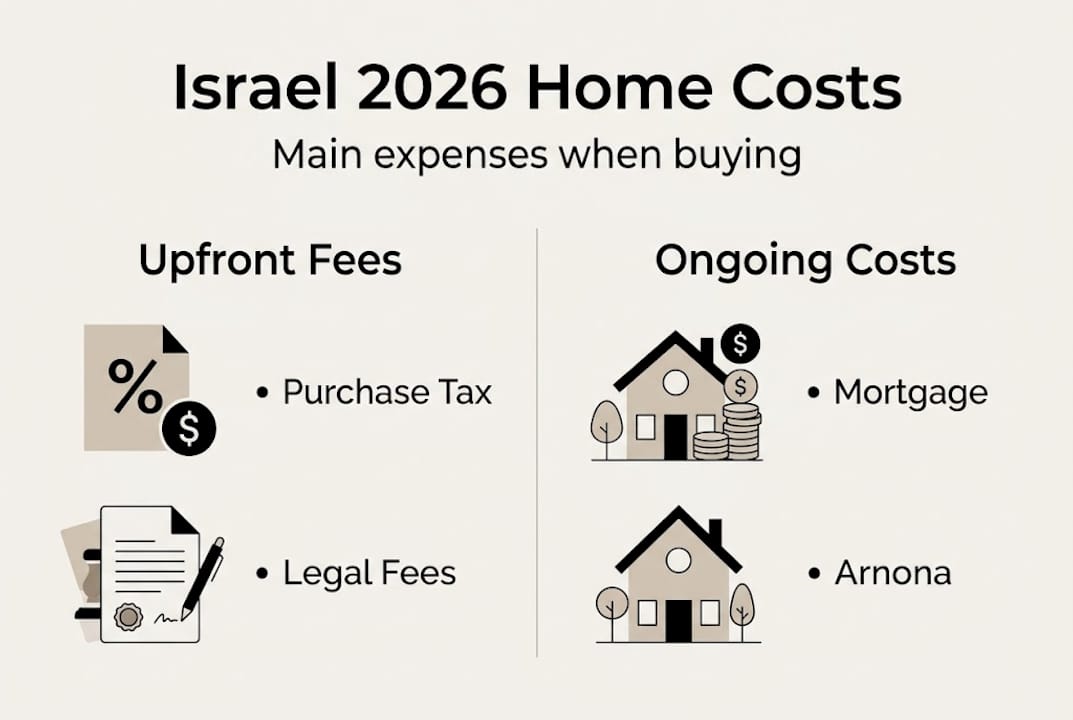
Property tax (known as arnona) is a municipal tax charged based on the size and location of your property. For an observant family in a premium neighborhood, annual arnona costs can be meaningful. Property tax and maintenance add significant annual costs that buyers should factor into their long-term budget before choosing a unit size.
Here are the key ongoing expenses to plan for:
For observant families in areas with shared synagogue infrastructure, mikva access, or eruv maintenance contributions, there are often soft costs and communal expectations that fall outside the formal purchase. They are real expenses that impact the monthly budget.
Long-term planning matters here. A family that buys a three-bedroom apartment may find themselves needing a four-bedroom in five years. Building flexibility into your purchase from the start, and understanding what renovations are permitted under building codes, saves a great deal of difficulty later. Understanding what Israeli property documents say about renovation rights is an important early step.
After years of working with families purchasing homes in the area, one thing stands out. Most people plan well for the purchase tax and even budget for legal fees. What they miss are the compounding effects of the costs no one talks about until it is too late.
Index linkage is one. Most buyers hear the term, nod, and move on. Then, three years into their mortgage, they realize their balance has barely moved. That is not a bank error. It is CPI math.
Communal costs are another. Religious neighborhoods carry beautiful infrastructure, but that infrastructure has a price. The vaad bayit, the kehilla, the local institutions. They matter for quality of life, but they need to be in the budget from day one.
In multi-family purchases, where two families buy adjacent units or a building together, ownership agreements need to be discussed explicitly upfront. We have seen this become a source of serious conflict when it was not structured clearly in writing from the start.
The 18-month tax window for upgrading your home is a genuine strategic tool and most buyers only hear about it after it has passed. The best decisions in this market come from strategy, not emotion. Use a negotiating real estate framework and work through a solid buyer checklist before you fall in love with a property. That order matters.
Knowing the full cost picture is only part of the work. The other part is having the right team around you when decisions need to be made fast. At yigal-realty.com, we work with families at every stage of the purchase, from initial cost modeling and tax planning to contract review and key handover. Our agents specialize in the observant community market in and around the area, and our New York office supports international buyers through the full process. Whether you are a first-time buyer, an oleh making aliyah, or a family upgrading your home, we are here to help you buy smarter and avoid the mistakes that cost buyers the most.
For a first-time Israeli resident, purchase tax totals roughly₪80,000 to₪100,000 depending on current brackets, applying progressive rates from 0% to 5%.
Yes, olim receive reduced purchase tax rates for seven years after their aliyah date, making it one of the most valuable financial benefits of new immigration status.
Beyond the price and tax, expect legal fees, brokerage commissions, inspection costs, mortgage origination fees, and ongoing expenses like arnona and vaad bayit.
Index-linked mortgages can cause monthly payments and the outstanding balance to rise with inflation, meaning your total repayment may end up far higher than the original loan amount.
Arnona is a municipal property tax calculated per square meter based on location and size, and for larger homes in premium religious neighborhoods it can be a significant annual line item in your budget.