%20(4).png)
![[background image] image of cityscape background (for an architect firm)](https://cdn.prod.website-files.com/68961ade6feff9cbdffc080d/69384e066e0e9a310b6817f8_061f6bac-48bf-44b8-a689-078dacd8009f.avif)

Israel’s real estate escrow process runs through licensed attorneys, not independent escrow companies. When you buy property in Israel, your lawyer holds your funds in a dedicated trust account and releases payments only when specific contractual milestones are met. That single structural fact shapes everything about how transactions work here.
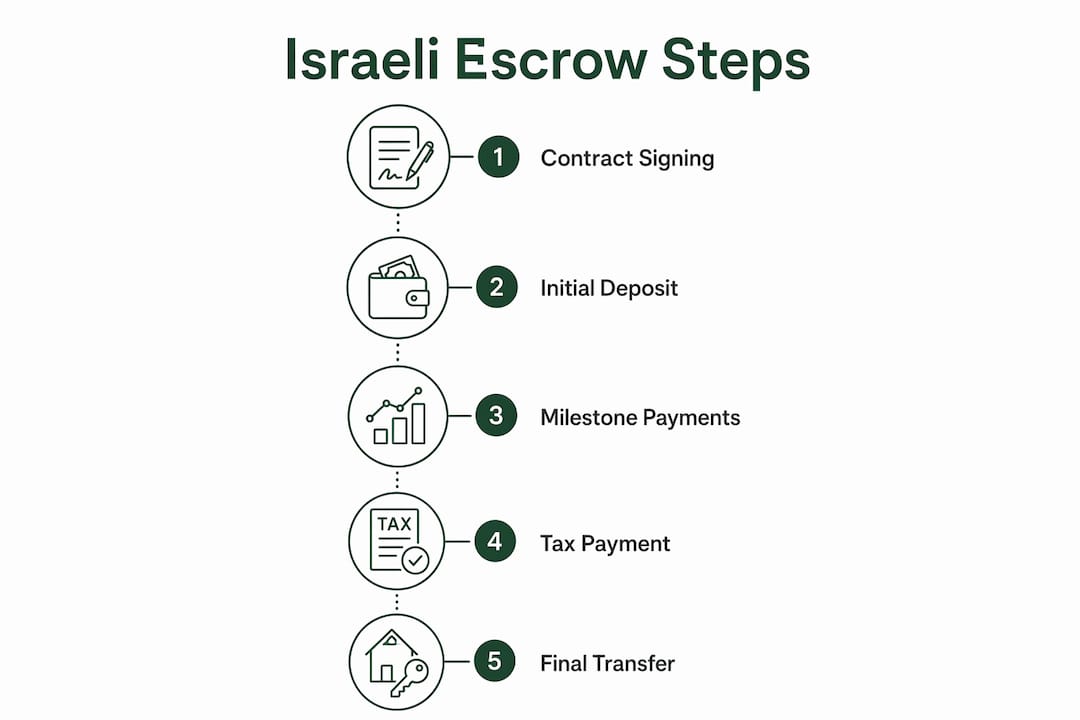
The Israel escrow process steps follow a defined sequence:
Lawyers’ trust accounts operate under both Israel Bar Association rules and Israeli banking regulations, requiring verification at each stage before funds move. There are no title insurance companies and no independent escrow firms as you would find in a US closing.
Israeli real estate attorneys hold client funds in accounts that are legally segregated from the firm’s operating money. This is not a courtesy arrangement. The Israel Bar Association mandates it, and the banks that hold these accounts apply their own compliance checks on top.
The system works because professional ethics and regulatory oversight replace the neutral third-party model used in the US. That is a meaningful difference, and it means your choice of attorney carries more weight here than it would back home.
Wiring funds internationally to an Israeli attorney’s trust account is straightforward in concept and occasionally complicated in practice. Foreign buyers typically send SWIFT transfers from their home bank or a regulated foreign exchange broker directly to the lawyer’s client account. The funds are then converted to New Israeli Shekel (NIS) for tax payments, construction vouchers, and developer disbursements as the contract requires.
Pro Tip: Prepare your source-of-funds documentation, including bank statements, a signed purchase contract, and a letter from your Israeli attorney, before initiating any wire. Missing documents are the single most common cause of transfer delays.
The purchase contract is the governing document for the entire escrow arrangement. It defines the payment schedule, the conditions under which funds are released, tax obligations, possession dates, and registration duties. Every escrow release ties back to a specific contractual condition being satisfied.
US buyers encounter a structurally different system here, and the gap is wider than most expect.
Getting the process right starts before you sign anything. The escrow account in Israel functions well when buyers arrive prepared and stay engaged throughout.
Tax obligations in Israel are woven directly into the escrow timeline. Purchase tax (Mas Rechisha) must be paid within 60 days of signing the purchase contract, and the Land Registry will not register your ownership until the Tax Authority issues a clearance certificate. For foreign buyers, the purchase tax rate starts at 8% with no first-property exemption available to non-residents.
Capital gains tax (Mas Shevach) applies to the seller and is also a prerequisite for registration. Israeli law treats unpaid real estate taxes as the most senior lien on a property, taking priority over mortgages in a foreclosure. Municipal taxes must be fully cleared by the seller before transfer, and your attorney typically holds back sufficient escrow funds to cover any outstanding Arnona or municipal obligations before releasing the final payment.
The structural protection is the mandatory segregation of client funds. Israeli lawyers’ trust accounts are held separately from firm operating accounts under Israel Bar Association rules, meaning a law firm’s financial difficulties cannot reach client funds. Banks holding these accounts apply their own compliance monitoring, and the tri-party verification requirement before any release adds another layer.
For off-plan purchases, the bank guarantee system provides a second line of defense. Each payment you make to a developer must be backed by a bank-issued guarantee. If the developer fails to complete or becomes insolvent, the guarantee can be called and your payments returned in full. Your attorney arranges receipt and safekeeping of each guarantee as payments are made.
When a dispute arises over escrow funds in Israel, the purchase contract is the first reference point. Most contracts include penalty clauses for breach, delay, or failure to meet conditions, and the escrow mechanism itself is designed to prevent funds from moving until conditions are verified. If a party believes funds were released improperly or conditions were not met, the matter typically goes to the Israeli civil courts or, where the contract provides for it, to arbitration.
The Israel Bar Association also has disciplinary authority over attorneys who mishandle client trust funds. A lawyer who releases escrow funds without contractual authorization faces professional sanctions in addition to civil liability. For US buyers, this means the regulatory oversight of attorneys provides a meaningful deterrent against mishandling, even without a neutral third-party escrow company in the picture.
Each party in an Israeli real estate transaction carries a defined role in the escrow process.
Buyer: Wires funds to the attorney’s trust account in stages, provides source-of-funds documentation, and monitors milestone completion.
Seller: Receives staged payments as contractual conditions are met; must clear taxes and municipal debts before the final payment is released.
Escrow agent (buyer’s attorney): Holds funds in a segregated trust account, verifies that each release condition is satisfied, coordinates with the seller’s attorney, and manages tax filings and Land Registry submissions.
Seller’s attorney: Negotiates contract terms, confirms milestone completion from the seller’s side, and coordinates removal of the He’arat Azhara at final registration.
Real estate agent: Facilitates the introduction and negotiation but plays no role in holding or releasing escrow funds. In Israel, the agent’s involvement typically ends once the purchase contract is signed.
A US buyer purchases a new-construction apartment in Beit Shemesh. After signing the purchase contract, the buyer wires an initial deposit in NIS to the attorney’s trust account via SWIFT from a US bank. The attorney registers the He’arat Azhara at the Land Registry within days of signing, and a second payment is released once registration is confirmed.
As construction progresses, the developer issues Shovar vouchers at each milestone. The buyer’s attorney verifies that the bank guarantee covering each voucher is valid before releasing the corresponding payment. Purchase tax is paid within the 60-day window, and the Tax Authority issues a clearance certificate roughly six weeks later. At possession, the buyer receives keys and the final payment is released after the attorney confirms all municipal debts are cleared. Final Land Registry registration follows, typically 4–10 weeks after the registration application is filed.
Several mistakes show up repeatedly in transactions involving US buyers.
Signing before due diligence is complete: In Israel, the contract is binding at signature. A Nesach Tabu (Land Registry extract) search should be completed before any document is signed to confirm there are no existing liens or encumbrances.
Relying on the seller’s attorney for escrow: This creates a direct conflict of interest. Always retain independent counsel to hold and manage your funds.
Underestimating AML documentation requirements: Arriving at a payment deadline without source-of-funds documentation assembled can freeze a transfer for weeks. Prepare the full compliance file before the first wire.
Missing Shovar deadlines: Construction voucher deadlines carry contractual penalties. International wire timing, including potential AML review periods, must be factored into your payment schedule well in advance.
Ignoring exchange rate exposure: Contracts are denominated in NIS, but you are funding them in US dollars. Rate movement between signing and each payment date affects your total cost. Build a currency buffer into your budget.
Israel’s real estate escrow process is attorney-managed, milestone-driven, and governed by the Israel Bar Association and the Prohibition on Money Laundering Law 2000, with no independent escrow companies or title insurance as US buyers know them.
| Point | Details |
|---|---|
| Attorneys hold escrow funds | Israeli lawyers hold buyer funds in segregated trust accounts, releasing payments only when contractual milestones are verified. |
| He’arat Azhara replaces title insurance | The cautionary note registered at the Land Registry is the primary buyer protection, preventing competing claims during the transaction. |
| AML delays are common | Incomplete source-of-funds documentation can freeze international transfers for 2–6 weeks; prepare the full file before the first wire. |
| Off-plan purchases carry bank guarantees | Each Shovar payment must be backed by a bank-issued guarantee; if the developer fails, the guarantee returns your funds. |
| Tax clearance gates final registration | The Land Registry will not register ownership until the Israel Tax Authority confirms purchase tax has been paid. |