%20(4).png)
![[background image] image of cityscape background (for an architect firm)](https://cdn.prod.website-files.com/68961ade6feff9cbdffc080d/69384e066e0e9a310b6817f8_061f6bac-48bf-44b8-a689-078dacd8009f.avif)
TL;DR:
- Early access to new developments allows buyers to preview and reserve units before the public launch.
- It offers advantages like better pricing, priority unit selection, and customization options, but involves risks such as delays and market shifts.
Early access to new developments is defined as the right to review, reserve, or purchase a property before it opens to the general public. Buyers who secure this position gain exclusive previews of available units, lock in pre-launch pricing, and choose from the full inventory before demand narrows the field. In Israel’s fast-moving residential market, where Beit Shemesh and surrounding areas attract both local families and international investors, advance access opportunities can mean the difference between securing a preferred unit at a favorable price and settling for whatever remains after the public launch. Yigal-realty works directly with developers to give qualified buyers exactly this kind of priority position.
Early access, known in the industry as a pre-launch or soft-launch program, moves through four distinct stages before a project reaches the open market. Understanding each stage tells you exactly where your leverage is strongest.
The four stages work like this:
The mechanism that holds your place in Tier 1 or Tier 2 is an Expression of Interest (EOI). An EOI is a refundable deposit that signals serious intent without locking you into a binding contract. EOI deposits convert to formal allotment letters within 7 days of project registration, at which point your pricing is locked. Token deposits scale with unit value and remain refundable until regulatory registration, giving buyers a meaningful window to conduct due diligence.
In Israel, the regulatory framework adds a specific layer. The Israeli Land Authority and the Ministry of Construction and Housing govern project registration timelines. Buyers should confirm that a project has received its building permit before committing beyond a refundable EOI, since permit delays are the most common source of timeline uncertainty.

The financial case for buying early is direct. Early buyers gain access 30–90 days before public launch, securing pricing that runs 4–11% below the public launch grid. On a property priced at ₪2,000,000, that gap represents ₪80,000–₪220,000 in immediate equity.
Advantages of securing advance access:
Risks that every buyer must weigh:
Pro Tip: Before committing to any pre-launch project, request the developer’s track record on delivery dates for their last three completed projects. A developer who consistently delivers on time is worth a premium over one who offers a lower price but a history of delays.
Getting into Tier 1 is not accidental. It requires deliberate preparation across four areas.
Build direct developer relationships. Developer sales teams prioritize investors who can transact quickly or commit to bulk purchases. Public portals offer limited opportunities by comparison. Attending developer-hosted events, project launches, and industry networking evenings puts you in front of the people who control the invitation list.
Work with a specialized real estate agent who holds developer mandates. Not every agent has a Tier 1 relationship with a developer. An agent with a formal mandate receives the pre-launch inventory list before it reaches any public channel. Yigal-realty holds direct mandates with developers in Beit Shemesh and the surrounding region, which means clients receive notification of new projects before those projects appear anywhere else. Learning how to access new real estate projects through the right channel partner is the single fastest path to Tier 1 inventory.
Join investor networks and clubs. Organized investor groups pool their purchasing power and negotiating leverage. Developers grant group access because a committed group of buyers reduces the sales risk on a block of units simultaneously. If you are investing from abroad, connecting with a New York-based network that focuses on Israeli real estate gives you access to deal flow that never reaches the general market.
Get your financing in order before you need it. Financial strength is the decisive factor for safely navigating pre-construction investments. Mortgage pre-approval signals to a developer’s sales team that you are a qualified buyer, not a speculator who might walk away. Buyers who cannot demonstrate financial readiness are passed over in favor of those who can close. Understanding property financing options before you approach a developer puts you in the strongest possible position.
Track pre-launch calendars actively. Developers in Israel typically announce soft launches 60–90 days in advance through their registered channel partners. Set calendar alerts, follow developer social media accounts, and ask your agent to add you to their early notification list. Passive monitoring is not enough in a market where the best units can be reserved within 48 hours of a soft launch opening.
Pre-construction purchases carry a specific financial structure that differs from buying a completed property. Knowing the numbers before you commit prevents surprises that can strain your cash flow.
Pro Tip: Treat the deposit schedule as a cash flow plan, not just a legal obligation. Map each payment milestone against your income and savings timeline before you sign the reservation agreement.
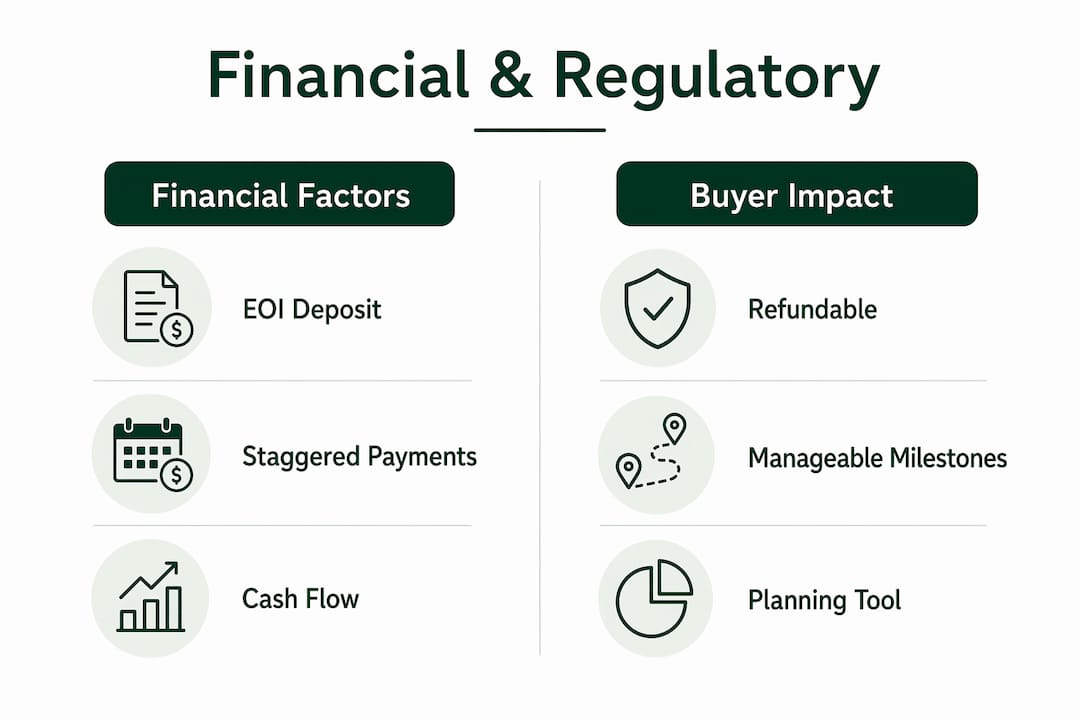
The table below summarizes the key financial commitments buyers typically face in a pre-construction purchase in Israel.
| Financial Factor | Typical Structure | Buyer Impact |
|---|---|---|
| Initial EOI deposit | Refundable, scales with unit value | Holds your unit selection with limited risk |
| Staggered deposit plan | 15–20% over 12–24 months | Spreads capital commitment across the build period |
| Interim occupancy fees | Applicable post-move-in, pre-registration | Adds monthly cost before mortgage payments begin |
| Permitting delays | 4 weeks to 18+ months in worst cases | Extends carry period and delays final financing |
| Appraisal gap risk | Difference between contract and appraised value | Requires cash reserve at closing |
Israeli real estate law provides escrow protections for pre-construction buyers, but the protections only apply when the developer has properly registered the escrow account with a licensed financial institution. Verify this registration independently through a licensed Israeli real estate attorney before transferring any funds. The attorney should also review the purchase agreement for clauses that allow the developer to modify unit specifications or delay delivery without penalty.
Understanding what pre-sale property means in the Israeli context, including the legal distinctions between a reservation agreement and a binding purchase contract, is foundational knowledge every buyer needs before signing.
Securing early access to new developments in Israel requires Tier 1 channel relationships, verified escrow protections, and mortgage pre-approval before the soft launch opens.
| Point | Details |
|---|---|
| Tier 1 timing advantage | Early buyers enter 30–90 days pre-launch, securing pricing 4–11% below the public grid. |
| EOI deposits protect priority | Refundable Expression of Interest deposits hold your unit selection until formal registration. |
| Financial readiness is the gatekeeper | Mortgage pre-approval signals credibility to developer sales teams and secures your place in line. |
| Permitting delays are the top risk | 79% of builders report delays from 4 weeks to over 18 months; build this into your timeline. |
| Legal verification is non-negotiable | Confirm escrow registration and review purchase agreements with a licensed Israeli attorney. |
Most investors I speak with come to me after they have already missed the window. They found a project on a public portal, fell in love with the floor plan, and then discovered that the best units were reserved months ago at prices they would have been happy to pay. That pattern is not bad luck. It is the predictable result of waiting for information to come to you instead of positioning yourself to receive it first.
The buyers who consistently get into Tier 1 share one habit: they invest in relationships before they invest in property. They attend developer events when they have no immediate intention to buy. They stay in contact with their agent between transactions. They ask to be added to early notification lists for projects that are still in the planning phase. By the time a soft launch opens, they are already on the list.
The second mistake I see constantly is treating financial preparation as something to handle after finding the right property. In pre-construction, the sequence is reversed. You need your financing confirmed, your deposit liquidity ready, and your legal counsel identified before the soft launch invitation arrives. A 48-hour window to reserve a unit is not enough time to arrange any of those things from scratch.
My honest advice: align yourself with a channel partner who has direct developer mandates, get your finances in order now, and think of early access as a relationship you build over months, not a transaction you execute in days.
— Spiros
Yigal-realty holds direct mandates with residential developers in Beit Shemesh and the surrounding region, which means clients receive notification of new projects before those projects reach any public channel. The team provides personalized guidance on unit selection, deposit structuring, and regulatory compliance, drawing on deep local knowledge and an international network through their New York office. For buyers navigating the legal and financial complexity of a pre-construction purchase in Israel, Yigal-realty offers end-to-end support from the first soft-launch invitation through to final registration. Connecting with how to attract local real estate clients is one part of the picture. Getting on Yigal-realty’s early notification list is the direct path to exclusive development opportunities in Israel’s most active residential markets.
Early access is the right to review and reserve a property before the public launch. It typically occurs 30–90 days ahead of the open market, giving buyers first choice of units and pre-launch pricing.
An Expression of Interest deposit is a refundable payment that holds your selected unit before formal contracts are signed. It converts to a binding allotment letter within 7 days of project registration, locking in your price.
Deposits are usually staggered at 15–20% of the purchase price spread over 12–24 months. This structure lets buyers manage cash flow across the construction period rather than committing the full amount upfront.
Verify escrow registration independently through a licensed Israeli real estate attorney before transferring any funds. Israeli law requires developers to hold pre-construction deposits in a regulated escrow account with a licensed financial institution.
Developers grant Tier 1 access to their top channel partners and direct investor relationships first. Those buyers reserve premium units within days of the soft launch opening, leaving reduced inventory for the public phase.