

If you are an English-speaking family looking at Beit Shemesh, the school question and the housing question are really one question. Public school registration follows your address, and the religious character of a school often mirrors the character of the street around it. Pick the school first, then the neighborhood, then the apartment. This guide explains how that works in practice, what support Olim children actually get, and what to check before you sign a contract.
A note on terms: “Anglo education” in Beit Shemesh is not a single school system. It is the set of options Anglo families use: state-religious (Mamlachti Dati) and other streams with strong Olim support, English-friendly high school tracks, and the municipal services that help new immigrants place their children.
Beit Shemesh has a long-established English-speaking community. Nefesh B’Nefesh dates it to 1991, when the first English speakers moved into the Sheinfeld neighborhood, and describes steady growth since. The same guide puts the city at roughly 147,000 residents as of 2021, with an Anglo share of about 15 to 25% citywide and some Ramat Beit Shemesh neighborhoods reaching 30 to 40%.

That density matters for education. Schools that already have many North American families tend to have English-speaking staff, active parent groups and experience with children who arrive without Hebrew. The Jewish Press quotes Mayor Aliza Bloch saying that Anglo families need not feel like strangers in the city, and describes an ecosystem that lets children integrate at their own pace.
The city also has an Absorption Department with English-speaking staff. According to the municipal Education, Youth and Community Administration guide, new immigrants should contact it to help with school placement and integration, ideally before arrival.
Israeli public education is divided into streams, and Beit Shemesh has them all. Most Anglo families fall into one of three groups.
| Stream | Typical Anglo fit | What to check |
|---|---|---|
| State (Mamlachti) | Secular or traditional families | Smaller in the city, so ask about class size and Olim support |
| State-religious (Mamlachti Dati) | Modern Orthodox and many dati leumi families | Level of religious expectations, dress code, Olim hours |
| Haredi | Families whose home life is Haredi | Language of instruction, curriculum, English support |
Nefesh B’Nefesh notes that the religious spectrum in Beit Shemesh runs from secular to Haredi and Hasidic. It also says specific streets or buildings can hold orientations that differ from the rest of the neighborhood. In Ramat Beit Shemesh, the sub-neighborhoods (Aleph, Gimmel, Daled, Hey/Neveh Shamir, Mishkafayim) each have their own flavor.
The practical result: two families with the same religious label can end up happier in different parts of the city. A school that looks right on paper may feel different once you meet the parents at pickup.
Most Olim children enter a Hebrew-language classroom. That is deliberate. The system is built around integration, and younger children usually pick up Hebrew quickly. What differs between schools is the scaffolding around that process: Hebrew pull-out lessons, a buddy system, English-speaking teachers’ aides, and parents who can translate for you at the first parent meeting.
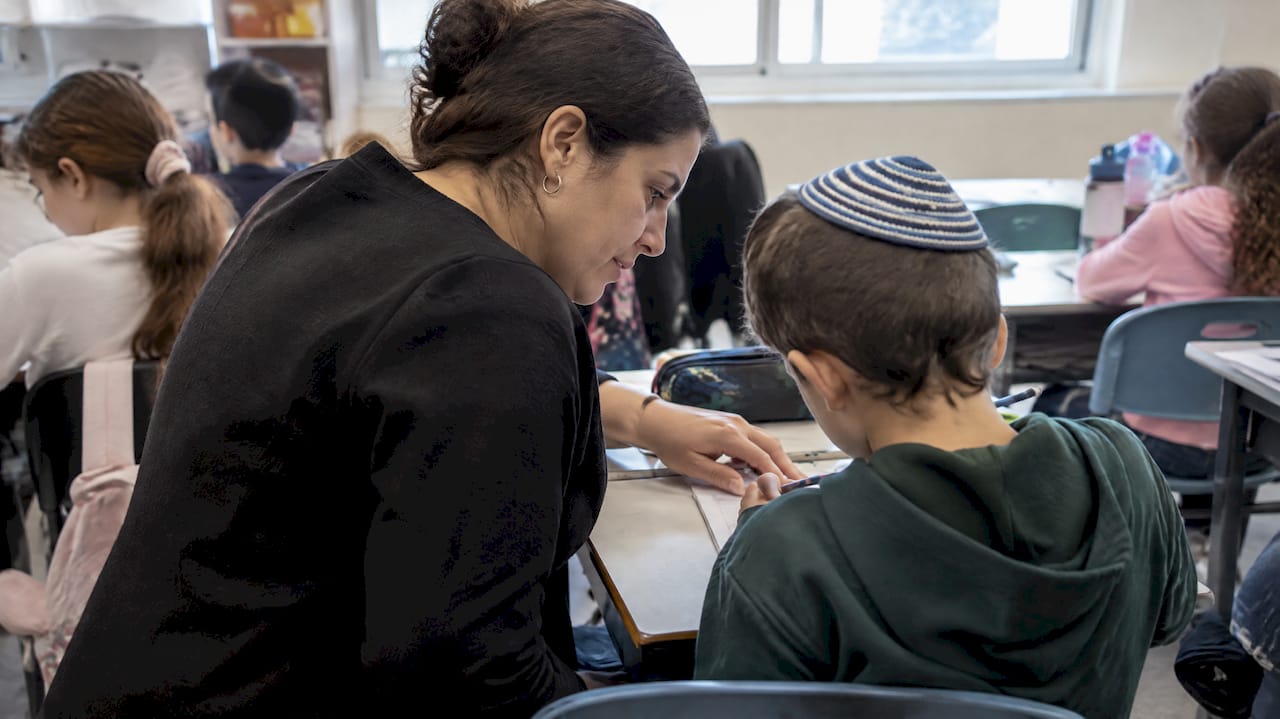
For religious families, there is a second layer. Schools differ in how they handle things like tefillah, Tanakh study style and dress code. Nefesh B’Nefesh recommends asking whether the school’s outlook matches your own, and warns that religious schools’ expectations for in-school and out-of-school behavior vary widely.
High school is where Anglo families feel the language gap most, because the curriculum is heavier and bagrut exams loom. For girls, YTA Beit Shemesh is a well-known option. According to its own site, it offers a full bagrut curriculum taught in English along with intensive ulpan programs, designed for new Olim and Israeli English speakers. Its Hebrew-language parent page describes it as a landing pad for new Olot moving into the Israeli system.
Boys have their own set of yeshiva high school and Torah-track options in the city, which differ widely in approach. We do not rank them. We recommend you visit, speak to current parents and ask direct questions about language support and expectations.
The headline fact is good. The Ministry of Education mandates Hebrew assistance for Olim children, commonly known as Shaot Olim, and Nefesh B’Nefesh puts it at six hours a week.
The fine print matters. The same guidance explains that the quality of enhanced services depends heavily on a school’s critical mass of Olim students. In a school with few of them, parents should ask how consistently the hours will be provided. It also says that even in communities with many Olim students, enhanced services may carry an extra cost that you should clarify with the school.
Questions worth putting to any school before you commit:
Public school registration in Beit Shemesh is primarily digital and tied to municipal residency zones. Registration for elementary schools typically takes place in February and March through the municipal Education Department’s website, per the RBS Local registration guide, which follows the municipality’s own page for the 5787 (2026-27) school year.
Parents will need proof of residence, such as a rental or purchase contract. They also need official documents, including a Teudat Zehut with the children listed, and a Teudat Oleh for immigrants, according to the municipal guide.
This is where housing and education collide. If your registration depends on a signed contract, you cannot delay the property decision until after you have chosen a school. Work backward from the registration window:
Registration rules and dates are set by the municipality each year, so check the Education Department’s current page before you plan around any date.
Labels like “Olim-friendly” are not endorsements. Nefesh B’Nefesh’s planning material recommends visiting in person and speaking with current faculty and parents, because official labels can hide differences in how schools handle integration, language support and religious expectations.
A good school-visit day looks like this:
If you want to combine this with property viewings, read our guide to Anglo communities in Beit Shemesh first. Our overview of educational institutions in Beit Shemesh shows what sits near which neighborhoods, and the page on English-language minyanim helps you plan your Shabbat visit.
School zones, commuting time and community feel should be weighed together. A few principles help:
For a deeper look at the neighborhoods themselves, see our pages on popular neighborhoods in Beit Shemesh and religious neighborhoods.
Children take a move better when the school and the home are settled at about the same time. If you are packing up a household with kids, a practical guide such as these tips for moving house with children (a French-language page from a Swiss mover) offers ideas on involving the kids and keeping routines steady. The specifics of an international move to Israel are different, but the family-level advice travels well.
We work with families and investors in Beit Shemesh and surrounding areas, including international buyers coming from the US. The conversation about a home almost always starts with a conversation about a school, and we think that is the right order.
We see three common mistakes. The first is buying on the strength of a listing in a sub-neighborhood the family has not walked on a Shabbat. The second is assuming that a label such as state-religious means the same thing on every street. The third is leaving the contract too late, so that the school registration window closes before the family has an address.
What we try to do instead is slow down the first step and speed up the rest. We ask what stream, what language support, and what kind of community the family wants. Then we match that to projects and neighborhoods, explain the purchase process plainly, and give early access to new developments where we have it. We do not recommend a specific school for you, because only you can judge whether it fits. We do make sure the home you buy keeps the choice open.
If you are also weighing the purchase itself, our step-by-step home purchase guide and homebuying workflow for families lay out the order of events.
— Spiros
Our concierge project guidance is built for families who need to align a purchase with a school year. We walk you through the projects we represent, explain what each neighborhood is like day to day, and support international buyers through the process. You can start on our main page, or look directly at projects such as Neve Amim, Rotshtein Heights and Olmaya. Prices are not published on those pages, so contact us for current details.
Before you meet us, it helps to read our guides on Beit Shemesh housing developments and how to assess Israeli real estate, and our property buying tips.
Here is how the pieces fit if you plan to move for the next school year. It is a framework, not a promise: dates change, and the municipality sets the actual registration window.
The point is not to rush. The point is to know which date matters and to buy or rent early enough to meet it.
Mostly, no: elementary and middle school are taught in Hebrew, with Olim support and many English-speaking staff and parents. The exception is at high school level: YTA Beit Shemesh offers a girls’ track with full bagrut taught in English, according to its website. Check current offerings directly with each school.
Elementary registration typically happens in February and March through the municipal Education Department’s website. You need proof of residence and identity documents, including a Teudat Oleh for immigrants. If you arrive mid-year, contact the Absorption Department directly.
The Ministry of Education mandates Hebrew assistance for Olim, which Nefesh B’Nefesh puts at six hours a week. How well it works depends on how many Olim students the school has, so ask each school how the hours are delivered and whether there is an extra cost.
For public schools, registration is tied to municipal residency zones, so your address matters. Neighborhood orientation also shapes the school community. That is why we suggest choosing your stream first, then confirming the zone before you commit to a property.
You can, but it is risky. Registration relies on proof of residence, and zones differ. Visit schools on a pilot trip first, shortlist two or three, and then look for properties within those zones.