

The main English-speaking minyanim in Beit Shemesh are Mishkan Shilo, Aish Kodesh, Beis Tefillah Yonah Avraham, Kehillas Shivtei Yeshurun, and Heichal Menachem Chabad in Ramat Beit Shemesh. Before you walk out the door for any of them, check the shul’s website or Godaven listing, or send a quick call, email, or WhatsApp message to confirm the time.
TL;DR:
- Most English minyanim in Beit Shemesh, like Mishkan Shilo and Aish Kodesh, require direct confirmation of prayer times via website, call, or WhatsApp.
- Halachic zmanim differ based on opinions like GRA and Magen Avraham, so cross-referencing local zmanim is essential before arriving.
- Holiday and Selichot schedules often shift, making it necessary to verify specifics with the shul office close to the occasion.
- Neighborhood proximity to specific shuls influences access, parking, and seating, especially on Shabbat mornings when walking is preferred.
- Community integration begins with consistent attendance and connecting via WhatsApp or email lists to participate in shiurim, chesed, and social events.
Most English-friendly davening in the city clusters in Ramat Beit Shemesh Aleph, with smaller pockets in Sheinfeld and Givat Sharret. Each shul runs its own rhythm, so the fastest path to an accurate time is still a direct check rather than a general search.
Some of these shuls keep their calendars current online. Others lean on word of mouth and community lists, which is exactly why the next section matters.
Halachic times are not one-size-fits-all. The Vilna Gaon’s (GRA) opinion and the Magen Avraham’s opinion calculate the latest time for Shema and the start of Shacharit differently, and a shul that follows one will post times that look “off” if you are used to the other. Before assuming a posted time applies to you, ask which opinion the minyan follows.
For Beit Shemesh specifically, daily and halachic zmanim covering sunrise, latest Shema, chatzot, mincha, sunset, and nightfall are published online using the city’s own coordinates, and they typically list both GRA and Magen Avraham calculations side by side.
| Step | Action |
|---|---|
| 1 | Check the shul’s own website or its Godaven page |
| 2 | Cross-reference a local zmanim page for GRA versus Magen Avraham |
| 3 | Call, email, or message the shul’s WhatsApp or email list |
| 4 | Arrive early on Shabbat |
| 5 | If the door is locked, check for a posted number or ask a neighbor |
Pro Tip: Save the gabbai’s phone number after your first visit so your second trip never depends on guesswork.
Holiday schedules shift from the regular weekly calendar, often with earlier Shacharit, added Torah readings, or late-night Selichot that start well after midnight in the weeks before Rosh Hashanah. Aish Kodesh posts updated holiday schedules on its site but still asks visitors to confirm final details with the office, since timing can move close to the date.
Ramat Beit Shemesh Aleph, Ramat Shilo, Sheinfeld, and Givat Sharret form the main cluster of English-language davening in the city. Most of these neighborhoods are walkable within their own borders, which matters on Shabbat when driving is not an option.
Street parking fills up fast near popular shuls on Shabbat morning, so arriving early does double duty: it secures a parking spot and a seat. For a closer look at how these areas differ, the neighborhood guide to Beit Shemesh breaks down proximity to shuls and amenities in more detail. Newcomers attending a busy minyan for the first time often do better arriving 15 minutes ahead and asking a regular where visitors typically sit.
Showing up for davening is the first step, not the whole picture. Community leaders at shuls like Mishkan Shilo describe the English minyan as both a place to pray and a social hub built around shiurim, chesed projects, and regular kiddushim. Joining a WhatsApp or email list gets you the fastest updates on room changes or schedule shifts, and it is usually also where you will hear about the next communal event.
Weekday shiurim, including Daf Yomi and evening learning sessions, give newcomers a lower-pressure way to meet people than a crowded Shabbat service. If you are new to the area, reaching out directly to Mishkan Shilo or Aish Kodesh for guidance on where to plug in tends to get a faster answer than searching alone.
English-speaking minyanim grew alongside the wave of Anglo immigration into Ramat Beit Shemesh over the past few decades, as olim from the United States, United Kingdom, and other English-speaking countries settled in the newer neighborhoods built east of the older city center. What started as informal gatherings in apartments and community rooms gradually became established shuls with their own buildings, boards, and rabbinic leadership.
The growth tracked the broader development of Ramat Beit Shemesh Aleph and Bet as residential areas, with each wave of new housing bringing another cohort of English-speaking families who wanted davening in a familiar linguistic and cultural register. Shuls like Mishkan Shilo and Aish Kodesh emerged from that process, building communities that blend American and British religious customs with the practical realities of Israeli life.
That history still shapes how these shuls operate today. Many retain a strong connection to the diaspora communities their founding members came from, reflected in everything from the style of a derasha to the format of a kiddush. At the same time, they have become fully rooted parts of the local religious landscape, not satellite outposts of communities abroad.

The most obvious difference is language: an English minyan conducts announcements, shiurim, and social conversation in English, even though the liturgy itself is in Hebrew regardless of which minyan you attend. That single shift changes who feel comfortable walking in the door, particularly for new olim still building Hebrew fluency.
Beyond language, English minyanim in Beit Shemesh tend to run on customs familiar to American or British shulgoers: a structured kiddush after Shabbat morning services, a weekly derasha aimed at a mixed audience of native English speakers and longtime Israelis, and an active list of shiurim scheduled around work and family life rather than around a single rabbi’s open hours. Hebrew-speaking minyanim in the same neighborhoods often follow a more streamlined service with less English-language programming around the edges.
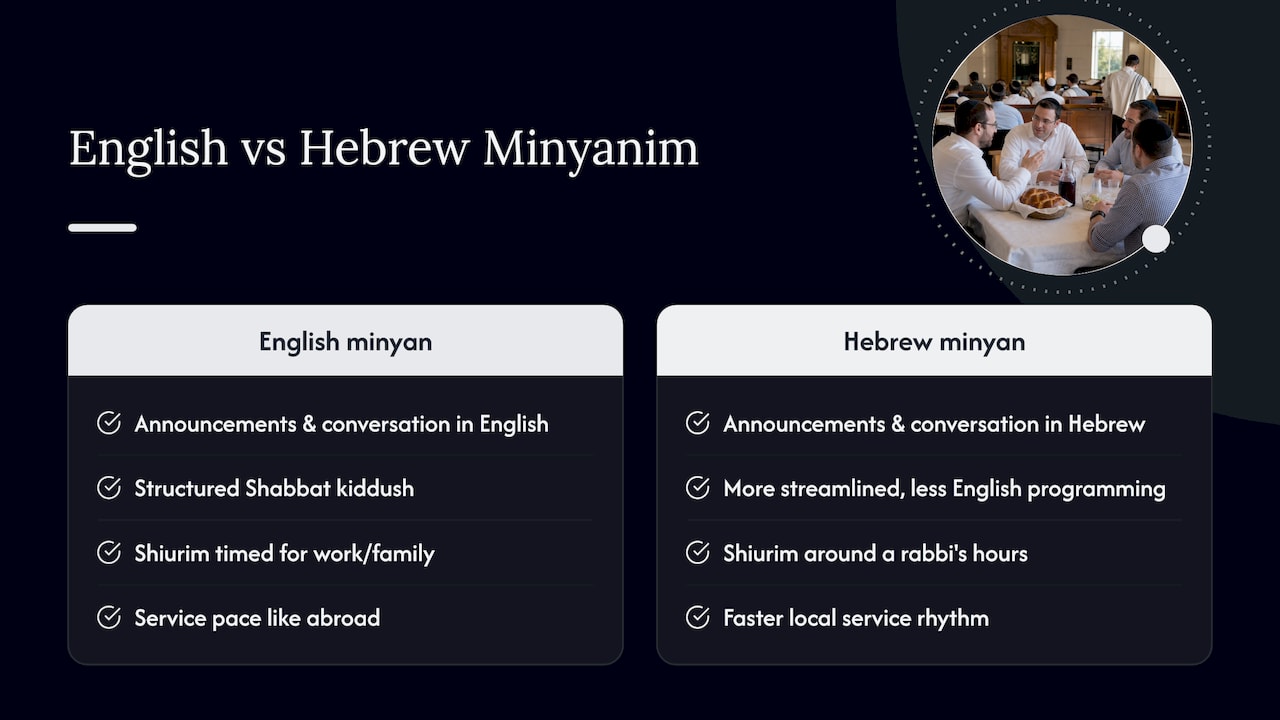
Pace is another difference worth naming. Visitors sometimes notice that English minyanim run services at a pace closer to what they knew abroad, which can feel more navigable for a newcomer still learning the local rhythm. None of this makes one style better than the other. It simply means the choice of minyan shapes the social and linguistic experience as much as the prayer itself.
English minyanim function as an entry point for new immigrants, not a separate track from the rest of the city’s religious life. A family that lands in Ramat Beit Shemesh without strong Hebrew can still find a full religious and social life through an English-speaking shul, from davening to shiurim to chesed committees, while gradually building the language skills to integrate more broadly.
These shuls also feed into the wider Beit Shemesh community in practical ways. Joint events, shared eruv maintenance, and overlapping chesed projects connect English minyanim to the Hebrew-speaking shuls around them, and many English-speaking residents eventually move between both worlds depending on the occasion. The presence of a strong English-minyan network has also made certain neighborhoods, particularly parts of Ramat Beit Shemesh Aleph, a known landing spot for new Anglo olim, which in turn shapes demand for housing and local services in those areas.
Each of the major English minyanim in Beit Shemesh operates under its own rabbinic leadership, and the shul’s office or website is the most reliable place to confirm who currently leads services, delivers the weekly derasha, or oversees the beit midrash. Because rabbinic roles and shul leadership can change, this article does not list specific names that are not independently confirmed here.
What stays consistent is the role these leaders play beyond the sanctuary. They typically run or oversee the shiurim schedule, serve as the first point of contact for newcomers asking about integration, and coordinate holiday and Selichot timing changes with the gabbai. If you want to know who is currently leading a particular minyan, the shul’s own website or a direct call to the office will give you a more current answer than any general guide.
An English minyan is often the first place a new oleh feels fully at home, not because the prayers differ, but because the conversation after them does. If you are choosing where to go, email a gabbai or join a WhatsApp group before your first visit rather than just showing up and hoping. The fastest route to a spiritual home here is consistency: pick one minyan and keep returning, even if the first week feels unfamiliar.
— Spiros
Choosing a neighborhood often comes down to which shul feels right, and some real estate firms work with English-speaking families who want to live within walking distance of communities like the ones covered here; if you need assistance managing currency exchange during your move, consider the Valiutoskeitykla to help with your relocation logistics. Concierge guidance can help you compare neighborhoods such as Ramat Beit Shemesh Aleph, Ramat Shilo, and Sheinfeld against your own priorities, including proximity to a specific shul and its community.
Beyond matching you to a neighborhood, we can share practical context on local shul access and connect you with the kind of on-the-ground detail that a listing alone will not show. If you are weighing a move and want a clearer picture of which areas suit your family, reach out through Yigal Realty to start that conversation, or read our tips for families relocating to Beit Shemesh for a broader look at the process.
Yes, many Beit Shemesh shuls, including English-speaking ones like Aish Kodesh, hold Selichot services in the weeks before Rosh Hashanah. Exact timing varies by shul and by date, so confirm directly with the shul office rather than assuming a standard start time.
Beit Shemesh has various event halls and community spaces, but this guide focuses specifically on English-speaking minyanim rather than event venues. Check with your shul office or a local directory for current information on event spaces in the city.
Beit Shemesh includes neighborhoods such as Ramat Beit Shemesh Aleph, Ramat Beit Shemesh Bet, Ramat Shilo, Sheinfeld, Givat Sharret, and the older city center. Ramat Beit Shemesh Aleph in particular hosts a concentration of English-speaking minyanim and families, as outlined in this neighborhood breakdown.
Prayer times vary by shul and by the halachic opinion it follows, with GRA and Magen Avraham calculations producing different latest times for Shema and Shacharit. The most reliable approach is to check a local zmanim page alongside your chosen shul’s own posted schedule.
Start with the shul’s own website or its Godaven listing, since both often show current prayer times and contact information. If nothing is posted, a short call, email, or WhatsApp message to the gabbai or office is the most accurate way to confirm before you go.