%20(4).png)
![[background image] image of cityscape background (for an architect firm)](https://cdn.prod.website-files.com/68961ade6feff9cbdffc080d/69384e066e0e9a310b6817f8_061f6bac-48bf-44b8-a689-078dacd8009f.avif)
TL;DR:
- Beit Shemesh’s real estate market is rapidly growing, driven by religious and Anglo families seeking community and affordability.
- Urban renewal projects require community approval and are subject to unpredictable approval timelines and public objections.
- Buyers should understand the planning process, neighborhood character, legal protections, and community priorities for successful investment.
Beit Shemesh has quietly become one of Israel’s fastest-growing real estate markets, and the numbers tell a striking story. Average prices hit ₪2.11M in Q1 2025, a 9.2% jump year over year, driven by a steady influx of religious and Anglo families seeking community, affordability relative to Jerusalem, and access to quality Jewish education. Yet for all the excitement, many buyers arrive confused about how new developments actually get approved, which neighborhoods fit their lifestyle, and what legal protections exist when buying off-plan. This guide cuts through that confusion with clear, practical information you can act on.
| Point | Details |
|---|---|
| Planning process matters | New developments are shaped by district committee approvals and require clear community consensus. |
| Neighborhood fit is crucial | Ramat Beit Shemesh Aleph, Daled/Neve Shamir, and Mishkafayim offer tailored options to religious and Anglo buyers. |
| Buyer protections exist | Independent legal review and bank guarantees help secure your investment against developer risks. |
| Market yields outperform | Beit Shemesh yields (3.5–3.8%) beat nearby cities, making it attractive for investors. |
| Community drives value | Religious amenities and schools can outweigh pricing and transit in purchase decisions. |
New housing in Beit Shemesh does not appear overnight. Every project, whether a single tower or an entire neighborhood, moves through a formal approval process managed by Israel’s district planning committees. These committees review submitted plans, evaluate environmental impact, check zoning compliance, and open the process to public objections before granting final approval. That last point matters more than most buyers realize.
New developments in Beit Shemesh including towers and urban renewal projects must clear district committee review, which can take months or even years depending on the complexity of the project and the volume of objections received. A project in one neighborhood might sail through in six months while a neighboring development stalls for two years over a contested environmental study.
Urban renewal deserves special attention because it affects existing residents, not just new buyers. The most common model is Pinui-Binui, which translates roughly to “evacuate and build.” Under this program, older apartment buildings are demolished and replaced with significantly larger structures. The math works when developers can offer current tenants upgraded units in the new building while still having enough additional units to sell at market price. But here is the catch: Pinui-Binui requires 66% tenant approval and typically a 1:3 unit ratio, meaning the new building must offer at least three units for every original unit demolished.
Not everyone is happy about growth. Beit Shemesh has seen fierce pushback on several planned expansions, including a proposal for Neighborhood Vav that drew more than 80 formal objections related to agricultural land use and environmental concerns. Critics argue that the city is expanding faster than it can build the roads, schools, and utilities to support new residents. Supporters counter that the demand is real and that blocking supply only drives prices higher.
Key planning realities buyers should understand:
If you want local real estate insight on which projects are moving smoothly through approvals and which face delays, working with someone embedded in the local market is genuinely worth your time.
“Understanding the planning pipeline is just as important as understanding the price. A project that looks cheap on paper can cost you years of waiting and significant stress if it is stuck in committee disputes.” — Beit Shemesh market observer
Once you understand how projects get approved, the next question is where you actually want to live or invest. Beit Shemesh is not one uniform city. It is a collection of distinct neighborhoods with very different characters, price points, and community profiles.
Ramat Beit Shemesh Aleph is the most established of the Anglo and religious neighborhoods. It has a mature infrastructure, dozens of shuls (synagogues) covering the full spectrum of Orthodox and Haredi communities, well-regarded yeshivot and Bais Yaakov schools, and shopping that serves an English-speaking population. Prices here reflect that maturity. Three and four-room apartments in new construction range from ₪2M to ₪3M, and resale units in desirable buildings rarely sit on the market long.

Ramat Beit Shemesh Daled and Neve Shamir represent the newer frontier. Infrastructure is still catching up, some roads remain unfinished, and certain amenities have not yet arrived. But prices are meaningfully lower than in Aleph, making these neighborhoods attractive for first-time buyers or investors willing to wait for the area to mature. Community growth here has been fast, and several new schools and shuls have opened in recent years.
Mishkafayim sits at the premium end of the market. This neighborhood attracts buyers looking for larger units, greener surroundings, and a somewhat quieter atmosphere than the denser Ramat Beit Shemesh areas. It is not the first choice for buyers prioritizing proximity to a specific yeshiva, but for families who want more space and are willing to pay for it, Mishkafayim delivers.
Here is a quick comparison to help frame your thinking:
| Neighborhood | Profile | Price range (3-4 rooms) | Infrastructure status |
|---|---|---|---|
| RBS Aleph | Established, Anglo, diverse Orthodox | ₪2.2M to ₪3M | Mature |
| RBS Daled / Neve Shamir | New, growing, more affordable | ₪2M to ₪2.6M | Developing |
| Mishkafayim | Premium, quieter, larger units | ₪2.5M to ₪3.5M+ | Established |
Foreign and Anglo buyers account for roughly 24% of transactions in these areas, and their priorities consistently center on community fit and school access rather than public transit. That is a meaningful distinction from buyers in Tel Aviv or Jerusalem, where train and bus access drive location decisions significantly.
A few challenges specific to newer neighborhoods are worth naming clearly. Infrastructure often lags behind construction, meaning you might move into a finished apartment on an unfinished street. Parking is chronically short in several developments. And the municipal property tax, known as Arnona, runs ₪55 to ₪60 per square meter in these areas, which is notable compared to some other Israeli cities.
Pro Tip: Before signing anything, visit the neighborhood at multiple times of day and on Shabbat. A street that feels calm on a Tuesday afternoon can feel completely different on a Friday night when parking is a battle and noise levels rise. Also ask your agent directly: is the mikveh open? Is the eruv complete? Are the schools accepting students? These are not minor details for religious families.
You can get a detailed breakdown of the investment case by reading about investing in new developments tailored specifically to religious families.
The process of buying a new apartment in Israel is more structured than many overseas buyers expect. That structure is genuinely protective, but only if you follow it correctly.
Here is how a typical new construction purchase unfolds:
“The bank guarantee is not a technicality. It is the single most important document in a new construction purchase. Buyers who skip confirming it are taking a risk they do not need to take.” — Israeli real estate legal community guidance
Pro Tip: Always clarify who is responsible for purchase tax (Mas Rechisha) and VAT. For new apartments purchased from a developer, VAT is typically included in the listed price. For resale properties, different rules apply. A misunderstanding here can add hundreds of thousands of shekels to your actual cost.
For a deeper look at the legal review process and smart property finance tips, both resources walk through these steps in detail.
If you are approaching this as an investor, or even as a family buyer who wants to make sure you are not overpaying, the current market data is encouraging.
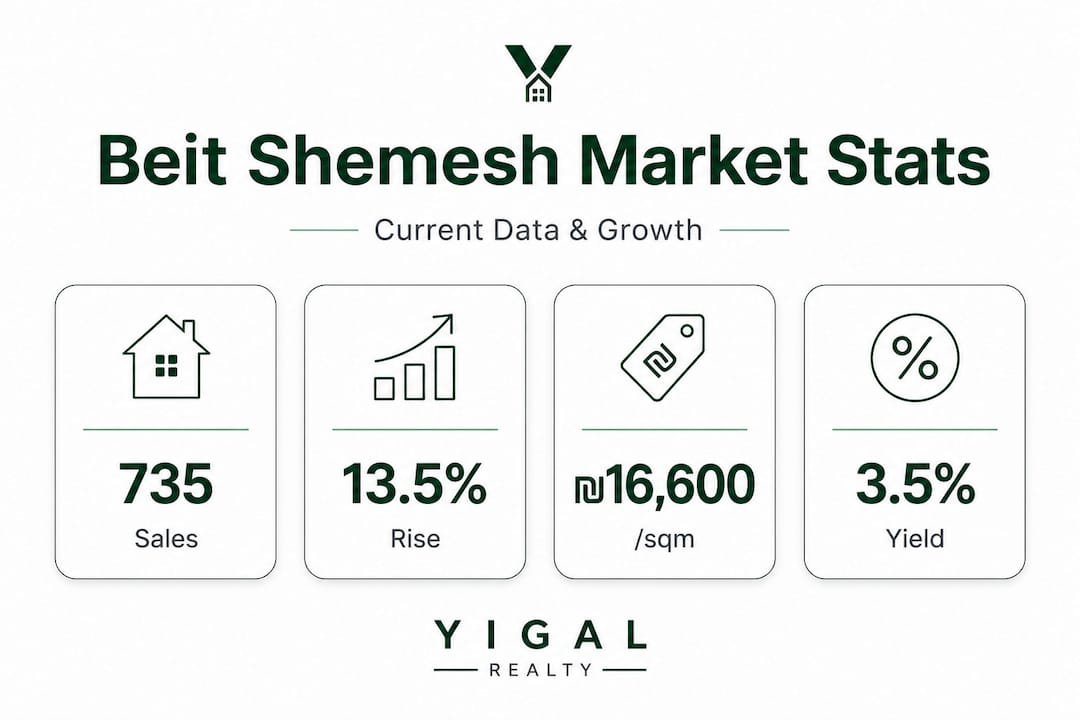
Q1 2025 transaction volume reached 735 sales, up 13.5% year over year. Price per square meter grew 10.3% to reach ₪16,600. These numbers reflect genuine demand, not speculative froth. The buyers are real families, mostly religious and Anglo, making primary residence decisions rather than flipping units.
Rental yields in Beit Shemesh are particularly interesting for investors. Gross yields of 3.5% to 3.8% place the city above Jerusalem (where yields typically run 3.1% to 3.4%) and above much of Tel Aviv. The reason is straightforward: prices in Beit Shemesh are lower than those competing cities while rents remain solid because demand for rental units within religious communities is consistently high.
Here is how Beit Shemesh compares to nearby markets:
| City | Avg price per sqm | Gross rental yield | Population growth |
|---|---|---|---|
| Beit Shemesh | ₪16,600 | 3.5% to 3.8% | Rapid (target 250,000) |
| Jerusalem | ₪25,000+ | 3.1% to 3.4% | Moderate |
| Modi’in | ₪18,000+ | 2.9% to 3.2% | Steady |
The population growth angle deserves more attention. Beit Shemesh is projected to reach 250,000 residents as ongoing construction absorbs young families who cannot afford Jerusalem. Each wave of new residents creates rental demand that supports yields for existing investors. That said, oversupply in specific sub-neighborhoods is a real risk if too many units come to market simultaneously.
For a detailed breakdown of 2025 real estate trends and a practical ROI guide for Beit Shemesh, there is solid analysis available. Local insights for returns can show you how neighborhood-level factors can swing your actual returns by 30% or more compared to citywide averages.
Key bullet points for investor consideration:
Most real estate advice, even good advice, is built on a framework that prioritizes price per square meter, proximity to transportation, and projected capital gains. That framework works reasonably well in Tel Aviv. In Beit Shemesh, it misses the point for a significant portion of buyers.
When we look at what actually drives purchase decisions in Ramat Beit Shemesh, the picture is different. Families are asking which neighborhood has the right school for their specific hashkafa (religious philosophy). They are asking whether a particular building has enough observant neighbors to form a minyan. They are choosing a street based on which rabbi lives nearby or which Bais Yaakov has space for their daughters. These are not secondary considerations. They are the primary ones.
We have seen buyers pass on objectively better financial deals in premium locations because the community feel was not right. And we have seen families pay above-market prices for units in buildings with the right social fabric. From a pure numbers standpoint, that looks irrational. From the perspective of someone who understands what makes a life in a religious community work, it makes complete sense.
The uncomfortable truth for investors who do not share these priorities is that ignoring them leads to poor decisions. A building in a neighborhood where the community is not yet established can sit with high vacancy because the target tenant simply will not move there, regardless of how beautiful the apartment is. The values that drive religious families to buy in Beit Shemesh are the same values that will fill your rental unit or make your resale quick.
Market statistics tell you what happened. Understanding community dynamics tells you what will happen next. Both matter, but the second one is harder to read from a spreadsheet.
Making a smart purchase in Beit Shemesh requires more than reading market data. It requires knowing which projects have clean approvals, which developers have delivered on time, and which neighborhoods match your family’s specific religious and educational needs. That kind of knowledge takes years to build. Yigal Realty brings that expertise directly to families and investors, with a team that understands both the Israeli real estate process and the unique priorities of observant communities. From first inquiry to final signature, working with local specialists who know Beit Shemesh from the inside makes the difference between a stressful purchase and a confident one. Reach out to explore current listings and get personalized guidance on the right neighborhood and project for your goals.
Pinui-Binui is an urban renewal model requiring at least 66% approval from existing tenants before demolition and rebuilding can proceed, typically at a 1:3 unit replacement ratio. Existing tenants receive upgraded units in the new building while the developer sells additional units on the open market.
Ramat Beit Shemesh Aleph, Daled/Neve Shamir, and Mishkafayim are the top choices, each offering a distinct mix of school options, shul density, price points, and community character. Aleph is the most established, while Daled and Neve Shamir offer newer entry-level pricing.
Foreign buyers receive bank guarantees on staged payments and can access up to 50% mortgage financing from Israeli banks, provided they complete the required legal and financial review steps with a qualified Israeli attorney.
The most common issues are infrastructure lag, parking shortages, and higher Arnona rates of ₪55 to ₪60 per square meter, particularly in newer neighborhoods where construction has outpaced municipal services. Buyers should inspect these factors on site before committing.