%20(4).png)
![[background image] image of cityscape background (for an architect firm)](https://cdn.prod.website-files.com/68961ade6feff9cbdffc080d/69384e066e0e9a310b6817f8_061f6bac-48bf-44b8-a689-078dacd8009f.avif)
Pre-construction deals are worth pursuing for most U.S. buyers who are financially prepared and willing to accept a 12–36 month wait. The core advantages of early access deals are real and measurable: you lock in today’s price on a future asset, pick the unit before anyone else sees the floor plan, and often collect developer incentives that reduce your net cost further. The industry term for this is “off-plan” or “pre-construction” purchasing, and it is how sophisticated investors have built equity before a building even tops out.
Who benefits most:
Who should pause:
Institutions like the Consumer Financial Protection Bureau and Regulation Z govern disclosure requirements on construction loans, and a brokerage like Yigal Realty can help you navigate those requirements before you sign anything.
Pre-construction deals deliver the strongest returns when price lock, escrow protection, and developer track record align from the start.
| Point | Details |
|---|---|
| Price lock creates built-in equity | Locking today’s price on a future asset captures appreciation during the 12–36 month build cycle. |
| Escrow and sunset clauses are non-negotiable | Deposits must be held by a neutral third party; a sunset clause protects your exit if completion is delayed. |
| Developer incentives reduce net cost | Launch discounts, upgrade packages, and closing-cost credits can combine for tens of thousands in savings. |
| Legal review before signing | A real estate attorney should confirm the specification schedule is attached and escrow terms are binding. |
| Yigal Realty secures priority access | Yigal Realty sources quiet launches, negotiates incentives, and coordinates protections before public release. |
An early-access or off-plan property purchase means you contract to buy a residential unit before it is built, based on architectural plans, renderings, and a specification schedule. The transaction follows a predictable sequence:
Construction horizons in the U.S. typically run 12–36 months depending on project scale and permitting. Developers rely on early sales to secure construction financing, which is why they are willing to offer pricing and incentives unavailable after public launch. Off-plan purchases let buyers lock in today’s price on a future asset via staged payments, creating a capital-appreciation opportunity if local market values rise during the build cycle.
The core off-plan advantages are lower entry pricing, staged payment capital efficiency, first choice of units, customization, and an appreciation runway. Each one is contingent on developer delivery and legal safeguards, but together they explain why pre-construction inventory sells out before most buyers even know a project exists.
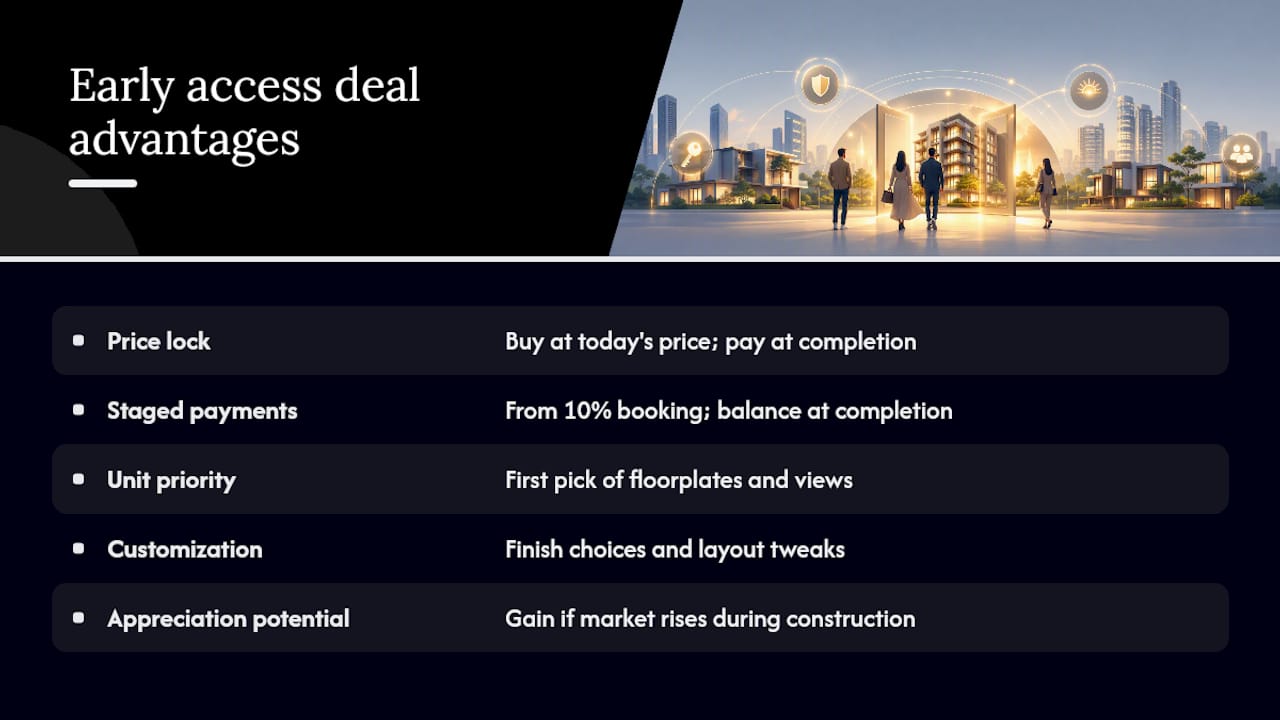
Price lock. You buy at today’s price and pay the balance at tomorrow’s completion. If the market rises during the build, you capture that gain without having deployed the full purchase price on day one.
Priority unit selection. Early buyers access the best floorplates and views that never reach the public resale market. That first-pick premium matters for owner-occupiers who want a corner unit or high floor, and for investors targeting higher rental demand or resale value.

Customization. Many developers allow finish selections, layout tweaks, and upgrade packages during the pre-construction window. Once a building is framed, those options close permanently.
In some structures, staged payment entry begins with as little as a 10% booking fee, with larger balances due at completion, which delays mortgage interest until after handover.
New construction warranties. Modern building codes, energy efficiency standards, and builder warranties on structural elements are built in. You are not inheriting someone else’s deferred maintenance.
Pro Tip: Before estimating your upside, check comparable completed units in the same submarket. If finished units are already trading at a premium to your contract price, your built-in equity is real. If they are not, the appreciation thesis depends entirely on market movement during construction.
Developers offer early-buyer incentives including price discounts, complimentary interior upgrades, flexible payment plans, and coverage of some closing costs to attract early investment and secure construction financing. These incentives are not marketing noise. They translate directly into net cost reduction.
Common incentives and their practical value:
That is not a rounding error.
Pre-construction purchases carry legal risks: delays, cancellations, and contract clauses that allow developers to change layouts or finishes. A real estate attorney should review every contract before you sign.
Core risks and their mitigations:
Successful off-plan investors also maintain financial buffers and plan for hold or rental strategies if market conditions soften during construction. A commonly suggested buffer is targeting a discount to projected market value at launch, which provides downside protection if appreciation does not materialize.
Pro Tip: Before signing, pull the developer’s certificate of occupancy history on prior projects. A developer who has delivered three buildings on time and on spec is a fundamentally different counterparty than one with no completed track record.
The process for accessing pre-market inventory follows a clear sequence:
A specialist brokerage like Yigal Realty sources quiet launches, negotiates extras, and protects buyer interests through each stage. For buyers who want a practical guide to the full purchase process, that resource covers deposit protections and due diligence in detail.
Pro Tip: Lock a unit in the first sales phase when the developer needs momentum and incentives are richest. Waiting for “more certainty” usually means paying public pricing for whatever units are left.
Most U.S. pre-construction purchases follow a 12–36 month cycle from reservation to handover. A representative payment schedule looks like this:
Delays of 3–6 months are common on larger projects. Budget for carry costs during that window: property taxes on the land, builder’s risk insurance, and any interim financing you are carrying.
Pro Tip: Ask your lender at pre-approval whether their construction-to-permanent product locks the rate at application or at conversion. A rate lock that expires before handover can cost you more than the developer incentives you negotiated. For more on property financing structures, Yigal Realty’s guide covers the key variables.
Group your due diligence into five areas:
Developer track record
Escrow and deposit protection
Specification and contract terms
Financing and completion
Assignment and resale
Pro Tip: The single question that most reliably exposes developer risk: “Can you show me the construction lender’s commitment letter and the current draw schedule?” A developer who hesitates on that question is telling you something.
The buyers who do best in pre-construction are not necessarily the most aggressive. They are the most prepared.
The situations where I would pause: a developer with no completed projects, a contract with no attached specification schedule, a market where comparable finished units are already trading below the pre-construction ask, or a buyer whose financing depends on a rate environment that may not exist at handover. The benefits of buying off-plan are real, but they require the right conditions to materialize.
Experienced investors sometimes use staged payments as a form of leverage, planning an assignment of the contract once a portion of the purchase price is paid, capturing appreciation before handover without ever taking title. That strategy works in rising markets with developer consent. In flat or declining markets, it leaves you holding a contract on a depreciating asset with no easy exit.
Buyers who find pre-construction deals on their own typically arrive after the best units are already reserved. Yigal Realty sources exclusive early-access launches before they reach public platforms, negotiates developer incentives on your behalf, coordinates attorney review and escrow setup, and monitors milestone payments through to handover. You get the unit selection, the pricing, and the protections, without spending months tracking developer pipelines yourself.
One recent buyer secured a corner unit with a complimentary kitchen upgrade and full closing-cost coverage in the first sales phase, before the project was publicly listed. That combination of priority access and negotiated incentives is what a specialist brokerage makes possible.
To see current exclusive launches or request an early-access consultation, contact Yigal Realty directly.
This article is general information, not a substitute for advice from a qualified financial advisor. Consult a qualified financial professional about your own circumstances before acting on anything here.