%20(4).png)
![[background image] image of cityscape background (for an architect firm)](https://cdn.prod.website-files.com/68961ade6feff9cbdffc080d/69384e066e0e9a310b6817f8_061f6bac-48bf-44b8-a689-078dacd8009f.avif)
TL;DR:
- Buying property in Israel without proper due diligence risks unforeseen legal, physical, and financial issues that may undermine your investment. This process involves verifying ownership, structural conditions, financial records, and regulatory compliance within a designated review period, which varies between residential and commercial properties. Conducting comprehensive due diligence, with professional assistance, ensures informed decisions, mitigates risks, and is essential for successful Israeli real estate investment.
Buying property in Israel without doing proper due diligence is like signing a contract before reading it. Property due diligence is the structured process of verifying every legal, physical, and financial fact about a property before you commit your money. For families and individuals investing in the Israeli market, especially from abroad, this process carries even more weight because local regulations, land ownership laws, and building codes carry serious consequences if misunderstood. This article breaks down exactly what due diligence covers, how it works, and what you need to do to protect your investment.
| Point | Details |
|---|---|
| Due diligence protects your investment | Verifying legal, physical, and financial facts before closing prevents costly surprises after purchase. |
| Timing matters in the process | The due diligence period in Israeli real estate typically runs 7 to 60 days depending on property type. |
| Documents are the foundation | Ownership records, zoning permits, and financial statements must all be reviewed and verified independently. |
| Professionals are non-negotiable | Lawyers, inspectors, and appraisers each cover separate areas that no single person can handle alone. |
| Findings shape your next move | What you discover during due diligence may lead to renegotiation, repair requests, or walking away entirely. |
The definition of due diligence in real estate is straightforward: it is a fact-finding process that buyers conduct after signing a purchase agreement but before the deal closes. You are not just hoping the property is what the seller claims. You are verifying it.
Think of it this way. Due diligence tests seller’s claims after the contract is signed, while earlier underwriting only projected potential returns. The difference is significant. Underwriting is optimism. Due diligence is proof.
The scope of what is due diligence in real estate covers four broad areas:
One distinction worth knowing: a property appraisal tells you what a property is worth according to market comparables. Due diligence is a comprehensive fact-finding exercise covering financial, physical, legal, environmental, and market realities together. An appraisal is one input. Due diligence is the full picture.
Pro Tip: Never skip the legal title check in Israel. The land registration system includes multiple ownership categories, and an encumbrance you missed before closing becomes your problem after it.
The due diligence period in real estate is the window of time, formally agreed upon in the contract, during which you have the right to investigate the property and potentially exit the deal based on your findings.
In residential real estate, due diligence periods typically run 7 to 14 days, with some markets allowing up to 21 days. Commercial transactions tend to run much longer. Standard commercial due diligence periods range from 30 to 60 days, and complex assets may require 90 or more days to investigate properly.
Israeli real estate norms differ somewhat from the US market, but the principle is identical. Your contract should specify a clear start and end date for the due diligence window. This is where many buyers lose valuable time. Buyers who fail to define a clear start date in their Letter of Intent often waste a significant portion of their investigation window in unnecessary back-and-forth.
Here is a practical sequence to manage your time effectively during the due diligence period:
Pro Tip: In Israeli real estate transactions, the notarial period can overlap with due diligence. Confirm with your attorney which deadlines are legally binding and which are conventional, so you know exactly where flexibility exists.
A structured due diligence process in real estate does not happen by chance. It requires a deliberate sequence of requests, reviews, and professional engagements. Here is how to approach it.
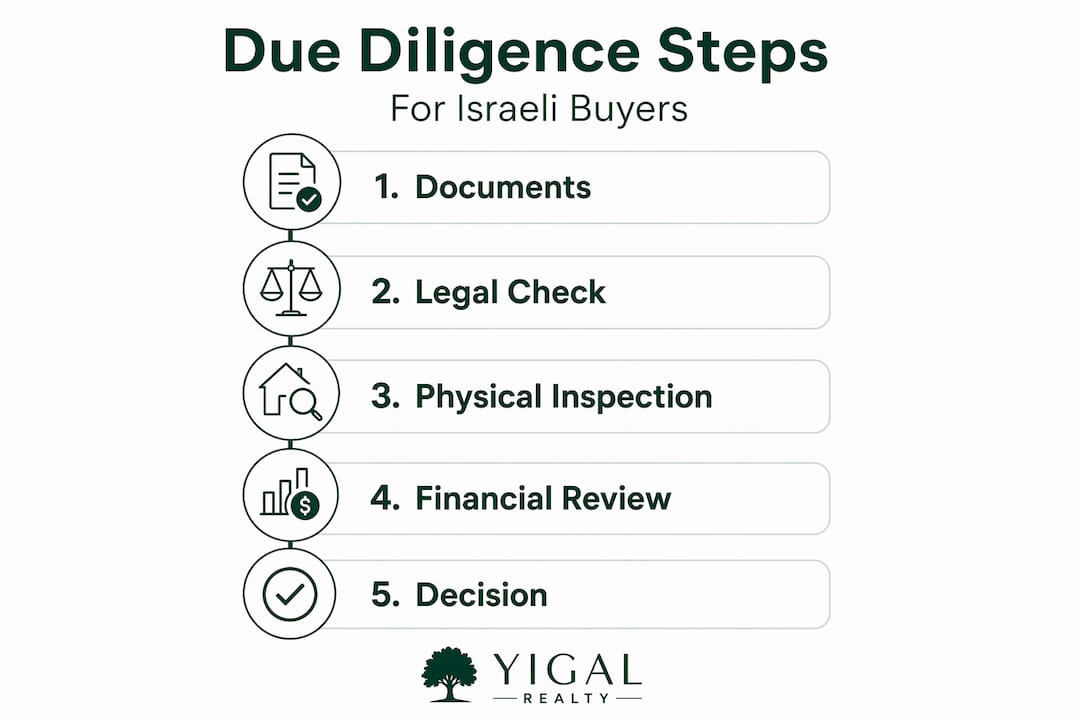
What are due diligence documents in real estate? They include title deeds, zoning certificates, building permits, tax payment records, utility bills, homeowner association agreements, any existing mortgages or liens, and, for investment properties, rent rolls and lease agreements.

Document organization during real estate due diligence is one area where buyers consistently lose time. Create a shared folder immediately. Categorize documents by type: legal, financial, physical, and regulatory. This keeps your team of professionals on the same page and prevents delays. For Israeli buyers, the essential property documents to request include the Nesach Tabu (title extract), the building permit, and the occupancy certificate.
A standard home inspection covers visible systems and structures. For investment-grade decisions, a Property Condition Assessment (PCA) goes further. PCAs follow the ASTM E2018 framework and provide detailed reports on deferred maintenance costs and the remaining useful life of major building systems.
Do not rely solely on what the seller tells you about the property’s condition. Seller maintenance records are often incomplete or misleading. An independent inspector gives you numbers you can actually budget around.
Here is a summary table of professionals involved and their specific roles:
| Professional | Role in due diligence | What they uncover |
|---|---|---|
| Real estate lawyer | Legal title review, contract analysis | Liens, encumbrances, zoning violations |
| Building inspector | Physical condition assessment | Structural issues, system failures, code violations |
| Appraiser | Market valuation | Whether the asking price reflects market reality |
| Certified accountant | Financial document review | Income verification, expense accuracy |
| Realtor/buyer’s agent | Market and context guidance | Neighborhood trends, comparable sales, deal norms |
The role of lawyers in real estate transactions in Israel goes beyond drafting contracts. Your attorney should be actively reviewing the Tabu extract, checking for any pending legal proceedings against the property, and confirming that all permits are in order before you close.
Key documents to request from the seller before due diligence begins:
Collecting due diligence information is only half the job. The real work is deciding what it means for your investment decision.
Think of your findings in three categories:
Here is a comparison of typical outcomes based on what buyers discover:
| Finding | Recommended action | Possible outcome |
|---|---|---|
| Undisclosed lien on title | Request lien removal before closing | Seller pays off lien or deal falls through |
| Building addition without permit | Request permit legalization or price reduction | Negotiate credit or exit if legalization is not possible |
| Roof at end of useful life | Request repair credit or price reduction | Adjusted purchase price covering replacement cost |
| Income overstated by seller | Renegotiate based on verified actuals | Lower price or modified terms |
| Clean findings across all areas | Proceed to closing with confidence | Smooth transaction |
When findings support renegotiation, come with specifics. A contractor’s estimate for the roof replacement, or your inspector’s report quantifying deferred maintenance, is far more persuasive than a general concern. Numbers drive negotiations.
If you need to exit the deal within the due diligence period in real estate, your contract should specify the mechanism for doing so. In most Israeli residential transactions, the terms for withdrawal and any financial consequences are written into the purchase agreement. Know those terms before the period begins, not after.
I have watched buyers at every experience level approach Israeli real estate, and the pattern is consistent. The ones who get burned are almost never the ones who paid too much. They are the ones who skipped the legal check, trusted the seller’s word on permits, or assumed a quick walkthrough counted as proper inspection.
What I’ve learned working with buyers in the Israeli market is that the legal layer here is genuinely different from most Western markets. Land categories, building rights, and municipal planning approvals interact in ways that can make a perfectly attractive apartment a financial liability if the permits are not clean. That reality does not make Israel a difficult place to invest. It makes thorough legal due diligence a hard requirement, not an optional step.
The other thing I’d say directly: do not let time pressure skip this process. Sellers and developers sometimes create urgency. A good property will still be a good property after your lawyer reviews the Tabu extract. If a seller is genuinely reluctant to provide documents for standard review, that tells you something important about the deal.
From everything I’ve seen, the buyers who invest confidently and hold their properties well are the ones who took the due diligence process seriously from day one. They did not just sign and hope. They verified, questioned, and made decisions based on facts.
— Spiros
Understanding due diligence is step one. Executing it correctly in the Israeli market, with the right professionals and local knowledge, is where most buyers need genuine support. Yigal-realty works directly with families and individuals investing in Beit Shemesh and surrounding communities, providing guidance throughout the property due diligence process from document requests through legal review. The team connects buyers with trusted local attorneys, inspectors, and agents who know the specific demands of Israeli real estate. Whether you are purchasing your first apartment in Israel or expanding an existing portfolio, explore Yigal-realty’s resources and current property listings to start your search with confidence and proper support.
Property due diligence is the process of independently verifying the legal, physical, and financial facts about a property before completing a purchase. It protects buyers from undisclosed problems, title defects, and inflated seller claims.
The due diligence period is the contractually agreed window during which a buyer investigates a property and can exit the deal based on findings. Residential periods commonly run 7 to 14 days; commercial transactions often require 30 to 60 days or more.
Due diligence documents include title deeds, building permits, occupancy certificates, tax records, existing mortgage documentation, and for investment properties, lease agreements and verified income statements.
An appraisal determines market value using comparable sales. Due diligence covers a broader scope including legal title, physical condition, financial accuracy, and regulatory compliance. They serve different purposes and should both be completed.
Yes. If your contract includes a due diligence contingency, you can typically withdraw within the specified period based on your findings. The exact mechanism and any financial consequences depend on the specific terms written into your purchase agreement.