%20(4).png)
![[background image] image of cityscape background (for an architect firm)](https://cdn.prod.website-files.com/68961ade6feff9cbdffc080d/69384e066e0e9a310b6817f8_061f6bac-48bf-44b8-a689-078dacd8009f.avif)
TL;DR:
- Ownership models in kibbutzim vary from private titles to membership shares and leases, affecting rights and obligations. Confirming the legal status before any purchase ensures proper financing, resale, and community integration. Local specialists and thorough due diligence are essential for navigating these unique communal property arrangements.
A kibbutz community is an Israeli communal settlement where residents share governance, amenities, and often economic life — but whether you can buy private title, a membership share, or only a lease-like arrangement depends entirely on the specific kibbutz. That single distinction shapes your financing options, resale rights, and daily obligations as a resident. Before you fall in love with a property, confirm the ownership model. A specialist broker and a local attorney are not optional here.
The word kibbutz (plural: kibbutzim) means “gathering” in Hebrew. The first kibbutz, Degania, was founded in 1910 by a small group of Zionist pioneers who combined collective farming with equal pay, democratic management, and shared ownership of all assets. By 1921, Degania’s members had formally abolished private property. That founding model spread quickly, and by the 1920s dozens of communal groups had settled on land owned by the World Zionist Organization.
The classic kibbutz, as Britannica describes it, held all wealth in common: communal dining halls, children educated and cared for collectively, and weekly general assemblies where every member had an equal vote on policy and elected administrators. It was simultaneously a farm, a school, a social safety net, and a direct democracy.
Key features of the original model:
Today there are roughly 265–270 kibbutzim across Israel, most with populations under 1,000 residents.
Starting in the late 1990s, kibbutzim began shifting away from equal income sharing toward market-based wages. That labor reform triggered a broader transformation: housing was privatized, communal dining halls closed in many communities, and individual households gained more autonomy. The Israeli government formally recognized this split by classifying kibbutzim into three legal types:
Most kibbutzim today function as small towns that have diversified into industry, tourism, and services well beyond farming. Privatization, though, is not uniform. Some kibbutzim privatized income and housing while keeping democratic governance structures intact, which creates a hybrid: you may own your unit outright but still need community approval to renovate or rent it to an outsider.
Pro Tip: Don’t assume “privatized” means fully private. A renewed kibbutz may still require a membership vote to approve new residents or restrict short-term rentals. Read the bylaws before you make an offer.

Daily life in a modern kibbutz varies more than most buyers expect. Some communities still run a communal dining hall a few nights a week; others have converted it into a community center or event space. Shared green spaces, playgrounds, and walking paths are common. Local schools, synagogues, and religious accommodations for observant families exist in many kibbutzim, though the level of religious observance varies significantly by community.
Housing models you are likely to encounter:
Academic case studies document how privatization physically reshaped kibbutzim: communal zones shrank, private lots expanded, and new neighborhoods emerged with different ownership rules than the original housing clusters. Inspect the master plan and ask for recent general assembly minutes to understand how the community plans future development.
For observant buyers specifically, proximity to a synagogue, eruv status, and Shabbat-accessible amenities matter as much as the property itself. Confirm these details directly with the kibbutz office before scheduling a serious viewing.
The most important early question is legal status: are you buying private title, a membership share, or a long-term lease? That single clarification determines your mortgage eligibility with both Israeli and U.S.-based lenders, your resale rights, and what happens if the kibbutz changes its rules.
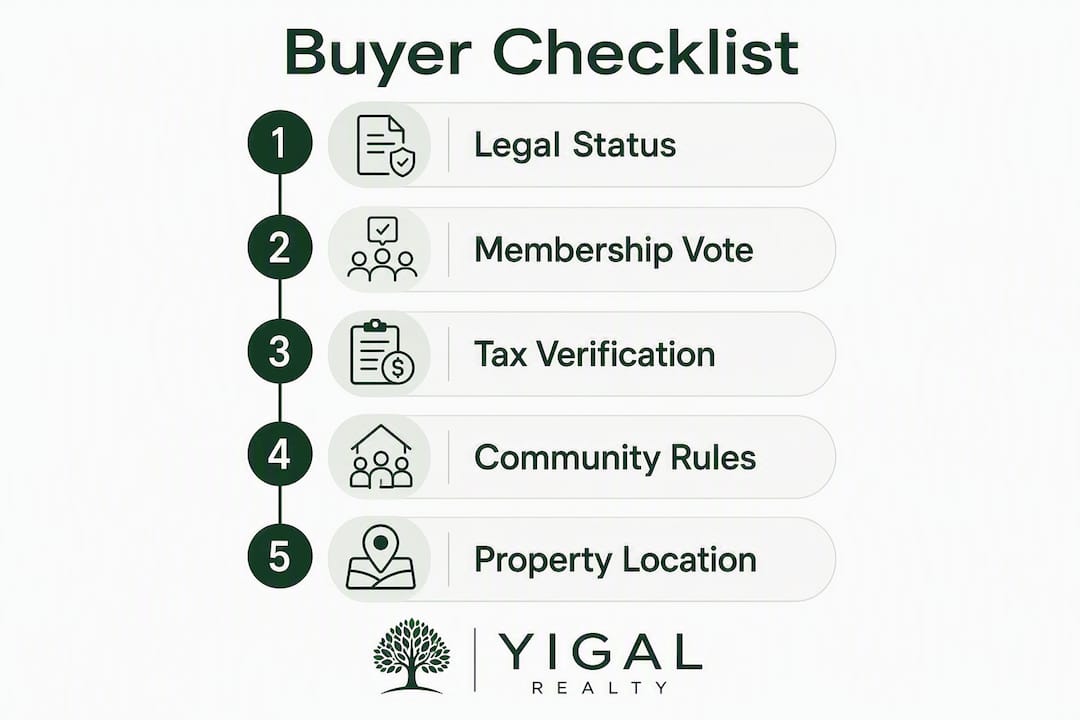
Documents to request from the kibbutz:
| Document | Why It Matters |
|---|---|
| Title deed or land lease agreement | Confirms ownership type and land authority terms |
| Kibbutz bylaws and charter | Sets out membership rules, resale restrictions, rental policies |
| General assembly minutes (last 2–3 years) | Reveals pending policy changes and housing decisions |
| Recent financial statements or annual budget | Shows community financial health and fee obligations |
| Membership agreement or share purchase contract | Defines your rights and obligations as a member |
| Municipal tax and utility obligations | Clarifies ongoing costs beyond the purchase price |
Numbered buying timeline (estimated ranges):
Some kibbutzim have formal absorption programs for newcomers; others do not. Ask the Kibbutz Movement or the individual kibbutz directly whether an absorption track exists, and whether it includes school placement support.
Pro Tip: Verify whether purchase taxes or VAT apply to your transaction as a foreign buyer. Home purchase costs in Beit Shemesh vary by buyer category, and the rates for non-residents differ from those for Israeli citizens. Confirm with a licensed Israeli attorney before signing anything.
Also check: proximity to schools and religious services, public transport connections to Beit Shemesh and Jerusalem, and the kibbutz’s primary employment base. Treat it like evaluating a small municipality, because that is effectively what it is.
A broker who knows kibbutz communities does more than find listings. They verify the ownership model before you spend time on a property, request community documents on your behalf, and facilitate introductions with kibbutz committees. For observant buyers, they can confirm eruv status, school placement paths, and whether the community’s religious character matches your family’s needs.
Steps to expect when engaging a specialist:
Before your first broker call, prepare a written buyer profile, proof of financing or pre-approval, and a prioritized list of must-have amenities. That preparation cuts weeks off the approval timeline. For a full step-by-step framework, the guide for observant buyers covers the Israeli purchase process in detail.
A kibbutz community today is not a single model: ownership rights, governance rules, and daily life vary by community type, and confirming legal title early is the single most consequential step for any U.S. buyer.
| Point | Details |
|---|---|
| Ownership type varies widely | Confirm private title, membership share, or lease before any other due diligence step. |
| Three legal kibbutz types exist | Collective, renewed, and urban kibbutzim each carry different property rights and community obligations. |
| Absorption programs differ | Ask directly whether the kibbutz has a formal newcomer program — it affects school placement and approval timelines. |
| Treat it like a small municipality | Evaluate local employment, schools, religious services, and transport as you would for any small town. |
| Yigal-realty specializes here | Yigal-realty works with observant buyers in Beit Shemesh and surrounding areas, handling document review, kibbutz introductions, and closing support. |
The buyers who run into trouble are almost always the ones who fell for a property before asking the governance question. A renewed kibbutz can look and feel like a private neighborhood, complete with detached homes and manicured streets, right up until the general assembly votes to restrict outside rentals or require a waiting period for new members. That is not a hypothetical. It is a documented pattern in communities that privatized housing but kept democratic governance intact.
The other underestimated factor is social composition. Fieldwork on kibbutz privatization identifies distinct groups within these communities: longtime veterans, returning adult children, and urban newcomers. Each group has different stakes in property decisions and different cultural expectations. Knowing which group currently dominates local governance tells you a lot about how flexible the community will be with a foreign buyer.
For observant families, the religious character question is equally concrete. An urban kibbutz like Tamuz in Beit Shemesh operates in a secular framework inside a city. A rural renewed kibbutz near Jerusalem may have a synagogue but no eruv, or an eruv but no daily minyan. These are not details to discover after you have signed a reservation agreement.
Buying near or within a kibbutz community in the Beit Shemesh area means navigating ownership models, community approvals, and religious-community specifics that most general brokerages simply do not track. Yigal-realty focuses specifically on observant buyers and investors in Beit Shemesh and surrounding neighborhoods, with direct experience in new developments, off-market listings, and community introductions that speed up the approval process.
Services include document review coordination, introductions to kibbutz committees, referrals to Israeli legal counsel, and transparent fee explanations from day one. Early-access listings in religious community neighborhoods are available to buyers who engage before public launch.
Bring your buyer profile, financing documentation, and the document checklist from this article to your first consultation. Contact Yigal-realty to schedule a targeted property review and get matched with listings that fit your community and ownership requirements.
This article is general information, not legal or financial advice. Confirm current rules, tax rates, and ownership terms with a licensed Israeli attorney and the relevant primary sources for your specific situation.