%20(4).png)
![[background image] image of cityscape background (for an architect firm)](https://cdn.prod.website-files.com/68961ade6feff9cbdffc080d/69384e066e0e9a310b6817f8_061f6bac-48bf-44b8-a689-078dacd8009f.avif)
TL;DR:
- Property handover in Israel is a formal process focusing on inspections, documents, and legal rights.
- Buyers must thoroughly inspect their property, document defects, and understand delay compensation rights.
- Proper preparation and documentation ensure legal protections and leverage in case of delays or defects.
Getting your keys feels like the finish line. But for buyers purchasing property in Israel, especially in growing observant communities like Beit Shemesh, receiving those keys is actually just the start of a critical phase that most people underestimate. Property handover involves formal inspections, legal documents, statutory rights, and timelines that can make or break your investment. Miss a defect, skip a document, or misread a delay clause, and you could lose thousands of shekels in compensation you were legally owed. This article breaks down exactly what happens at handover, what you need to check, and how to protect yourself every step of the way.
| Point | Details |
|---|---|
| Handover is not final ownership | Receiving your keys marks possession, but legal ownership via Tabu registration may happen months or years later. |
| Inspect thoroughly before signing | Careful inspection—ideally by an engineer—can uncover issues and save you major repair costs. |
| Understand your compensation rights | If handover is delayed beyond 60 days, Israeli law entitles you to significant rent-based compensation. |
| Document defect findings | Keep detailed records of any flaws and communications, as these guide post-handover repairs and legal claims. |
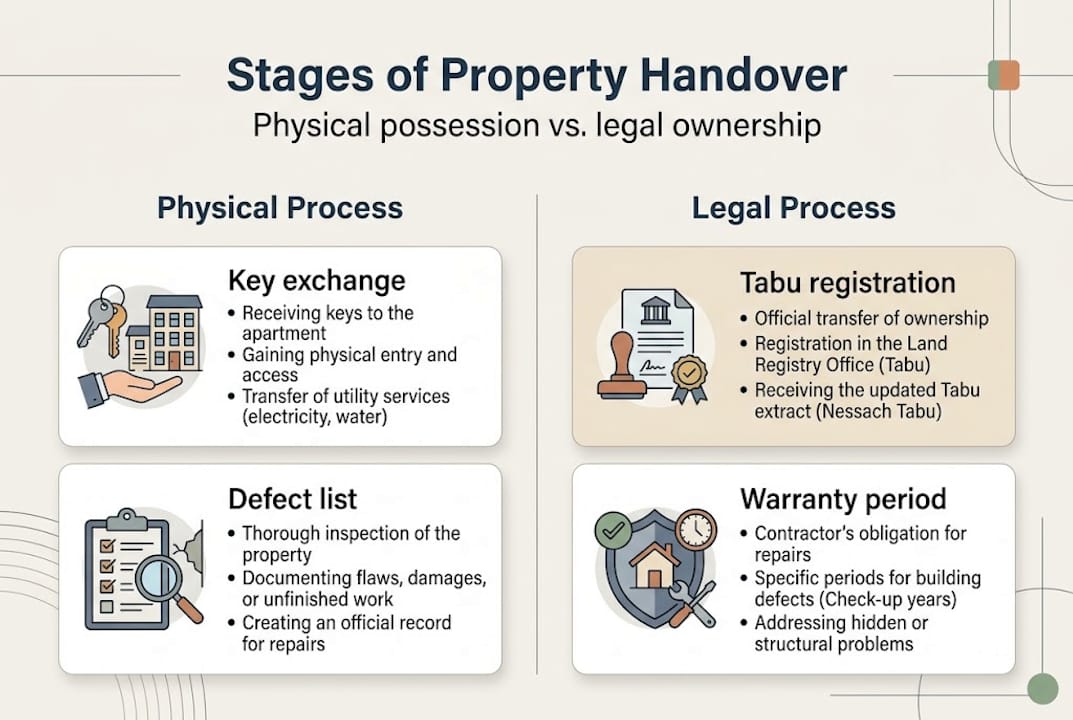
Property handover, known in Hebrew as “mesirat hador,” is the formal moment when a developer transfers physical possession of your apartment to you. This is different from full legal ownership. Many buyers confuse the two, and that confusion is costly.
When you receive your keys, you gain the right to occupy the property. But Tabu registration, which is the formal transfer of legal title in Israel’s land registry, typically happens months or even years after handover. This is especially common with off-plan purchases in rapidly developing areas like Ramat Beit Shemesh, where entire neighborhoods are still being registered with the land authority while residents are already living in their homes.
Understanding this distinction protects you on two fronts. First, it clarifies your rights during any dispute. Second, it tells you exactly when your warranty clock starts ticking, because many defect and repair deadlines are tied to the handover date, not the Tabu registration date.
Who is typically involved in a property handover?
For overseas buyers or new olim purchasing in Beit Shemesh from abroad, the process adds another layer. You may not be physically present, which means a local representative holding your power of attorney steps in. This is completely legal and very common, but it requires careful preparation in advance.
Why timing matters more than most buyers realize
The handover date triggers several financial and legal events simultaneously. Your mortgage obligations often begin at or near this date. Your right to inspect the property for defects is exercised at this moment. Your statutory warranty period starts. And if the developer hands over the property late, your right to compensation depends on how precisely that delay is documented.
“For buyers in observant communities investing in new developments like those in Ramat Beit Shemesh, the gap between receiving your keys and completing Tabu registration can span one to three years. Understanding this timeline upfront prevents legal and financial surprises.”
To understand the full context of property buying guide for observant buyers, it helps to see handover not as a single event but as a structured process with defined rights at each stage.
Knowing what happens and in what order turns handover day from a stressful experience into a manageable checklist. Here is how the process typically unfolds for buyers in Israel.
Receive the Tofes Arba (Form 4). This is the municipal occupancy permit. Without it, the developer cannot legally hand over the property. It confirms that the building passed government inspections and is safe to inhabit. No Tofes Arba means no valid handover, and you should not accept keys without it.
Schedule a professional inspection. Before or on handover day, hire a licensed engineer to walk through the apartment with you. This person checks structural integrity, systems, and finishes. Their report becomes your legal documentation for any repair demands.
Review the delivery protocol. This document, signed by both you and the developer, officially records the condition of the property at handover. List every defect you observe. If it is not in writing, it did not happen. Signing a clean protocol when defects exist weakens your legal position significantly.
Confirm building insurance. The developer is required to hold insurance on the structure during construction. At handover, responsibility begins shifting to the building committee (vaad bayit) and to you personally for your unit’s contents.
Complete the handover signature and receive keys. Once your engineer’s report is reviewed, defects are documented, and the delivery protocol is signed, you receive your keys. This is the official handover date for all future legal calculations.
Overseas buyer step: set up power of attorney in advance. If you cannot be present, a step-by-step home purchase process through a licensed attorney ensures your authorized representative can sign on your behalf. This document must be notarized and apostilled if signed outside Israel.
Pro Tip: Never sign the delivery protocol under pressure or time constraints. Developers sometimes schedule handovers at end-of-quarter dates to meet internal targets. Take your time, bring your engineer, and document everything in writing before your pen touches that form. For tips for observant buyers in Beit Shemesh specifically, working with a local attorney who understands community-specific developments adds another layer of protection.
The delivery protocol is your most powerful document. Think of it as your before-and-after snapshot. Anything not recorded there becomes much harder to claim later.
A walkthrough without a checklist is just a tour. You need a structured approach to catch issues that are easy to miss but expensive to fix after you have signed.
Core areas to inspect:
| Area inspected | Common defect | Estimated repair cost (ILS) |
|---|---|---|
| Silicone seals (bathroom/kitchen) | Gaps, mold growth | 500 to 1,500 |
| Balcony drainage | Pooling, cracks | 2,000 to 6,000 |
| Electrical panel labeling | Unlabeled circuits | 800 to 2,000 |
| Door/window sealing | Air gaps, sticking | 1,000 to 3,500 |
| Floor tiles | Hollow tiles, cracks | 3,000 to 10,000 |
| AC drainage | Leaking into ceiling | 1,500 to 4,000 |
Pro Tip: Photograph every defect with a timestamp. Use a separate folder for handover day photos versus later photos. This timestamp protection is critical if a dispute arises six months down the road about when a defect first appeared.

The “bedek” period in Israel gives buyers a defined window after handover to report defects with the burden of proof on the developer, not on you. But that protection only applies to defects you can prove existed at handover. The first-time buyer checklist and advice from expert homebuyer guidance resources both emphasize this same point: document first, negotiate second.
Handover delays are common in Israel’s construction market. Understanding your rights before a delay happens puts you in a much stronger position to act quickly and effectively.
When does a delay officially begin?
A delay is counted from the contractually agreed handover date. Developers are allowed a 60-day grace period after that date before statutory compensation kicks in. This grace period is standard in Israeli purchase contracts and is not negotiable. After those 60 days, the compensation clock starts automatically.
What compensation are you entitled to?
Under Israeli law, delayed handover compensation is calculated at 150% of the equivalent monthly rent for a comparable apartment in the same area for the first 8 months of delay. After 8 months, the rate drops to 125% per month. For example, if a comparable apartment in your neighborhood rents for 5,000 ILS per month, your compensation for month one of delay would be 7,500 ILS. Over eight months, that adds up to 60,000 ILS before the rate adjustment.
“Israeli courts have consistently upheld buyer compensation rights in delay cases, even when developers cited labor shortages, material delays, or administrative backlogs. Force majeure claims by developers face significant scrutiny and are rarely accepted without extraordinary evidence.”
The force majeure question
Developers frequently cite force majeure (unforeseeable events beyond their control) to avoid paying compensation. Courts examine these claims strictly. War-related delays may qualify under specific circumstances, but supply chain issues, permit delays, or contractor disputes typically do not. Always consult your attorney if a developer raises this defense.
| Stage | Buyer’s rights | Burden of proof |
|---|---|---|
| Pre-handover | Document defects in protocol | Shared |
| Bedek period (post-handover) | Developer strictly liable for defects | On the developer |
| Warranty period (after bedek) | Buyer can claim, but must prove cause | On the buyer |
| Delay beyond 60 days | Automatic compensation at 150% then 125% | Law is automatic |
The bedek and warranty periods explained simply
The bedek period is a strict liability window. If a defect appears during this time, the developer must fix it without you needing to prove how it happened. The warranty period that follows is different: you retain rights, but now you must demonstrate that the defect was caused by construction failure rather than your own use. This is why thorough handover documentation is your most valuable long-term asset. Review property tips for families to understand how these protections apply specifically to larger units and family homes in Beit Shemesh.
Most buyers walk into handover thinking the hard part is over. In reality, the hard part is just changing form. The paperwork phase ends and the documentation and negotiation phase begins.
Here is what we have seen repeatedly: buyers who treat handover as a celebration rather than a business meeting end up paying for defects out of pocket that they were legally entitled to have fixed for free. The Israeli legal framework is genuinely protective of buyers. Nationwide off-plan delays are common, and courts do uphold compensation rights consistently. The system works. But only if you use it correctly.
The hidden advantage for buyers in observant communities is that developers building in high-demand areas like Ramat Beit Shemesh have strong reputations to protect. A documented dispute that goes to arbitration is not something they want publicized. That gives you real negotiating leverage when you show up prepared, with a professional engineer’s report and timestamped photos.
Our advice: treat every communication with your developer as a legal record. Use email, not just phone calls. Reference document numbers. Keep a folder. And if something feels wrong about the condition of your apartment on handover day, trust that instinct and do not sign until it is resolved or formally documented. Explore the real estate assessment guide to sharpen your evaluation skills before that day arrives.
Navigating property handover in Israel requires local knowledge, legal awareness, and practical experience that goes beyond any single checklist. At Yigal Realty, we specialize in helping observant buyers and investors purchase and receive properties in Beit Shemesh and Ramat Beit Shemesh with full confidence. From your first inquiry through inspection day and beyond, our team provides personalized guidance, community-specific insights, and connections to trusted engineers and attorneys. Whether you are purchasing from abroad or relocating locally, we help you arrive at handover prepared. Visit info.yigal-realty.com to explore current projects and connect with our advisors today.
Defects discovered after handover are covered first by the bedek period, during which the developer is strictly liable for repairs, then by a warranty period where the buyer must demonstrate that the defect stems from a construction fault.
Overseas buyers can authorize a local representative through a notarized and apostilled power of attorney to complete the handover process on their behalf, including signing the delivery protocol and receiving keys.
No. Handover transfers physical possession, while Tabu registration transfers legal ownership in the land registry and typically occurs months or years later, especially in new developments.
After a 60-day grace period, buyers are entitled to 150% of comparable rent for each month of delay during the first 8 months, and 125% per month for any delay beyond that period.