%20(4).png)
![[background image] image of cityscape background (for an architect firm)](https://cdn.prod.website-files.com/68961ade6feff9cbdffc080d/69384e066e0e9a310b6817f8_061f6bac-48bf-44b8-a689-078dacd8009f.avif)
TL;DR:
- Buying a home in Israel involves a complex process with unique legal, financial, and market differences for aliyah newcomers. Preparing an accurate full budget, understanding mortgage pre-approval, and defining the property’s purpose are essential before starting the search. Legal steps include hiring an independent lawyer and never signing preliminary agreements without legal review to avoid costly mistakes.
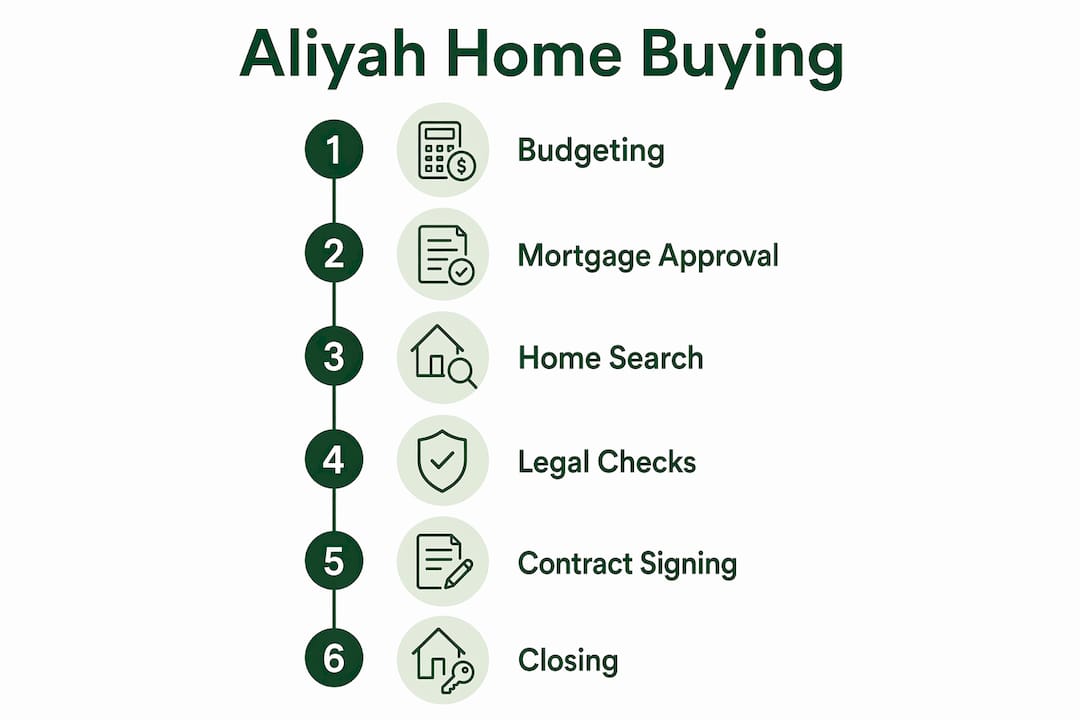
Step by step aliyah home buying is a structured process that takes newcomers through budgeting, property search, legal due diligence, financing, and closing in a market that operates very differently from the United States. Israel has no centralized MLS, uses a unique preliminary agreement system, and applies a sliding-scale purchase tax that directly affects your total cost. Families making aliyah who understand these differences before they start save significant time, money, and stress. This guide covers every stage in sequence, with specific tools, legal warnings, and practical tips drawn from real experience in the Israeli market.
Preparation is the stage most aliyah buyers underestimate. Skipping it leads to budget overruns, financing delays, and missed opportunities in a fast-moving market.

Your purchase price is only one part of the total cost. Add legal fees of 0.5%–1.5% of the purchase price, purchase tax (mas rechisha), agent commissions around 2% plus VAT, renovation costs, and moving expenses. A realistic budget for a 2,000,000 NIS apartment in Beit Shemesh could carry an additional 150,000–250,000 NIS in transaction costs before you move in. Build that buffer before you start viewing properties.
Israeli banks require income verification, tax returns, and bank statements for mortgage approval. New olim often face additional scrutiny because their Israeli income history is short or nonexistent. Getting a pre-approval letter from Bank Hapoalim, Bank Leumi, or Mizrahi Tefahot before you search tells sellers you are a serious buyer and sets a firm ceiling on what you can spend.
Buying a primary residence and buying an investment property trigger different tax rules, financing limits, and search criteria. Olim purchasing a primary residence qualify for purchase tax reductions. Defining your purpose upfront also shapes which neighborhoods you target and whether proximity to schools, synagogues, or public transit matters most.
Pro Tip: Currency exchange rates can shift your purchasing power by tens of thousands of dollars. Use a specialist like OFX or Wise to lock in rates when converting dollars or euros to shekels, rather than relying on your bank’s default rate.
Israel’s property search process requires more active effort than most buyers expect. There is no centralized MLS or Zillow-style database. Listings are fragmented across platforms, agents, and private sellers.
A buyer’s agent works for you, not the seller. This distinction matters enormously in Israel, where most agents represent the seller’s interest. A good buyer’s agent accesses a wider range of properties, negotiates on your behalf, and helps you avoid overpaying. You can read more about working with Israeli agents before committing to one.
Terms like “renovated,” “cozy,” and “great potential” often signal minimal updates, a small floor plan, or expensive structural work ahead. Budget for the worst case when a listing uses vague positive language. Visit every property at least twice, at different times of day, and walk the neighborhood on a weekday morning to assess noise, parking, and foot traffic.
Pro Tip: Market dynamics fluctuate significantly by neighborhood, not just by city. A street-level price difference of 10%–15% between two adjacent blocks is common in Israeli cities. Research at the micro level, not just the city level.
Legal due diligence is where aliyah buyers are most vulnerable. The Israeli legal system has specific documents and procedures that have no direct American equivalent. Getting them wrong is expensive.
Your lawyer must be independent of the seller and the agent. Legal fees run 0.5%–1.5% of the purchase price and cover contract review, Tabu (land registry) searches, permit verification, and deed registration. This is not optional. It is the single most protective step in the entire process.
The zikaron devarim is a preliminary agreement between buyer and seller. It sounds informal. It is not. Signing it without lawyer review legally commits you to the transaction before your due diligence is complete and before your mortgage is approved. Sellers and agents sometimes pressure buyers to sign quickly. Refuse until your lawyer has reviewed every line.
Critical warning: A zikaron devarim is legally binding the moment both parties sign it. If your financing falls through or due diligence reveals a problem after signing, you may lose your deposit and face legal liability. Your lawyer’s review is not a formality. It is your protection.
Your lawyer conducts the following checks before the purchase contract is signed:
For a deeper look at real estate transaction steps in Israel, Yigal-realty’s resource covers each stage in detail.
Once due diligence is clean and your lawyer approves the contract, the transaction moves into its final phase. This stage has the most moving parts and the tightest deadlines.
Full mortgage approval requires your signed purchase contract in addition to the financial documents you submitted for pre-approval. Israeli banks typically approve mortgages within two to four weeks of receiving a complete file. Delays usually come from missing documents, so prepare your file in advance.
| Stage | Key action | Who is responsible |
|---|---|---|
| Mortgage finalization | Submit signed contract and full documentation to bank | Buyer and mortgage broker |
| Contract signing | Sign legally binding purchase agreement with lawyer present | Buyer, seller, and lawyers |
| Deposit payment | Transfer agreed deposit (typically 10%) to escrow | Buyer |
| Purchase tax payment | Pay mas rechisha based on purchase price and oleh status | Buyer, coordinated by lawyer |
| Final balance transfer | Pay remaining balance on closing date | Buyer’s bank |
| Tabu registration | Register deed in land registry | Lawyer |
Purchase tax is calculated on a sliding scale, and new immigrants qualify for significant reductions. The exact benefit depends on the property price and your aliyah date. Your lawyer calculates the exact amount and files the payment with the Israel Tax Authority. Missing the payment deadline triggers penalties, so coordinate this step carefully.
Closing does not mean immediate deed registration. Tabu registration can take weeks or months after the transaction closes. You legally own the property from the closing date, but the official land registry record updates on its own timeline. Your lawyer tracks this process and notifies you when registration is complete.
For a full breakdown of home purchase costs in Beit Shemesh, including taxes and fees specific to that market, Yigal-realty has published a detailed buyers guide.
Successful aliyah home buying requires a trusted legal team, a realistic full budget, and a clear understanding of Israel’s unique market structure before you sign anything.
| Point | Details |
|---|---|
| Budget beyond the purchase price | Add legal fees, purchase tax, agent commissions, and renovation costs to your total budget. |
| Use multiple search platforms | Combine Yad2, Madlan, Facebook groups, and WhatsApp to access the full market. |
| Never sign without your lawyer | The zikaron devarim is legally binding; always have your lawyer review it first. |
| Olim get purchase tax benefits | New immigrants qualify for sliding-scale reductions on mas rechisha that lower total acquisition costs. |
| Tabu registration takes time | Deed registration after closing can take weeks or months; your lawyer monitors this process. |
Most buyers I speak with arrive thinking the hardest part is finding the right apartment. It is not. The hardest part is slowing down when the market pressure tells you to speed up.
Israeli sellers and agents move fast. There is a real culture of urgency around property transactions, and it is not always manufactured. Good apartments in desirable areas do sell quickly. But that urgency is also used as a tool to push buyers into signing before they are ready. I have seen families lose deposits because they signed a zikaron devarim under pressure before their lawyer reviewed it. That mistake is entirely avoidable.
The other thing buyers consistently underestimate is the emotional weight of the process. Buying a home during aliyah is not just a financial transaction. You are building your life in a new country, often in a new language, under real time pressure. That emotional load affects your judgment. Building your professional team, a lawyer, a buyer’s agent, and a mortgage broker, before you start searching gives you a buffer between your emotions and your decisions.
My honest advice: treat your lawyer as your most important hire, not an afterthought. The 0.5%–1.5% legal fee is the best money you will spend in the entire process. Everything else can be negotiated or recovered. A bad contract cannot.
— Spiros
Yigal-realty specializes in residential properties in Beit Shemesh and surrounding communities, with a focus on families making aliyah. The team coordinates every stage of the purchase process, from initial market search and neighborhood guidance to legal coordination and financing support. Yigal-realty’s New York office makes it easy to start the process before you land in Israel. For families who want a trusted partner through every step of buying a home in Israel, visit Yigal-realty’s main site to connect with an agent and explore current listings. You can also review their checklist for US buyers to prepare before your first property visit.
Aliyah home buying is the process of purchasing residential property in Israel as a new immigrant. It follows a specific sequence of budgeting, property search, legal due diligence, mortgage approval, and closing, with unique rules and tax benefits that apply to olim.
Yes. New immigrants qualify for significant reductions on mas rechisha, Israel’s purchase tax, calculated on a sliding scale based on the property price and the buyer’s aliyah date.
The zikaron devarim is legally binding the moment both parties sign it. Signing before your lawyer reviews it and before due diligence is complete can trap you in a transaction with no exit, even if financing falls through.
Tabu registration typically takes weeks to months after the closing date. You legally own the property from closing, but the official land registry record updates on its own schedule.
A buyer’s agent still adds value even when you find a property yourself. Israeli agents typically represent the seller, so having your own agent or at minimum an independent lawyer protects your interests during negotiation and contract review.