%20(4).png)
![[background image] image of cityscape background (for an architect firm)](https://cdn.prod.website-files.com/68961ade6feff9cbdffc080d/69384e066e0e9a310b6817f8_061f6bac-48bf-44b8-a689-078dacd8009f.avif)
TL;DR:
- Aliyah real estate focuses on religious needs, community, and lifestyle rather than just price and location.
- Understanding neighborhood features like eruv boundaries, mikva access, and religious school options is essential.
- Successful aliyah home purchases prioritize community fit and non-negotiables over perfection.
Making aliyah is one of the most meaningful decisions a Jewish family can make. But many people arrive with a surprising misconception: they think finding a home in Israel works roughly the same way it does back in the United States. It does not. Aliyah real estate is its own category entirely, shaped by religious needs, community infrastructure, immigration logistics, and a property market that moves by its own rules. Whether you are a first-time buyer or a seasoned homeowner, understanding what makes this process unique will save you time, money, and a great deal of frustration. This guide walks you through everything you need to know.
| Point | Details |
|---|---|
| Unique focus of aliyah real estate | These properties address the specific needs of new immigrants, including community, religious, and educational priorities. |
| Essential features for observant families | Aliyah-focused properties often include kosher kitchens, proximity to synagogues, and strong support networks. |
| The buying process has key differences | Immigrants must navigate unique legal steps, documentation, and often rely on bilingual professionals. |
| Choosing the right home is about priorities | Balancing affordability, values, and community fit matters most when selecting aliyah real estate. |
The phrase “aliyah real estate” does not appear on most official Israeli government forms. It is not a legal designation. But it describes something very real: a segment of the Israeli property market specifically suited to the needs of new immigrants, particularly those with religious and observant lifestyles.
For most Israelis, buying a home is about price per square meter, commute time, and school districts. For olim (Jewish immigrants to Israel), the checklist looks quite different. Aliyah real estate addresses lifestyle, religious, and community needs in ways that standard Israeli properties simply do not prioritize. You are not just buying walls and a roof. You are buying into a way of life.
Here is what most first-time olim get wrong about this market:
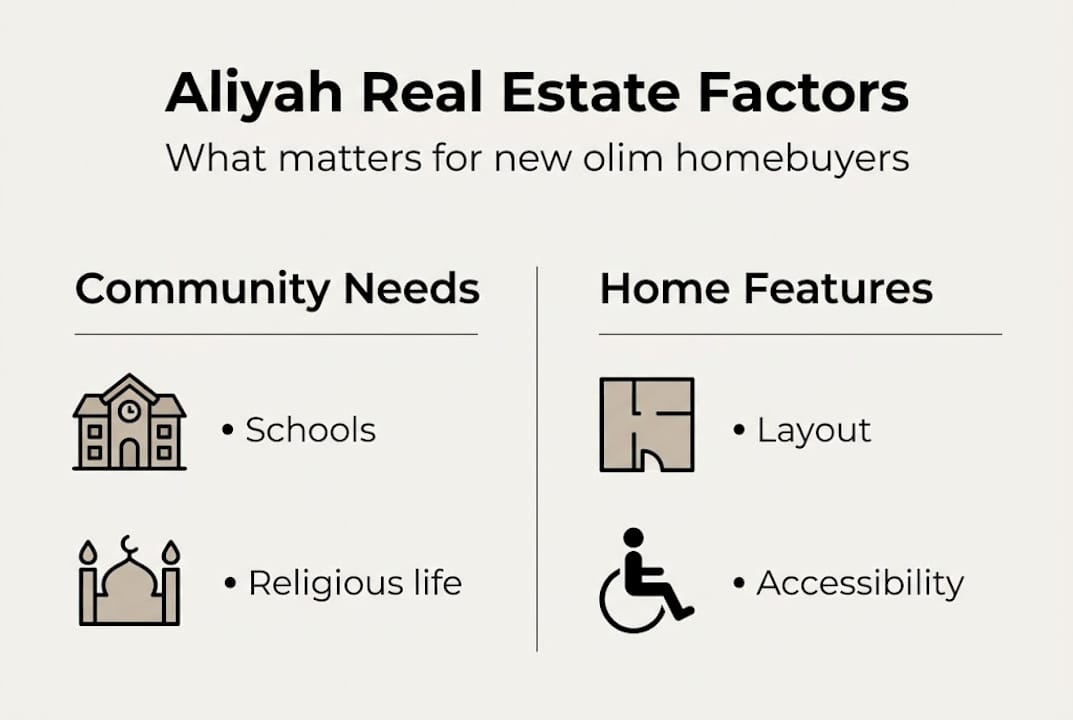
Observant families typically need to know: Is there a mikva nearby? Which kashrut standards do local stores follow? Are the schools in the neighborhood aligned with our hashkafa (religious worldview)? These are not optional considerations. They determine whether a home is actually livable for your family.
“The right home for an oleh family is not just about square footage or a nice view. It is about whether your children will thrive, whether Shabbos will feel natural, and whether the community will hold you when things get hard.”
Demand for this type of property has grown steadily. When you look at choosing Israeli real estate as an oleh specifically, you quickly realize the supply of truly aliyah-oriented properties is concentrated in a handful of cities, with Beit Shemesh leading the list for Anglo and religious immigrant communities.
Many olim prioritize neighborhoods with established religious infrastructure, and for good reason. Without it, daily observant life becomes unnecessarily difficult. But not all religious infrastructure is equal, and not every buyer needs the same things.
Here is a direct comparison of what aliyah-focused properties typically offer versus standard Israeli properties:
| Feature | Aliyah-oriented property | Standard Israeli property |
|---|---|---|
| Proximity to synagogue | Usually within walking distance | Not a factor |
| Eruv coverage | Commonly confirmed | Rarely mentioned |
| Kosher kitchen setup | Often pre-fitted or ready | Standard kitchen only |
| Anglo-friendly community | Frequently present | Uncommon |
| English-language schools | Nearby or accessible | Not prioritized |
| Religious school options | Core selling point | Variable |
| Mikva access | Considered in location | Not considered |
Once you know what features matter, here is how to rank them for your own family:
Pro Tip: Do not rely only on real estate listings to evaluate a neighborhood’s community fit. Reach out directly to local Anglo WhatsApp groups or Facebook communities. Ask what Shabbos feels like on the block, which shuls are growing, and whether newcomers are welcomed warmly. Listings cannot capture that.
Working with real estate agencies for aliyah that specialize in religious communities makes this evaluation process significantly easier.
Once you know what to look for, understanding the actual buying process will set you up for success. The Israeli property market operates differently from the American one in ways that catch olim off guard repeatedly.
Before you start viewing properties, you need to do three things:
Understanding the legal differences and required documentation is critical for new immigrants. Israel uses a Torrens-style land registry system (the Tabu), which is different from the American title insurance model. Your lawyer must perform a full registry search before you sign anything.
Documents you will typically need include:
Pro Tip: Hire a bilingual lawyer before you hire a real estate agent. Many contracts are in Hebrew, and critical clauses about payment schedules, penalties, and property conditions can be misread or missed entirely by someone relying on rough translations. This is not a step to cut costs on.
The reason so many olim rely on using a buyer’s agent comes down to one word: context. An Anglo-friendly agent who has helped dozens of olim understands not just the paperwork, but the cultural rhythms of the transaction. They know when to push and when to wait. This is especially valuable when navigating Israeli real estate for the first time.
Armed with process knowledge, you will need clear criteria for choosing the best property for your situation. The biggest mistake buyers make is optimizing for the wrong things.
Here is a side-by-side look at the main community types and their real estate implications:
| Community type | Pros | Cons |
|---|---|---|
| Haredi | Strong community support, affordable pockets | Less English spoken, specific lifestyle expectations |
| Modern Orthodox | Balance of religious and secular access | Smaller supply, higher demand |
| Anglo-friendly | English support, familiar cultural norms | Premium pricing, limited to certain cities |
| Mixed (Dati/Chiloni) | Diverse environment, more property options | Less defined religious infrastructure |
Different communities offer varying support networks and religious facilities, which directly affects how comfortable daily life feels for a newly arrived family. A significant percentage of Anglo olim consistently choose cities like Beit Shemesh, Raanana, and Modi’in specifically because of their religious community density and English-language resources.
Key criteria to evaluate before committing:
Before making a final decision, ask yourself:
Reviewing benefits of Israeli communities before narrowing your shortlist is worth the time. And once you find a property you love, knowing the basics of negotiating real estate in Israel can make a real difference in your final price.
Here is something we have seen play out dozens of times with families making aliyah: they spend months researching the “perfect” property and then feel blindsided when reality does not match the vision. No property is perfect. That is not cynicism. It is just the truth.
The families who integrate most successfully are not the ones who found a flawless home. They are the ones who knew their non-negotiables, accepted the tradeoffs, and invested in community relationships from day one. A slightly smaller apartment in the right neighborhood will serve your family far better than a spacious home in an area where you feel isolated.
Aliyah is an adjustment on every level: language, bureaucracy, schooling, daily rhythm. Expecting your home to compensate for all of that puts too much pressure on four walls. Focus instead on where your family will grow, not just where you will live. Real estate for Jewish families making aliyah works best when it serves the life you are building, not the life you are leaving behind.
Ready to move from research to action? Finding the right aliyah real estate requires more than browsing listings online. It requires local expertise, community knowledge, and someone who has guided families through this exact process before. At Yigal Realty, we specialize in properties in Beit Shemesh and surrounding areas, with a focus on observant and religious communities. Our team understands what Anglo olim need and works closely with buyers at every step. When you are ready to begin, explore aliyah real estate options and connect with our team for personalized guidance that fits your family’s values and timeline.
Aliyah real estate is specifically tailored to address new immigrants’ needs, including community belonging, religious facilities, and English-language support, which standard Israeli properties rarely prioritize.
No, but many buyers prioritize religious amenities and community support. These features are common in aliyah-oriented properties because proximity to synagogues and schools is a core driver for the majority of olim buyers.
Yes, foreigners can purchase property in Israel, but the process often requires additional paperwork and a trusted legal representative. Legal differences and documentation requirements are significant and should not be handled without professional help.
Look for Anglo-friendly agencies with direct experience in olim transactions. Agency comparisons and client reviews are your best tools for finding agents who genuinely understand the aliyah buying process.