%20(4).png)
![[background image] image of cityscape background (for an architect firm)](https://cdn.prod.website-files.com/68961ade6feff9cbdffc080d/69384e066e0e9a310b6817f8_061f6bac-48bf-44b8-a689-078dacd8009f.avif)
TL;DR:
- Expert guidance helps match families to neighborhoods aligned with their religious identity and lifestyle.
- Professional assistance prevents costly legal, construction, and demographic pitfalls in Beit Shemesh real estate.
- Tailored guidance ensures long-term community fit, property value, and smooth transaction processes for observant buyers.
Most families searching for a home in Beit Shemesh assume the process comes down to two things: price and square footage. That assumption can cost you dearly. The reality is that buying in a religious community involves layers of complexity that no floor plan or listing price can reveal. Which neighborhood actually matches your family’s religious identity? Is the building free of unauthorized construction? Will the developer deliver on promises? These are questions that project guidance services are specifically designed to answer. This article breaks down exactly why expert guidance is not optional for observant families, and how it protects your investment, your lifestyle, and your peace of mind.
| Point | Details |
|---|---|
| Community fit matters | Choosing the right religious community and project features can define your family’s happiness and stability. |
| Guidance avoids costly errors | Expert project advisers help you sidestep legal and financial pitfalls common in Beit Shemesh home buying. |
| Customized for religious lifestyles | Project guidance tailors the process to halachic needs, community values, and practical amenities. |
| Professional support is essential | Relying only on your own research can lead to expensive mistakes, especially for foreign and first-time buyers. |
Beit Shemesh is not a single community. It is a collection of distinct neighborhoods, each with its own religious character, demographic makeup, and social norms. Ramat Beit Shemesh Aleph leans Dati Leumi. Ramat Beit Shemesh Bet is predominantly Haredi. Newer sections like Gimmel and Daled are still forming their identities. Buying in the wrong pocket can mean your children have no suitable school, your family feels socially isolated, or your resale value suffers when the neighborhood shifts.
This is why cultural fit matters as much as price. A three-bedroom apartment in a neighborhood that does not align with your observance level is not a bargain. It is a liability. The buying process for overseas families adds another layer of complexity, since non-residents face purchase taxes of 8 to 10% and are limited to 50% mortgage financing, making every decision carry higher financial stakes.
Many buyers focus entirely on the apartment itself and completely miss the neighborhood-level risks: demographic shifts, ongoing construction noise, and illegal additions that appear on no official document.
Here are pitfalls that catch non-local and first-time buyers off guard:
| Neighborhood | Cultural profile | Legal risk level | Construction activity | Community stability |
|---|---|---|---|---|
| RBS Aleph | Dati Leumi / Mixed | Medium | Low to moderate | High |
| RBS Bet | Haredi | Medium to high | Moderate | Moderate |
| RBS Gimmel | Mixed, developing | Higher | High | Still forming |
| RBS Daled | Haredi, new | Medium | Very high | Early stage |
Understanding these distinctions before you sign anything is exactly what professional guidance provides.
The most immediate benefit of working with a project adviser is personalized community matching. This is not about finding you an address. It is about finding your family a place where Shabbos feels natural, where your kids can walk to school safely, and where your neighbors share your values. That kind of match requires local knowledge that no online listing can provide.
Beyond community fit, professional guidance brings engineering inspections into the process. Building quality in Israel varies significantly between developers, and engineering inspections are essential for catching structural issues, poor materials, or incomplete work before you are legally committed. An inspector can identify problems that would cost tens of thousands of shekels to fix after closing.
Project advisers also help you recognize features that add genuine long-term value for religious families. A sukkah balcony, for example, is not a luxury. It is a functional necessity that adds measurable property value and improves daily religious life. Proximity to a shul, a mikveh, or a well-regarded yeshiva can make a property worth paying a premium for, even if the apartment itself is modest.
Here is how a guided home buying process typically unfolds:
Pro Tip: Most buyers underestimate the paperwork involved in Israeli real estate. Zoning certificates, tama 38 implications, and taboo (land registry) checks are not optional steps. Skipping them can expose you to serious legal and financial risk.
The value of valued property features specific to observant living is something most buyers only appreciate after the fact. Guidance puts that knowledge in your hands before you commit.
The most expensive mistakes in Israeli real estate are almost always avoidable. They happen when buyers rely on enthusiasm rather than expertise. A family falls in love with an apartment, rushes the legal checks, and discovers six months later that a storage room was built without a permit. That illegal addition now complicates their title and their ability to sell.
Independent research is possible but carries real risks without professional help. Experts consistently recommend professional guidance to avoid unvetted developers, surprise zoning changes, and contract clauses that favor the seller. The Israeli market has its own legal culture, and what seems standard may not protect you.
Here are real-world pitfalls and how a project adviser addresses each one:
| Mistake | Typical cost | How guidance prevents it |
|---|---|---|
| Buying with illegal construction | Fines plus legal fees | Permit and taboo review |
| Overpaying purchase tax | 8 to 10% of purchase price | Tax status clarification upfront |
| Poor developer choice | Delays, defects, lost deposits | Developer vetting and track record check |
| Zoning surprise | Reduced resale value | Municipal plan review before purchase |
Pro Tip: Skipping local rabbinic guidance when buying in a religious neighborhood is a long-term lifestyle risk. Rabbis in established communities often know which buildings have unresolved issues, which developers honor their commitments, and which streets are genuinely walkable for Shabbos. That knowledge is free, but most buyers never think to ask.
Knowing how to approach negotiating with confidence and understanding Israeli real estate laws gives you a real edge in a market that can otherwise feel opaque.
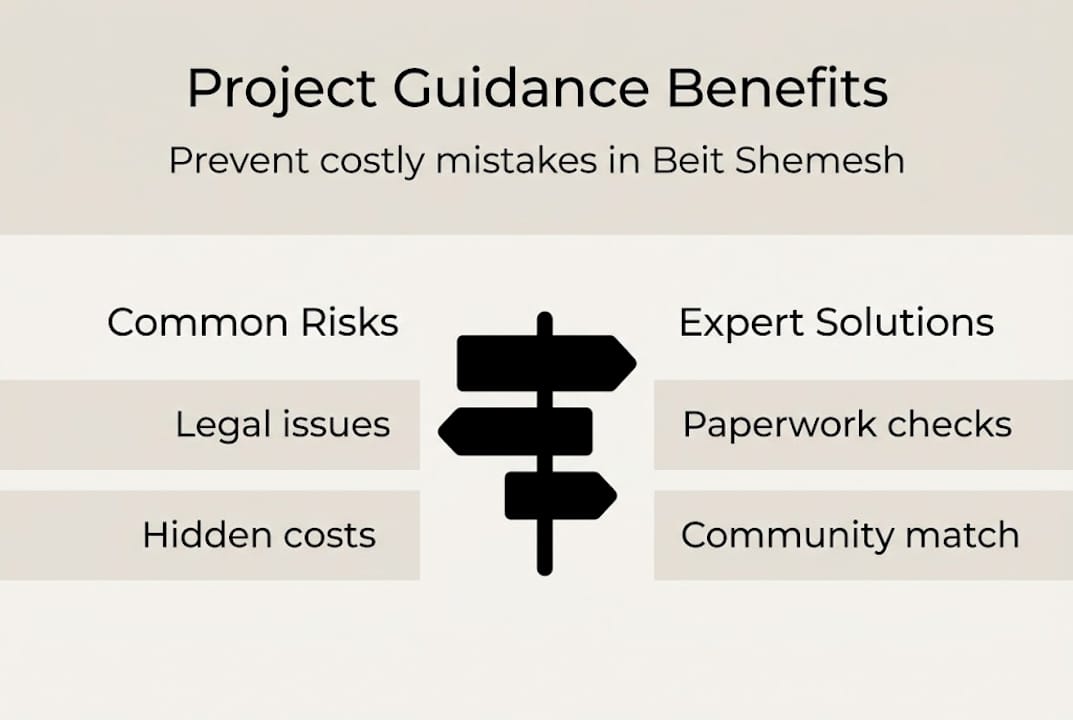
Project guidance for observant families goes beyond standard real estate advice. It integrates halachic considerations, community priorities, and lifestyle compatibility into every recommendation. This is not a service you can replicate by reading listings online.

Anglo-friendly seminars in Beit Shemesh are one example of how this works in practice. These events combine rabbinic and professional advice so that buyers hear from community rabbis, experienced real estate advisers, and legal professionals in a single setting. For families making aliyah or purchasing a second home in Israel, this kind of structured guidance is invaluable.
Consider a scenario where a family from New York is buying in Ramat Beit Shemesh. They want a Shabbos-friendly building, a sukkah balcony, and proximity to a specific type of shul. Without guidance, they might find an apartment that checks two of those boxes but sits in a building where the community culture does not match their observance level. A project adviser bridges that gap by knowing both the family’s priorities and the neighborhood’s reality.
Here are the amenities and features that matter most to observant families when evaluating a property:
You can explore more perspectives on these priorities by exploring religious real estate topics that address the specific needs of observant buyers in Israel.
After working with hundreds of religious families in Beit Shemesh, we have seen one pattern repeat itself: the buyers who struggle most are the ones who believed they could figure it out alone. They had spreadsheets, they visited multiple times, and they read every forum. But they still missed the things that only come from years of local experience.
The uncomfortable truth is that price and location are the easy parts. Cultural fit, legal integrity, and long-term community stability are where most mistakes happen. And those mistakes are expensive, not just financially, but in terms of daily quality of life.
We have seen families pay a premium for an apartment in the “right” building, only to realize the community culture was not what they expected. No spreadsheet catches that. Local knowledge does.
Over-relying on self-research can actually cost more in the long run. The hours spent, the emotional investment, and the risk of missing a critical legal detail all add up. Working with an in-depth guide service is not a luxury. For religious families buying in a complex, culturally specific market, it is the most practical decision you can make.
Yigal Realty specializes in helping observant and religious families find homes that truly fit their lives in Beit Shemesh and surrounding areas. Our advisers understand the halachic priorities, the neighborhood dynamics, and the legal landscape that shape every smart purchase. Whether you are making aliyah, buying a second home, or relocating within Israel, we offer personalized guidance from first inquiry to final closing. Read our detailed property guidance articles to deepen your knowledge, or connect with our advisers today for a tailored consultation that puts your family’s priorities first.
Project guidance means expert help navigating the cultural, legal, and practical risks unique to religious neighborhoods in Beit Shemesh, including demographic fit, illegal construction checks, and purchase tax planning.
Independent research is possible but exposes you to hidden risks such as unvetted developers and zoning changes that professionals are trained to identify and prevent.
Key features include walkability to shuls, sukkah balconies that add value, kosher kitchen infrastructure, and proximity to strong community institutions.
Project guidance ensures properties meet legal requirements and helps you avoid costly errors with purchase taxes, illegal construction, and contract terms that may not protect your interests.