%20(4).png)
![[background image] image of cityscape background (for an architect firm)](https://cdn.prod.website-files.com/68961ade6feff9cbdffc080d/69384e066e0e9a310b6817f8_061f6bac-48bf-44b8-a689-078dacd8009f.avif)
TL;DR:
- Before relocating to Israel, you must open your Aliyah file and hire an Israeli real estate attorney. Starting apostille requests and FBI background checks early is crucial because they govern your entire timeline. Verifying neighborhood and street conditions in Beit Shemesh through local knowledge prevents costly surprises after arrival.
Before you book flights or browse listings, do two things: open your Aliyah file with the Jewish Agency and retain an Israeli real estate attorney. Everything else on this relocation guide for Israel flows from those two decisions. The Jewish Agency assigns you an account manager and guides you through the Aliyah process over several months. Your attorney runs title searches, checks for liens, and flags unauthorized building additions before you sign a single page. Nefesh B’Nefesh and Yigal-realty’s on-the-ground Beit Shemesh team can support both tracks simultaneously.
Pro Tip: Apostilles and the FBI background check are the two tasks that quietly govern your entire timeline. Start them the day you decide to move.
Start gathering documents 8–10 months before your planned Aliyah date. FBI checks and apostilles are the slowest steps, and they must be complete before you arrive.
| Document | Issuing Authority | Apostille Required | Typical Lead Time |
|---|---|---|---|
| Long-form birth certificate (each family member) | State vital records office | Yes (Secretary of State) | several weeks |
| Marriage/divorce certificate | State or county clerk | Yes | several weeks |
| FBI background check | FBI / U.S. State Dept. apostille | Yes (federal, slower) | several weeks |
| Proof-of-Judaism letter | Recognized synagogue rabbi | No | 1–2 weeks (must be dated within 12 months of submission) |
| Personal status affidavit | Self-completed; notarized | Yes or Israeli consulate | several weeks |
| Power of attorney (remote purchase) | U.S. notary + apostille | Yes | several weeks after notarization |
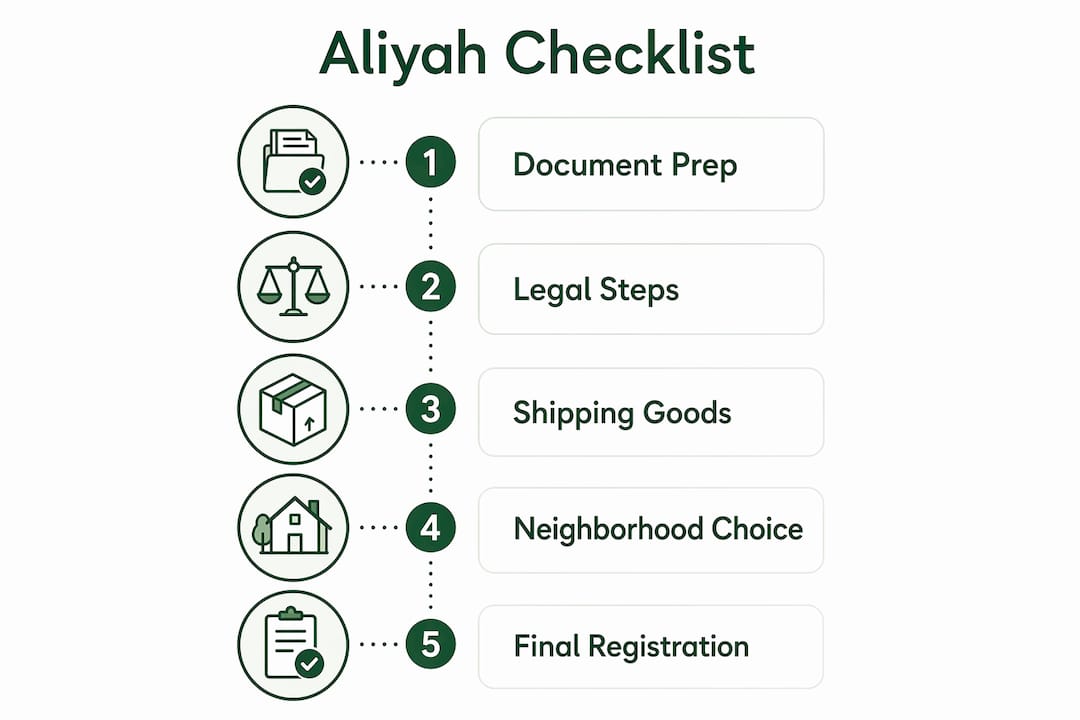
A few details that catch people off guard. A Consular Report of Birth Abroad is not a substitute for the actual birth certificate from the country of birth. Short-form birth certificates without the names of both parents are rejected. The proof-of-Judaism letter must come from a rabbi affiliated with a recognized rabbinical organization and must be dated within the past year — a letter even one day past twelve months is automatically rejected. Federal documents like the FBI check are apostilled by the U.S. State Department in Washington, D.C., not by state offices, which adds time.
Pro Tip: Keep every original document in your carry-on. If your checked bag is delayed or lost, arrival processing stops entirely.
Hire the attorney before you make an offer, not after. An Israeli real estate attorney searches the Tabu (land registry) for outstanding mortgages, municipal liens, and encumbrances. More critically, they check building permits to confirm no unauthorized additions exist on the property.
Unauthorized additions are a specific, serious risk. A seller may have enclosed a balcony or added a room without permits. That addition can invalidate mortgage approval mid-transaction, leaving you without financing and potentially forfeiting a deposit. Your attorney catches this before you are committed.
Skipping independent legal counsel is the single most common and costly mistake international buyers make in Israel. An attorney’s fee is a fraction of what a failed transaction or an unmortgageable property costs.
For U.S. buyers, financing options include Israeli bank mortgages for non-residents (typically at lower loan-to-value ratios than resident mortgages) or cash purchases. Currency exchange timing matters: the shekel-dollar rate moves, and coordinating the transfer close to closing reduces exposure. Consult a licensed tax professional about U.S. reporting obligations and any Israeli tax implications before closing.
Yigal-realty coordinates directly with attorneys and provides New York office support to help international buyers manage document logistics and due-diligence timelines from abroad.
The sequence is: offer with conditions → attorney-reviewed contract → deposit → due-diligence period → mortgage approval or cash confirmation → exchange of funds → Tabu registration.
For remote purchases, a transaction-specific power of attorney is required. The POA must name a single property at a defined price and set conditions; your attorney cannot act beyond those boundaries. It must be notarized and apostilled in the U.S. before being couriered to Israel. Embassy and notary scheduling can add days or weeks, so build this into your timeline early.
Tabu registration is the final step that legally transfers ownership and protects your chain of title. Do not treat it as a formality.
Plan for several weeks of sea-freight transit, plus additional time for customs clearance at the Israeli port. Start the shipping process at least three months before your target arrival date.
| Shipping factor | Details |
|---|---|
| Sea freight transit | 6–10 weeks (variable by carrier and season) |
| Customs clearance | Add 1–3 weeks at port |
| Olim duty-free eligibility | Available within first three years; documentation required |
| Air freight | Faster but significantly more expensive; use for essentials only |
Olim can ship household goods duty-free under specific conditions during the first three years after Aliyah. You must present your Aliyah documentation to claim the exemption. Missing or incorrect paperwork at customs delays clearance and can generate unexpected fees.
Pro Tip: Carry your Aliyah certificate and customs-exemption paperwork in your carry-on. Customs agents at Ben Gurion need to see originals, not copies.
Neighborhood choice in Ramat Beit Shemesh is a street-level decision. Two streets apart can mean a radically different cultural experience in terms of hashkafa, noise, and community expectations — even within the same named sub-neighborhood.
The main sub-neighborhoods to research: Ramat Beit Shemesh Aleph (largest Anglo concentration, strong English-speaking infrastructure), Gimmel (rapid growth, multiple community identities within the same development), Daled, Hey/Neve Shamir, and Mem-Shalosh. Each has its own character, and within each, individual streets vary.
Do not assume a neighborhood label tells you what the street feels like. The difference between one block and the next in RBS Gimmel can be the difference between a Dati-Leumi environment and a Charedi one.
Key selection criteria for observant Anglo families:
Pro Tip: Request a video walkthrough of the specific street and building, not just the apartment. Yigal-realty can arrange on-the-ground walkthroughs for remote buyers.

Within the first few days: register with the Population and Immigration Authority, choose a Kupat Cholim (health fund), and open a local bank account. These three unlock almost everything else.
First week:
First month:
First 90 days:
Plan 6–12 months from decision to fully settled. Document preparation alone can take 3–4 months when FBI checks and apostilles are factored in.
| Phase | Typical Duration | Key Cost Categories |
|---|---|---|
| Document prep and Aliyah file | 3–4 months | Apostille fees, FBI check, notary costs |
| Property search and offer | 1–3 months | Broker fees, travel or video-call costs |
| Contract through closing | 2–4 months | Attorney fees, purchase tax (Mas Rechisha), deposit |
| Shipping and customs | 2–3 months | Freight, insurance, customs handling |
| Arrival and setup | 1–2 months | Interim housing, utility deposits, renovation/setup |
Purchase tax (Mas Rechisha) rates vary by buyer category and property value; confirm the current rate applicable to your situation with your attorney. Legal fees, shipping, and interim housing are the three cost categories buyers most consistently underestimate.
The top three: skipping independent legal counsel, underestimating apostille and FBI timing, and assuming neighborhood homogeneity within Ramat Beit Shemesh.
Red flags when evaluating a property:
Relocation pitfalls:
Require the seller’s attorney to provide Tabu extracts and full building-permit documentation as a written condition of contract. If they resist, that resistance is the answer.
Pro Tip: A real estate due-diligence checklist reviewed with your attorney before signing protects your deposit and your mortgage approval.
Pre-departure (start 8–10 months out):
During purchase:
Pre-shipment:
Arrival week:
90-day follow-ups:
A successful move to Israel requires starting legal and document steps at least 8–10 months out, hiring an Israeli attorney before signing anything, and verifying neighborhood fit at the street level before committing to a property.
| Point | Details |
|---|---|
| Hire an attorney first | Retain an Israeli real estate attorney before making any offer to catch liens, unauthorized additions, and title issues. |
| Start documents early | Begin apostilles and FBI checks 8–10 months before your Aliyah date; these steps govern your entire timeline. |
| Neighborhood fit is street-level | Ramat Beit Shemesh sub-neighborhoods vary sharply by block; verify hashkafa in person or via video walkthrough. |
| Budget beyond the purchase price | Legal fees, shipping, interim housing, and utility deposits are consistently underestimated cost categories. |
| Yigal-realty for Beit Shemesh buyers | Yigal-realty provides local neighborhood vetting, attorney coordination, and New York office support for international buyers. |
The buyers who move through this process smoothly share one habit: they treat the attorney hire and the document apostilles as Day One tasks, not things to get to after they find a property they love. By the time a great apartment appears in Ramat Beit Shemesh Aleph or Gimmel, the buyers who are ready have their POA apostilled, their attorney briefed, and their Aliyah file active. The ones who are not ready watch that apartment go to someone who was.
The neighborhood question is where I see the most painful surprises. Families research Ramat Beit Shemesh online, decide it fits their hashkafa, and then discover on arrival that the specific building they bought in sits on a street that does not match what they expected. That is not a research failure — it is a street-level reality that only on-the-ground knowledge resolves. Yigal-realty’s role is to provide exactly that: not just a listing, but a genuine read on whether a specific address fits a specific family.
The Tabu registration check at the 90-day mark is the one post-arrival task buyers most often skip. Do not skip it. Title registration is what legally protects your ownership, and confirming it is complete closes the loop on the entire purchase.
Buying in Beit Shemesh from the U.S. means coordinating attorneys, apostilles, POA logistics, and neighborhood research across a nine-hour time difference. Yigal-realty handles the local side of that equation: neighborhood vetting, attorney coordination, Tabu extract confirmation, and introductions to schools and community contacts. The New York office bridges the time-zone gap so nothing falls through between your morning and Israel’s afternoon.
For families relocating to observant Anglo communities in Ramat Beit Shemesh, Yigal-realty’s relocation and property listings give you verified access to current inventory, early-access projects, and the street-level community knowledge that online research cannot replicate. Request a relocation consultation at info.yigal-realty.com to start the conversation.
Official sources and community guides change their forms and timelines periodically. Always verify current requirements directly with the issuing authority before submitting documents.
This article is general information, not legal, tax, or immigration advice. Confirm current requirements with the Jewish Agency, Nefesh B’Nefesh, your Israeli attorney, and a qualified tax professional for your specific situation.