

A kosher kitchen in a new apartment is easiest to get right on paper, before the contractor pours, tiles or installs anything. Decide how your household separates meat and dairy, put that on the sale plans and the technical specification, and then check at handover that what you were given matches what you signed. This guide walks through the planning, the details to raise with the architect or kitchen planner, and the handover inspection.
There is no single “kosher kitchen” layout. Some families keep two full sets of everything with two sinks on opposite walls. Others work with one sink and dish basins, or with a shared counter that is covered during use. A designer interviewed by kbbreview describes working out how far a client’s separation goes as a delicate but essential part of early design. The same applies in Israel: before you meet the kitchen planner, know your own answers.
Sit down with your spouse, and with your Rav if you have questions, and settle these:
Writing these down matters because new-build buyers in Israel usually deal with a sales office, a kitchen supplier and a site manager, who often do not talk to each other. A short written brief saves you from three different interpretations.
BC Kosher’s kitchen planning guidance frames the goal clearly: a kosher layout should preserve the separation of meat and dairy across work areas, storage, sinks and cooking. Two sinks and separate counters are the convenient route. A single sink or a shared counter can work, but it requires specific separation measures and rabbinic guidance.
The Israeli kashrut advisory service Kosharot advises building two separate sinks, one for meat and one for dairy, preferably in different areas of the kitchen. If the two sinks end up side by side, they should be deep enough that dishes do not overflow into the neighboring sink, or a raised countertop should divide them.
If you cannot fit two sinks, Chabad.org’s guide to koshering a kitchen notes that distinct dish pans must be used in a single sink. Treat that as a fallback, and ask your Rav how to apply it to your sink’s shape.
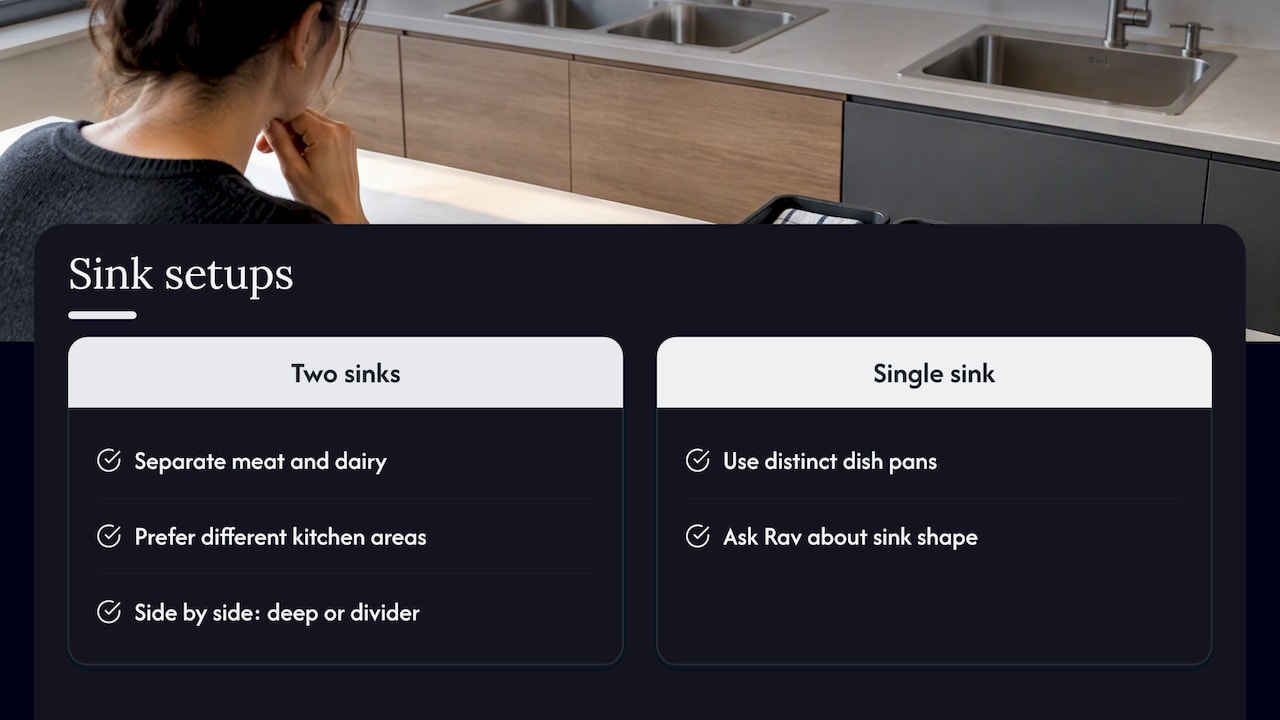
Kosharot suggests large meat and dairy work surfaces on both sides of the sinks. Voriah, an Israeli kitchen company, suggests dividing the surface into meat and dairy areas on different sides, with subtle markings such as a different surface color or covering. That gives guests, cleaners and children a visual cue without an ugly label.
Material matters too. The kbbreview piece says designers should ensure worktops are non-porous, such as stainless steel, Corian or specific porcelain, to meet kashrut standards on absorption. If your contractor’s default is a porous natural stone, raise it during the finishes stage, and check with your Rav what your household accepts.
The Shulchan Aruch HaRav, in its chapter on kitchen utensils, describes the ideal as placing meat and dairy cabinets on opposite sides of the kitchen, near their own sinks and counters. It also advises against cabinets directly above the stove or oven, because steam could affect what is stored there.
In practice, plan these:
If you are choosing between a walk-in pantry and wall cabinets, a comparison of pantry versus cabinets shows how fixtures and cabinetry should be decided before the kitchen goes in. For a kosher home the extra question is which side of the room each one serves.
This is where new apartments are most forgiving, because pipes and wiring are still behind open walls or at least cheaply changed. Once the walls are closed and tiled, every change costs more.
| Item | What to specify | Source |
|---|---|---|
| Dishwasher | A second drain so a second machine can be added later; or two narrow 45 cm machines, a common practice in new kitchens | Kosharot, Voriah |
| Sinks | Two, in different areas, or deep enough to prevent overflow | Kosharot |
| Microwave | Two separate units to avoid halachic complexity | Kosharot |
| Plata | A fixed, permanent location with a dedicated outlet, not an extension cord on the counter | Voriah |
| Oven and stove | No cabinets directly above | Shulchan Aruch HaRav |
| Appliance features | Sabbath mode on some high-end models: lights off, automatic shut-off disabled | kbbreview |
A few notes on the table. The dishwasher drain is the cheapest insurance on the list: even if you start with one machine, a second drain keeps the option open. The plata point is easy to forget until the first Friday, at which point the extension cord appears. Ask for the outlet to be placed where the plate will actually sit, and make sure the circuit can carry it.
If you are moving existing appliances into the new kitchen, a guide to preparing appliances for a move covers the practical side, such as defrosting a fridge and freezer ahead of the move. Before the appliances come into a kosher kitchen, ask your Rav whether and how each one needs to be kashered.
In an Israeli purchase from a contractor, the plans and specification are your leverage. Under the Sale (Apartments) Law, 1973, the seller must attach a specification to the sale contract, and any amendment to it requires both parties’ signatures. That is the reason to turn your kosher kitchen brief into a signed change order rather than a conversation.
A workable sequence:
If you are still choosing a project, it helps to know what counts as new construction and how the process differs from buying resale. Many religious families also find that the advantages of new developments include exactly this: the chance to shape the kitchen before it exists.
We work with families who buy in Beit Shemesh and surrounding areas, and the kitchen comes up in almost every conversation about a new project. What we see is that the strongest buyers treat the kitchen as a legal and practical document, not as a design mood board. They decide their separation customs early, they ask the developer what can be changed and by when, and they insist on signed paperwork.
We also tell buyers to look beyond the kitchen itself. Where the apartment sits in the building affects Shabbat and daily life, which is why we wrote about choosing a location in the building and about Sabbath considerations while house hunting. A perfect kitchen on a floor your family finds hard on Shabbat is not a perfect home.
Our advice is simple. Bring the Rav’s guidance and the kitchen brief to the first serious conversation about a project, not the last. It is much easier to adjust a plan than a finished room.
— Spiros
Handover is when your paper plan meets the actual room. The Ministry of Construction and Housing’s guide for buyers from a contractor says to use the sale contract, the signed technical specification and the plans as your benchmark, and to document defects and deviations. For the kitchen, that means comparing the delivered layout, fixtures, finishes, dimensions and utility points with what was agreed.
Bring with you:
The handover checklist from an Israeli law firm recommends testing all taps and the sink, opening every cabinet door and drawer, checking hinges and slides, and inspecting tiles, grout and hollow or damaged areas. Run every tap, let the water drain, and look under the sink for leaks. Operate every appliance connection you can.
A handover checklist from another Israeli firm recommends recording every defect clearly in the signed delivery protocol, photographing the protocol and the defects, collecting copies of warranties and instructions, and not relying on verbal promises to repair things later. The ministry guide adds that you should list each item precisely and keep a copy together with warranties, instructions and correspondence.
The Sale Law also matters here. A difference from the specification, building regulation or official standard counts as non-conformity. Notice is due within one year of the apartment becoming available, or, if you discover it later, within a reasonable time after discovery (see the law’s text). For anything beyond a simple punch list, speak with a lawyer who handles contractor purchases.
A brand-new kitchen installed by a contractor and untouched by non-kosher hands is the easy case. Ovalot says preparation for that situation may need only basic cleaning and a quick rabbinic consultation. The same source says that for second-hand apartments with an unknown kitchen history, it is best to assume a full koshering process is needed and to consult a qualified rabbi before moving in.
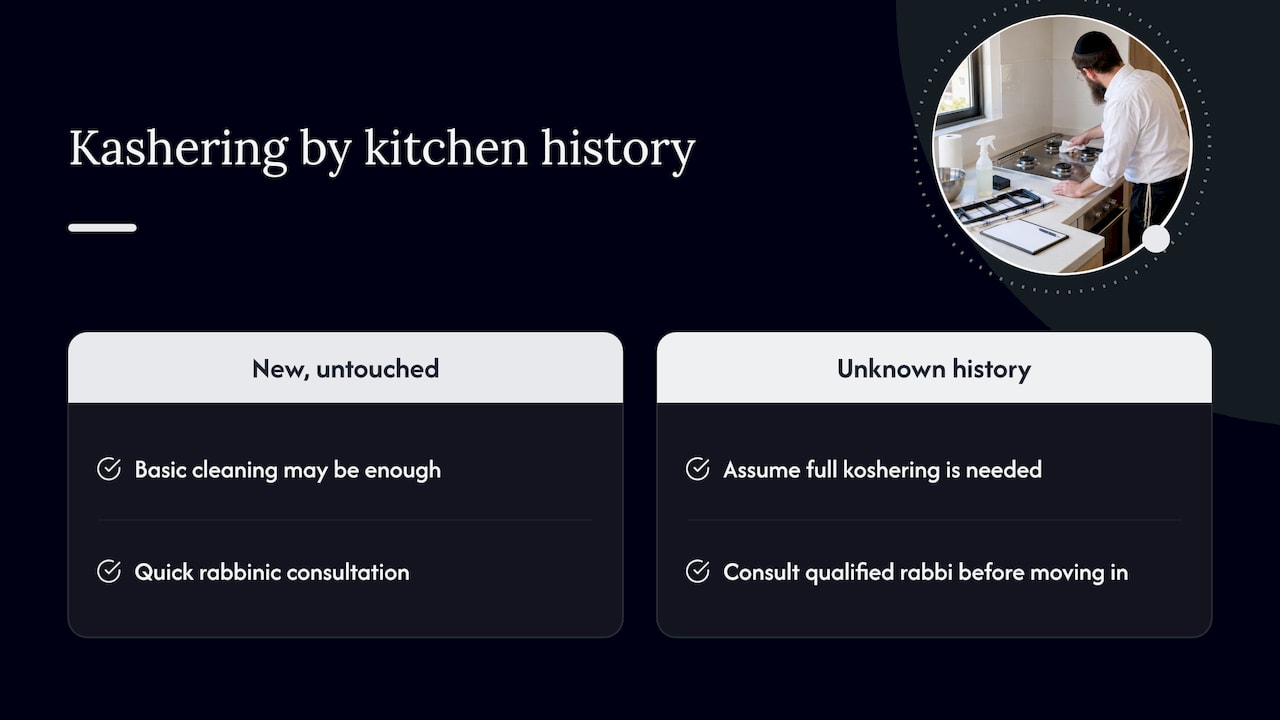
The Orthodox Union’s Israel guide makes the underlying point: whether a kitchen needs kashering, and how, depends on the material and prior use. Ask your Rav, and ask for help if you are unsure. That matters in a new apartment more often than people expect: showroom display appliances, tradespeople who used the kitchen during finishing, or a resale unit with a previous tenant can all change the picture. Do not guess. Describe exactly what happened and let your Rav decide.
If you are also planning the move itself, our family moving checklist for Israel and our relocation guide for moving to Israel cover the rest of the sequence. For a wider look at what religious buyers prioritize, see our piece on kosher real estate for families in Israel and our examples of new developments for religious families.
If you are buying in Beit Shemesh or nearby, we can help you ask the right kitchen questions before you commit. Our concierge project guidance walks you through a development, including what the specification covers and what to raise with the developer. Our current projects include Neve Amim, Eucalyptus, Rotshtein Heights, Olmaya, Givaat Zeev and The Trilogy House. Tell us your household’s customs, and we will help you compare projects on what matters to you.
Two sinks are the convenient solution and are what Israeli kashrut advisers recommend, ideally in different areas of the kitchen. If you have only one, distinct dish pans must be used, and your Rav should guide the details. Decide before plumbing is installed, because adding a sink later is costly.
Yes, if you plan for it. Kosharot advises preparing a second drain for a future dishwasher. Some new kitchens instead use two narrow 45 cm dishwashers from the start.
Compare the kitchen with the signed contract, specification, plans and change orders. Test every tap and appliance connection, open all cabinets and drawers, inspect tiles and grout, and record each deviation in the signed handover protocol with photos.
A new contractor kitchen untouched by non-kosher use is a much simpler case and may need only cleaning and a quick rabbinic consultation. If its history is uncertain, ask your Rav before using it. The method depends on the material and prior use.