%20(4).png)
![[background image] image of cityscape background (for an architect firm)](https://cdn.prod.website-files.com/68961ade6feff9cbdffc080d/69384e066e0e9a310b6817f8_061f6bac-48bf-44b8-a689-078dacd8009f.avif)
TL;DR:
- Choosing a home in Israel’s observant communities involves a commitment to lifestyle, neighborhood culture, and future stability. New developments offer legal protections, green building standards, and community features designed to support Torah life, making them advantageous for families and investors. Ensuring proper documentation, understanding warranty terms, and evaluating community design are essential steps to protect your investment and enhance quality of life.
Choosing a home in Israel’s observant communities is not simply a real estate decision. It is a commitment to a way of life, a neighborhood culture, and a future for your family. The advantages of new developments go far beyond modern kitchens and fresh paint. They include statutory legal protections, mandatory green building standards, and community spaces purpose-built for Torah life. Whether you are a family relocating from the United States or an investor seeking stable, community-rooted assets, understanding what new construction actually delivers, in law, in design, and in daily life, changes how you evaluate every listing.
| Point | Details |
|---|---|
| Legal protections | New developments in Israel provide statutory defect inspection periods up to seven years and bank guarantees securing buyer payments. |
| Green building benefits | Mandatory green standards reduce energy and water use, offering long-term savings despite minor upfront cost increases. |
| Community design | Developments for religious buyers include shared kehillah spaces like Torah libraries, fostering strong family and community life. |
| Warranty importance | Document defects promptly and verify developer guarantees as warranty effectiveness depends on the developer’s financial stability. |
| Expert advantage | Understanding legal and community features empowers families and investors to make informed property purchase decisions. |
The single most underappreciated aspect of buying new in Israel is the statutory protection framework every buyer receives by law. Under the Sale (Apartments) Law 1973, new developments provide inspection periods from 1 to 7 years with added warranties, and bank guarantees protect payments beyond the initial 7%. This is not a developer perk. It is the law.
Here is how the inspection and warranty system works in practice:
After each inspection window closes, that additional warranty year gives you a final window to catch problems that only surface over time.
The bank guarantee system is equally important. Once your payments exceed roughly 7% of the purchase price, the developer is legally required to secure the remaining funds through a licensed bank. If the developer defaults or goes bankrupt, you can recover your money. This protection simply does not exist when you buy a secondhand apartment.
Understanding these protections is one of the core benefits of buying new constructions that families and investors consistently overlook until they actually need them. Timely written notification of any defect is essential. Verbal complaints do not preserve your rights. Document everything in writing, from day one.
Since 2022, virtually every new residential development in Israel must comply with SI 5281, the national green building standard that reduces energy consumption and water use. The upfront cost increase, typically 1 to 3 percent above conventional construction, is offset by long-term savings on utilities and a measurably healthier living environment.
What does SI 5281 actually require in a home you will live in?
Stat to know: Homes built to the SI 5281 standard typically show utility bill reductions of 20 to 30 percent compared to pre-2022 construction, meaning the “premium” cost of buying new often pays for itself within a decade.
The new construction benefits in Israel extend beyond the environmental. A well-insulated, thoughtfully designed home also holds its resale value better, particularly as energy costs rise and buyers increasingly prioritize running costs alongside purchase price. Green-compliant homes attract a broader pool of buyers, which matters to investors planning a future sale or rental.
This is where new developments for observant communities pull decisively ahead of older stock. New projects designed for religious families do not just add a room and call it a shul. They are architecturally planned around the concept of kehillah, meaning the community itself is the product.
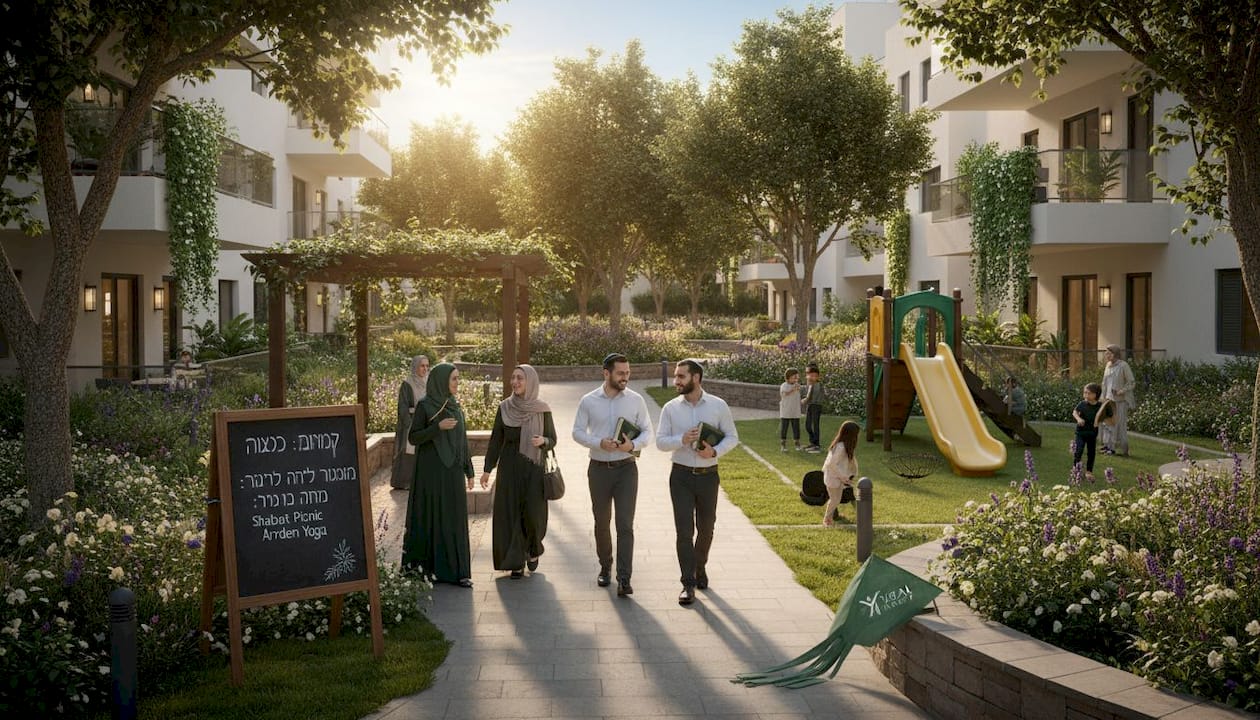
Recent developments like Givat Hashalvah illustrate this directly. That project prioritizes kehillah atmosphere with large communal spaces including Torah libraries and dedicated study halls, designing the spaces between buildings to foster Torah life, not just the apartments within them.
Practically, this means buyers in such developments gain access to:
This kind of design does not happen in older buildings. You can renovate a kitchen. You cannot renovate a building’s relationship to its community. For investors, this communal atmosphere is a stabilizing force. Families in these environments have strong reasons to stay long-term, which means lower vacancy rates and steadier rental demand. Explore how community amenities in religious areas directly influence property values and tenant stability.
Before committing, it helps to see the tradeoffs clearly. Here is a direct comparison across the factors that matter most to religious families and investors in Israel.
| Factor | New developments | Older properties |
|---|---|---|
| Legal defect protection | Statutory 1 to 7 years, mandatory by law | No warranty; buyer bears all repair costs |
| Bank guarantees | Required for payments above ~7% | Not available |
| Energy efficiency | SI 5281 compliant; 20 to 30% lower utility costs | No compliance required; higher running costs |
| Community design | Purpose-built for religious life, shared spaces included | Rarely designed for observant communities |
| Renovation requirement | Minimal on move-in | Often significant; hidden costs common |
| Purchase price | Typically higher upfront | Usually lower initial cost |
| Long-term investment security | Bank guarantees and statutory warranties protect buyers | Greater financial exposure, fewer legal safeguards |
| Resale value trajectory | Strong, especially in growing religious communities | Variable; depends heavily on location and condition |
Older properties have real appeal. Character, lower entry cost, and established neighborhoods are genuine advantages. But the risk profile is materially different. Plumbing surprises, structural issues, and the absence of any developer warranty shift all repair costs to you from day one. For the advantages of new projects in Beit Shemesh specifically, the combination of legal protection and community design creates a compelling case that older stock simply cannot match.
Knowing your rights theoretically is one thing. Enforcing them is another. Here is what actually works when buying new in Israel.
Pro Tip: Keep a dedicated folder, physical or digital, with every defect notice you send, every developer response you receive, and photos with timestamps. If a dispute reaches court, this folder is your case.
Use the property development guide for homebuyers to understand how the purchase timeline aligns with your warranty windows, especially relevant if you are buying off-plan and moving in significantly later than the contract date.
Here is what most real estate conversations get wrong about buying new: they frame it as a lifestyle preference rather than a risk management decision. The legal structure of new construction in Israel is designed explicitly to protect buyers, not developers. During the inspection period, the defect claim burden of proof favors the buyer, protecting families from uneven finish quality. The developer must prove the defect did not exist, not the other way around. That is a significant legal advantage that disappears entirely the moment you buy a resale property.
Community-centric design in new developments is also consistently undervalued in standard real estate analysis. The financial models used to compare new versus old rarely account for the cost of not having a nearby beit midrash, the friction of driving to a mikveh across town, or the social isolation that comes from living in a building where you are one of two observant families. These are real costs. They affect quality of life, community belonging, and ultimately whether families stay or leave. Developments designed around kehillah life remove those costs entirely.
The sustainability argument surprises most buyers when they run the actual numbers. A 2 percent higher purchase price that returns 25 percent lower utility bills over 20 years is not a luxury. It is sound economics. And as energy costs continue to rise across Israel, the gap between green-compliant and older stock will only widen.
Perhaps most importantly: buying new is not just about modernity. It is about entering a legally protected relationship with your developer, supported by bank-backed guarantees, enforceable warranties, and a community built to sustain the way of life you are choosing. For US Jewish families considering Israeli real estate, this combination of legal security and community belonging represents a genuinely different value proposition than purchasing property in North America.
If this article has given you a clearer picture of what to look for, the next step is finding developments that actually deliver on these standards. Yigal Realty specializes in new residential developments designed specifically for observant and religious families in Beit Shemesh and the surrounding region. Their team provides direct guidance on legal protections, developer credentials, green building compliance, and community features so you are never evaluating a listing blind. Whether you are a family relocating from abroad or an investor seeking long-term stability, explore the community amenities in religious developments and review the property development guide for homebuyers to start your search with a strong foundation.
Buyers benefit from statutory inspection periods ranging from 1 to 7 years depending on the defect type, along with mandatory bank guarantees securing payments beyond roughly 7% of the purchase price. These protections are legally enforceable and apply to all qualifying new residential developments.
The SI 5281 standard requires new developments to reduce energy and water use through superior insulation, efficient fixtures, and low-emission materials, yielding long-term utility savings that offset the slight upfront cost increase over time.
Many new developments feature dedicated Torah libraries and communal spaces designed to create a genuine kehillah atmosphere, supporting daily religious practice and community cohesion in ways older buildings rarely can.
Defect claim periods begin on your move-in date and extend up to 7 years for structural elements, with courts able to grant an additional 6 months for filing claims when defects have been properly documented throughout.
Warranty rights transfer to subsequent buyers, but a developer’s insolvency can make those rights unenforceable if bank guarantees were not properly arranged at purchase. Always confirm the specific guarantee documentation before signing.