

Leverage means buying an apartment partly with a bank loan so that your own cash controls a larger asset. For an investment apartment in Israel, the Bank of Israel caps that loan at 50% of the property’s value, so you need at least half in equity, plus purchase tax and fees on top. Leverage can raise your return on equity. It can also turn a flat market into a loss, because the payments are due whatever the apartment does.
This guide covers the rules that set your limit, a worked example, the costs people forget, and how to decide how much leverage is sensible.
Without a loan, your return is rent plus price change, divided by the cash you put in. With a loan, you divide by a smaller number: only your equity. If the apartment gains more than the loan costs, the difference accrues to you on a smaller base. If it gains less, or loses value, the same mechanism works against you.
A simple illustration with round, hypothetical numbers (not a forecast, and ignoring rent, taxes and fees):
| All cash | With 50% loan | |
|---|---|---|
| Cash you hold | 2,000,000 NIS | 2,000,000 NIS |
| Apartments bought | One at 2,000,000 NIS | Two at 2,000,000 NIS each, each 50% financed (loans of 2,000,000 NIS in total) |
| Price rise of 5% | +100,000 NIS | +200,000 NIS before interest |
| Price fall of 5% | -100,000 NIS | -200,000 NIS plus interest |
The second column doubles the exposure to a price change in both directions, and it ignores the interest, which you pay every month. That is why leverage is a risk decision as much as a return decision.
The Bank of Israel’s ceilings are 75% for a sole dwelling, 70% for a replacement dwelling and 50% for an investment dwelling, according to the Bank’s own publication on LTV limits. The same document notes that these limits are a financial stability tool and that they have affected investors more than other borrowers, often pushing them toward smaller, cheaper properties farther from city centers.

In practice, if you already own an apartment and buy a second one to rent out, the new one is an investment dwelling and the 50% ceiling applies. Banks can lend less than the ceiling. The ceiling is the most you can get, not what you are owed.
The LTV is calculated on the lower of the contract price and the appraiser’s valuation. If you pay a premium, for example to secure a unit in a sought-after new project, the extra comes out of your equity. Budget for the case where the appraisal comes in under the price.
Many Israeli investors ask whether they can borrow against the apartment they already own to fund the equity for the next one. The rules here have changed over the years and banks apply their own policies. Ask each bank, in writing, what it will accept as the source of your equity before you sign a purchase contract. Do not assume.
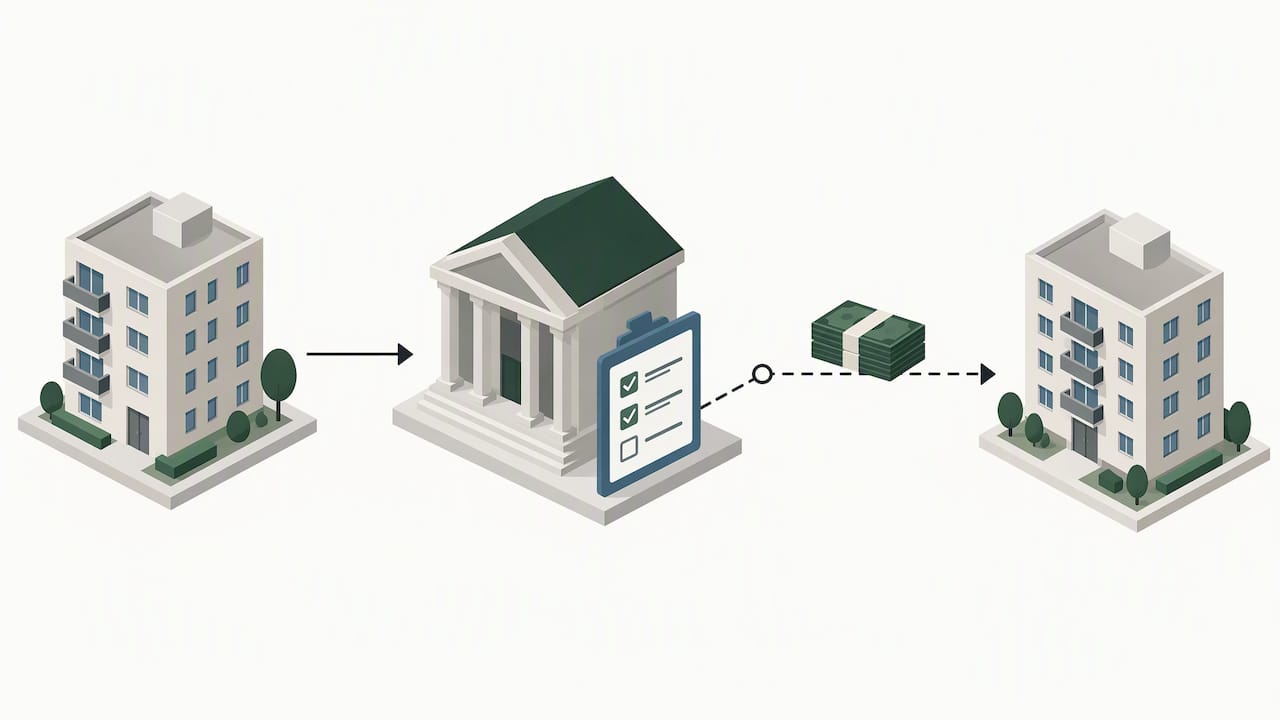
Equity is not only the 50% down payment. For an investor, the largest add-on is purchase tax (mas rechisha).
According to the Israel Tax Authority, an additional residential apartment is taxed at 8% on the value up to 6,055,070 NIS and 10% on the portion above that, under a temporary order valid until February 10, 2027. The same notice states that a sole dwelling has a much more generous exemption threshold, which does not apply to investors. Check the date before you plan a closing, because temporary orders are not guaranteed to be renewed. The Tax Authority also publishes an official purchase tax calculator in Hebrew. We explain the logic for buyers living abroad in our guide to purchase tax for foreign investors.
Other items to put in your model: attorney fees, brokerage, an appraiser, mortgage opening costs, registration costs, renovation or furnishing, and a vacancy reserve. Our overview of Israeli property registration shows where some of these arise.
Suppose a buyer has 1,300,000 NIS available and is looking at a 2,000,000 NIS apartment, with an appraisal that matches the price. These are hypothetical figures.
The buyer can proceed, but the reserve is thin. A buyer who borrows less, or looks at a 1,800,000 NIS apartment instead, has a much safer margin. This is the kind of arithmetic worth doing on three or four candidate apartments before you fall for one.
The interest rate your bank charges is built from two parts: the central bank’s rate environment and the bank’s own margin. The Bank of Israel’s interest rate stood at 3.25% as of its September 1, 2026 decision, down from 4% earlier in the year. You cannot negotiate that. The margin you can influence: the Bank of Israel says the spread depends on borrower risk, underwriting costs and competition between banks.
The mortgage reform makes comparing easier. Banks must provide a detailed approval in principle (ishur ekroni) within 5 to 7 business days of a complete application, and you can collect these offers without opening an account at each bank. The approval includes expected total interest, total payments, the first monthly payment and the highest expected monthly payment. That last figure matters most for an investor, because it shows what you pay if rates move against you.
A practical sequence:
For other funding routes beyond a standard bank mortgage, see our articles on ways to finance a home in Israel in 2026 and seven ways to finance Israeli real estate.
Foreign buyers, especially from the US, face the same LTV ceilings plus documentation. Banks typically want proof of income and of the source of the funds, and documents in another language may need translation. Ask your bank which documents it needs and in what form. If your papers were issued in Canada and need to be legalized for use abroad, this guide to apostille for Canadian documents explains how the process works for property purchases.
If you are a US taxpayer, remember reporting. Foreign financial accounts, including an Israeli account used for a mortgage, must be reported on the FBAR if the combined value of all foreign accounts exceeds $10,000 at any time in the calendar year. Speak to a US tax professional who knows Israel about your own situation, including how rental income and any sale are taxed in both countries.
For the legal side, start with our guides on Israeli real estate laws for US buyers and tips for international buyers. For the wider picture of structuring tax-efficient purchases, see our article on tax benefits and returns.
Leverage becomes dangerous in a few predictable ways.
A useful rule: if the apartment sat empty for six months and rates rose, could you still pay without selling? If not, borrow less.
We work with families, investors and overseas buyers around Beit Shemesh, and the most common mistake we see is starting from the apartment and working back to the financing. The better order is the reverse. Know your equity, your tax and cost bill, and the monthly payment you would be comfortable with in a bad year. Then look for an apartment that fits inside that.
We also encourage investors to treat the 50% ceiling as a maximum, not a target. In a market where buyers have more choice than they did a few years ago, you can often afford to wait for the right unit at the right price, and a smaller loan lets you do that. For new developments in particular, read the payment schedule carefully: staged payments to a developer change when your cash is needed compared with a resale purchase, and that affects when the bank money arrives.
Finally, compare the whole picture, not the headline price: total interest over the life of the loan, tax, fees and the expected rent. A well-chosen apartment with modest leverage usually beats a bargain with a stretched loan.
— Spiros
If you are weighing an investment purchase in Beit Shemesh, Jerusalem or the surrounding area, we can help you test financing numbers against specific projects and walk you through the purchase process step by step. You can start with our concierge project guidance, or browse developments such as Neve Amim, Rotshtein Heights and Olmaya. For the legal groundwork, our guide to Israeli real estate law basics is a good first read.
The Bank of Israel’s ceiling for an investment dwelling is 50% of the property’s value. That value is the lower of the contract price and the appraiser’s valuation. Your bank may lend less depending on your income and risk profile.
An investment home is defined as any dwelling that is neither your sole home nor a replacement home. A second apartment you keep alongside your existing one therefore falls into the 50% category. If you are selling your current home and buying another, the replacement rules may apply, so confirm your case with the bank and your attorney.
No. The loan is limited to a share of the property’s value. Purchase tax, legal fees and other costs come from your own pocket, so your cash needs are higher than the 50% down payment alone.
Ask each bank for an approval in principle. Banks must issue it within 5 to 7 business days of a complete application. Compare total expected payments and the highest expected monthly payment, not only the first monthly payment.