%20(4).png)
![[background image] image of cityscape background (for an architect firm)](https://cdn.prod.website-files.com/68961ade6feff9cbdffc080d/69384e066e0e9a310b6817f8_061f6bac-48bf-44b8-a689-078dacd8009f.avif)
TL;DR:
- Evaluating property listings involves triangulating valuation methods, analyzing full operating expenses, and completing thorough inspections to ensure sound investments. Using multiple valuation approaches and virtual tours helps identify red flags, while setting a firm offer floor before negotiations prevents emotional overspending. Discipline and data-driven analysis are essential for building long-term wealth in real estate.
Evaluating property listings is the process of systematically determining a property’s fair market value by applying proven valuation methods, analyzing operating expenses, and using digital tools to screen options before committing to a purchase. Done correctly, this process protects you from overpaying, uncovers hidden costs, and gives you a defensible number to anchor your offer. Tools like Automated Valuation Models (AVMs), platforms such as DealCheck and Mashvisor, and structured inspection frameworks all play a role. The industry term for this process is property due diligence, and combining it with formal valuation methods is what separates disciplined buyers from those who rely on gut feeling.
The three approaches every serious buyer should know are the Sales Comparison Approach, the Income Approach, and the Cost Approach. Using all three together, rather than relying on just one, is what produces a high-confidence fair value. Each method checks the others, and when they converge, you can move forward with real confidence.

The Sales Comparison Approach uses recent comparable sales, called “comps,” to establish a market-based price floor. The standard is 3-5 comparable sales within roughly 800 meters of the subject property, adjusted for differences in condition, size, location, and features. This method works best in active markets where transaction data is plentiful. In slower or niche markets, you may need to widen your search radius or accept older comps, which reduces precision.
The Income Approach calculates what a property is worth based on the income it generates. You start with gross rental income, subtract operating expenses, and arrive at Net Operating Income (NOI). From there, you apply a cap rate of 4-10% for residential rentals to derive an implied value. This method is most relevant for investors, but homebuyers in markets with strong rental demand can use it to understand whether a property is priced in line with its income potential.
The Cost Approach estimates what it would cost to rebuild the property from scratch, then adds land value. It is most useful for unique properties, older homes, or new construction where comparable sales are scarce. While it rarely produces the most precise number in a liquid market, it provides a useful ceiling. If the market price exceeds replacement cost by a wide margin, you are paying a premium that may not be recoverable in a downturn.
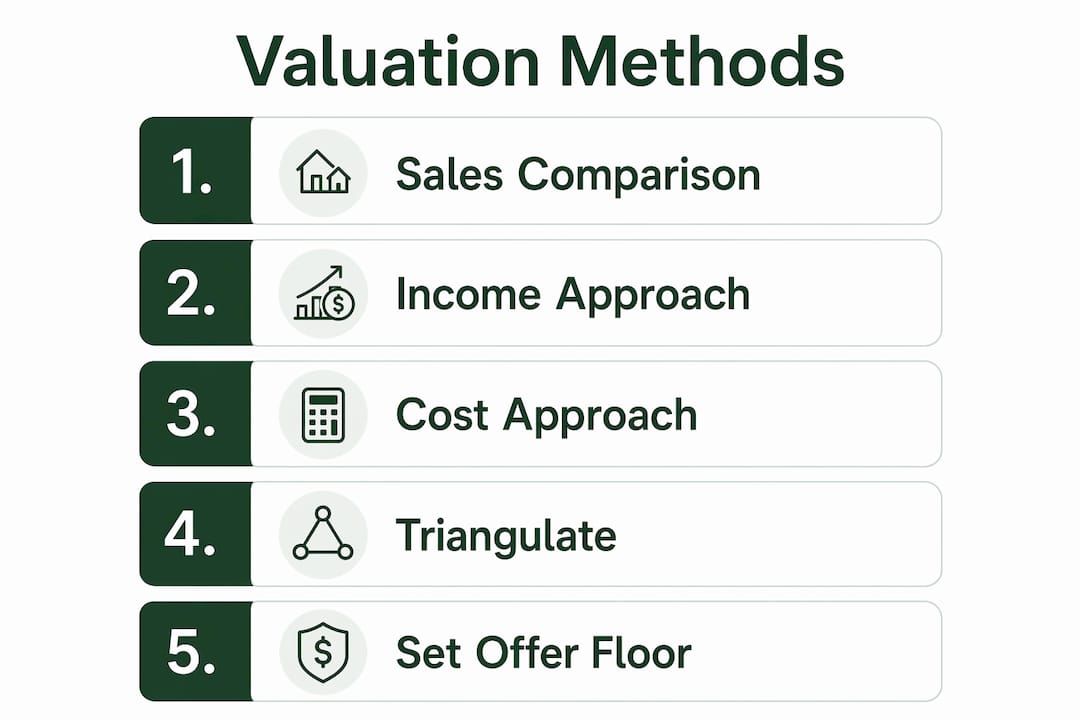
Triangulating the three methods is where the real insight comes from. When all three outputs land within 5% of each other, you have a reliable valuation. When divergence exceeds 8-10%, that is a signal to investigate further or adjust your offer. Relying on a single method is the most common valuation mistake buyers make, and it is entirely avoidable.
Pro Tip: Build a simple spreadsheet with one column per valuation method. If the outputs diverge by more than 8%, flag the listing for deeper research before scheduling a physical visit.
Accurate expense modeling separates profitable purchases from costly mistakes. Many buyers focus entirely on the purchase price and mortgage payment while ignoring the full cost of ownership. For rental investors, management fees run 8-12%, maintenance and repairs consume 5-10%, and vacancy allowance adds another 5-10% of gross income. These three line items alone can consume 20-30% of your expected rent before you pay a single dollar toward the mortgage.
The core financial metrics to calculate for every listing are:
Quick screening tools like the 1% rule (monthly rent should equal at least 1% of purchase price) and the 50% rule (operating expenses roughly equal 50% of gross rents) are useful filters, but they are not substitutes for a full financial model. Use them to eliminate obvious losers quickly, then build a complete model for every listing that passes.
Stress-testing your numbers is non-negotiable. Model a pessimistic scenario where rent comes in 10% below your projection and vacancy runs at 12%. If the deal still produces positive cash flow under those conditions, you have a resilient investment. If it breaks even only under best-case assumptions, the risk is too high. Tools like DealCheck and Mashvisor automate much of this modeling and let you run scenarios in minutes rather than hours.
Pro Tip: Never use the seller’s provided income and expense figures without independently verifying them against tax returns, utility bills, and local rental comps. Sellers routinely understate expenses.
AVMs from platforms like Zillow, Redfin, or Opendoor are useful for tracking market trends rather than setting individual deal prices. They lag the market by 2-4 months and miss non-public improvements like renovations or smart home upgrades. Use them to understand price direction in a neighborhood, not to determine what a specific property is worth.
Virtual and 3D tours have become a standard first-pass screening tool, and knowing what to look for makes them far more useful. When reviewing a virtual tour, work through these five areas in order:
Red flags in virtual tours include blurry or pixelated areas that may be hiding damage, rooms that appear in the floor plan but are absent from the tour, and listing photos that appear significantly older than the stated renovation date. Any of these warrants a direct question to the listing agent before you invest time in a physical visit. For a structured property viewing workflow, combining digital screening with on-site visits produces the most complete picture.
Physical inspections are where valuation theory meets reality. The five inspections that form a complete due diligence package are:
The five inspections typically cost between $400 and $1,000 in total, which is a negligible expense relative to the purchase price. Waiving them to speed up a transaction is one of the most expensive mistakes a buyer can make.
Use an off-ramp framework to classify each inspection finding. Green light means no material issues. Yellow flag means a defect exists but is quantifiable and priceable. Red flag means a significant defect that requires a price reduction or seller repair before proceeding. Walk-away means a defect so severe that no price adjustment makes the deal viable. This framework keeps emotion out of the decision and gives you a clear basis for negotiation.
Adjust your offer price by the cost-to-cure a defect, not by an arbitrary round-number discount. A $15,000 roof replacement is a $15,000 reduction request, not a $25,000 “lowball” that insults the seller and kills the deal.
For guidance on the documentation process and legal verification steps, working with an experienced local advisor reduces the risk of missing a critical item under time pressure.
Once you have run valuation, expense modeling, and inspections on two or more properties, you need a side-by-side framework to make a final decision. Assessing property listings in isolation is a trap. A property that looks strong on its own may look weak when placed next to a better-priced alternative with lower risk.
Build a comparison table for every shortlisted property that includes adjusted offer floor, expected NOI, cap rate, inspection risk flags, and your estimated 5-year appreciation scenario. This forces you to apply the same criteria to every option and removes the emotional pull of a “favorite” property that has not earned that status through the numbers. For a deeper look at how to compare properties in a structured way, a standardized framework saves significant time and reduces decision fatigue.
Set a firm offer floor before you enter any negotiation. The floor is the maximum price at which the deal still meets your minimum return threshold under your pessimistic scenario. If the seller will not accept a price at or below your floor, walking away is the correct decision. Discipline at this stage is what separates buyers who build wealth through real estate from those who simply own property.
Accurate property evaluation requires triangulating three independent valuation methods, modeling realistic expenses, and completing all five due diligence inspections before committing to an offer price.
| Point | Details |
|---|---|
| Triangulate three valuation methods | Use Sales Comparison, Income, and Cost Approaches together; divergence over 8-10% signals a pricing problem. |
| Model full operating expenses | Budget for management fees, maintenance, vacancy, and reassessment risk before calculating NOI or cap rate. |
| Use virtual tours as a screening filter | Focus on walls, layout, light, storage, and fixtures to identify red flags before a physical visit. |
| Complete all five inspections | Building, pest, strata, title, and vendor disclosure together cost under $1,000 and protect against major surprises. |
| Set a firm offer floor | Calculate your maximum acceptable price under pessimistic assumptions and walk away if the seller exceeds it. |
After working through property evaluations across multiple markets, the single most consistent finding is that buyers who rely on one signal, whether that is an AVM estimate, a seller’s income statement, or a gut feeling about a neighborhood, pay more and earn less than buyers who triangulate. The math is not complicated. What is hard is the discipline to run every method on every deal, even when you are excited about a property.
The most expensive mistake I have seen repeatedly is waiving inspections in a competitive market to win a bid. Buyers who do this are not being bold. They are transferring risk to themselves that the seller should carry. A $600 inspection that reveals a $40,000 foundation issue is the best money you will ever spend.
Neighborhood transaction velocity tells you more about a market’s direction than social media sentiment or news headlines. When properties in a specific area are selling in under 14 days, that is a data point. When they sit for 90 days, that is also a data point. Build your valuation assumptions around transaction data, not narrative.
The buyers who consistently make good decisions set their offer floors before they fall in love with a property. Once you are emotionally committed, your floor becomes negotiable. Before that point, it is not.
— Spiros
Yigal-realty specializes in residential properties in Beit Shemesh and surrounding areas, with a team that guides buyers through every stage of the evaluation process described in this article. From applying the right valuation frameworks to coordinating inspections and structuring offers, Yigal-realty provides the local market knowledge and professional support that turns a complex process into a clear decision. Whether you are a first-time homebuyer or an experienced investor, the team’s expertise in the Israeli residential market, combined with access to current project listings and flexible payment options, gives you a real advantage. Visit Yigal-realty to explore available properties and connect with an advisor who knows the market from the inside.
The three core methods are the Sales Comparison Approach, the Income Approach, and the Cost Approach. Using all three together and checking that their outputs converge within 5% produces the most reliable fair value estimate.
NOI equals gross rental income minus all operating expenses before debt service, including management fees, maintenance, vacancy allowance, taxes, and insurance. It is the foundation for cap rate and investment comparison across listings.
AVMs are useful for tracking market trends but not for pricing individual deals. They lag the market by 2-4 months and miss non-public improvements, so they should supplement, not replace, a full comparative market analysis.
The five standard inspections are building, pest, strata or HOA review, title search, and vendor disclosure review. Together they typically cost $400 to $1,000 and protect against the most common post-purchase surprises.
Residential rental cap rates typically range from 4% to 10% depending on the market and property type. A higher cap rate signals more income relative to price, but it often reflects higher risk or a less desirable location.