

If your money is in dollars and your apartment is priced in shekels, you carry currency risk from the day you sign until the day you pay the last installment. Hedging means fixing the exchange rate, or part of it, in advance. For most buyers the simplest hedge is also the best one: convert early, in stages, or match the currency you earn with the currency you owe. Complex derivatives are for specific cases and need a regulated provider.
This guide explains where the risk comes from, the realistic tools, what each one costs you, and how to build a plan around a purchase from a developer.
Most Israeli new-build contracts are denominated in shekels, usually with payments linked to a construction index. If you earn and save in dollars, euros or pounds, the price you actually pay in your own currency changes every day the shekel moves against it.
A simple example: a 3,000,000 NIS apartment. If you need to convert dollars at one rate when you sign and a rate 5% weaker for the dollar when the final payment is due, the same apartment costs you roughly 5% more in dollars. On this apartment that is the equivalent of 150,000 NIS, with no change in the property at all.
The risk runs in both directions. If the dollar strengthens, you pay less. Hedging is a decision to give up that coin flip. Whether you want to depends on how much a bad outcome would hurt you, not on a prediction of where the shekel is going. As the Bank of Israel explains, exchange rates are set by supply and demand, and the central bank can intervene, so nobody can promise a direction.

Not every buyer has a currency problem. Ask three questions.
If you are still working out the basics of an overseas purchase, our guide for expatriates buying an apartment in Israel covers the process end to end.
| Method | How it works | Main advantage | Main drawback |
|---|---|---|---|
| Convert everything at signing | You exchange the full amount and hold shekels until payments fall due | Total certainty, no contracts | You commit capital early and lose any favorable move |
| Convert in tranches | You exchange portions on a schedule that matches the payment plan | Averages the rate, simple | Some exposure remains on unconverted portions |
| Forward contract | You agree today on a rate for a future date | Fixes the rate for a known payment | Needs a regulated provider, can carry costs and obligations |
| Currency option | You pay a premium for the right, not the obligation, to exchange at a set rate | Keeps upside | Premium is a sunk cost |
| Shekel-denominated funding | You borrow in shekels against the purchase | Matches asset and liability | Subject to bank limits and your own income |
This is the plain option and it works. If you know that a payment of a given size falls due in eight months, you can exchange that amount now and keep it in a shekel account, or exchange it in several steps between now and then. You carry no derivative, no margin call and no counterparty.
The cost is the opportunity cost. If the dollar strengthens after you convert, you would have been better off waiting. That is the price of certainty, and it is the same price every hedge charges in a different form.
A forward is an agreement to exchange a set amount at a set rate on a future date. The CFTC’s overview of the FX market distinguishes the spot market, where trades settle within two days, from contracts that settle later, such as forwards. For a buyer, a forward is a way of saying: I know I will owe this many shekels on this date, so I fix today what they will cost me.
Two cautions. First, a forward is an obligation. If the shekel moves in your favor, you still exchange at the agreed rate. Experts note that a forward limits the downside and the upside together. Second, the rate you are quoted already includes the provider’s margin, which you may not see. Ask for the rate and compare it with the mid-market rate on the same day.
An option gives you the right to exchange at a given rate, and you pay a premium for that right. It keeps the upside, but the premium is gone whether you use the option or not. For a single, sizable, well-dated payment this can make sense. For a buyer who is unsure of the timing of payments, it is easy to overpay.
Bank of Israel rules set the maximum loan-to-value ratio at 75% for a single dwelling, 70% for a replacement dwelling and 50% for an investment dwelling. Standard Israeli mortgages are shekel loans, and the Bank of Israel’s housing loan directive governs how banks lend. A shekel loan for part of the price means that part is automatically matched to the asset: you owe shekels and own a shekel-priced property. This is often the cleanest “hedge” of all, but it only suits buyers who can qualify and who have, or will have, shekel income to repay it. Eligibility for non-residents varies by bank and by case, so confirm it with the lender.
Hedging is sold as protection, and that is exactly why it deserves scrutiny.
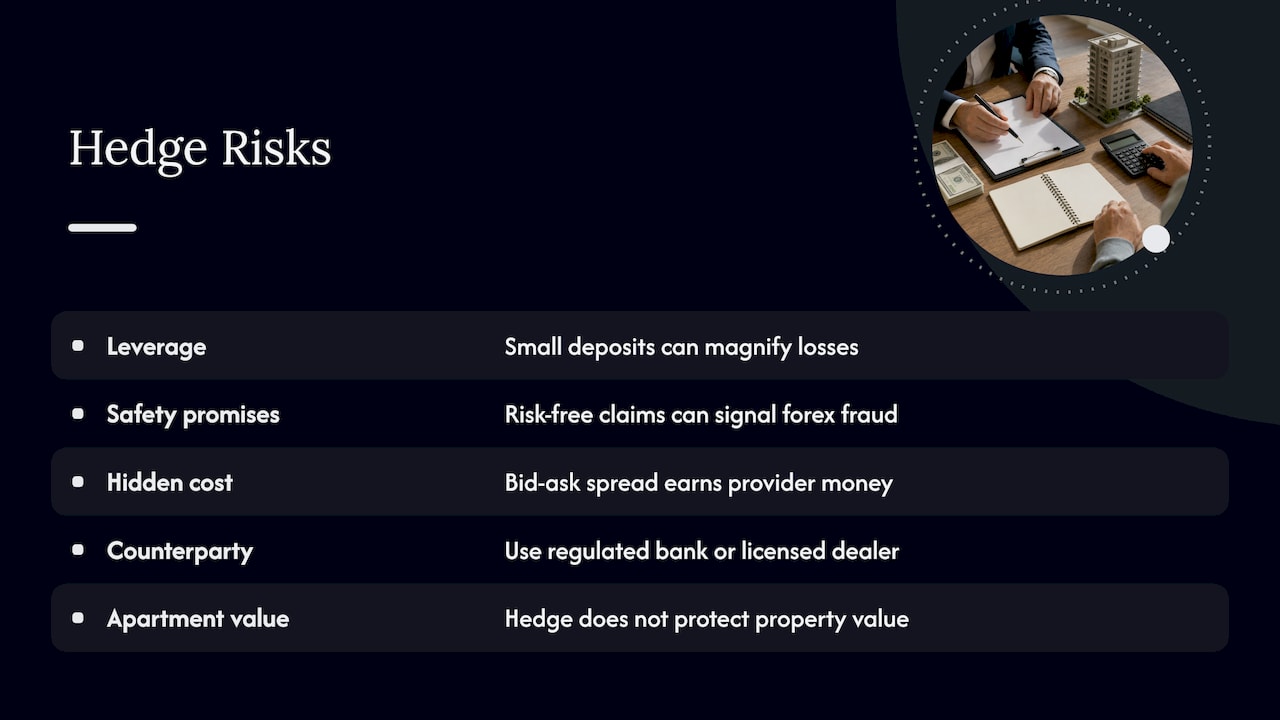
Leverage. Some retail forex products let you control a large contract with a small deposit. US regulators warn that such products can magnify losses quickly when prices move against you. A genuine hedge for a home purchase should not require you to post a margin that could be wiped out.
Promises of safety. The same CFTC and NASAA alert notes that advertisements stressing high returns with low risk are typical of forex fraud. If anyone tells you a hedging program is risk-free, walk away. The SEC’s guidance on foreign currency transactions likewise says forex can be very risky and is not suitable for every investor.
Hidden cost. “No commission” rarely means no cost. As a retail customer you are a price taker, and the bid-ask spread is where the provider earns its money. Ask for the all-in rate in shekels per dollar, not just the fee.
Counterparty risk. A hedge is only as good as the party on the other side. Use a regulated bank or a licensed dealer, and get the terms in writing.
The property itself. A currency hedge protects the exchange rate. It does not protect the value of the apartment. If prices fall, no hedge compensates you. Hedging manages one risk inside a purchase, and it is not an investment strategy.
Currency decisions interact with tax, and the interaction depends on your status.
Say you are buying a new apartment from a developer for 3,000,000 NIS with a payment schedule tied to construction milestones.
The percentages are an illustration, not advice. Your split should reflect how much a bad rate would cost you.
We work with families, investors and overseas buyers who are purchasing in Beit Shemesh and the surrounding area, and the currency question comes up in almost every conversation with a buyer abroad. Our view is simple.
First, decide the currency question before you fall in love with a project, not after. Buyers who set a budget in shekels at a rate they can live with make calmer decisions, and they negotiate better.
Second, resist complexity. A buyer with a clear payment schedule rarely needs anything more elaborate than converting on a plan. Where a derivative is considered, it should come from a regulated bank or dealer that you have vetted, never from a stranger who found you online.
Third, be honest about what a hedge cannot do. It cannot make an overpriced apartment a good deal, and it cannot guarantee that you ended up better off. Its job is to let you know your number.
We are brokers, not currency advisers, and we do not offer hedging products. What we do is sit with you early, lay out the real payment schedule of the project you are considering, and help you bring the right professionals in, a bank, a tax adviser and a lawyer, at the right time. For investment strategy beyond currency, see our investment tips for international buyers and our companion piece on protecting your home purchase from currency swings.
— Spiros
If you are weighing a purchase in Beit Shemesh or nearby, the first step is to see the actual payment terms of the project. Our concierge project guidance walks you through available developments, timelines and payment structures, with early access to new projects, so you can set your currency plan against real numbers. You can also look at individual projects such as Neve Amim, Olmaya or The Trilogy House.
Not automatically. Hedge the portion you are certain to pay on known dates, and treat later payments more cautiously, since schedules shift. The right share depends on how much a bad rate would strain your finances.
It can be, if it comes from a regulated bank or licensed dealer and covers a payment you will really make. It becomes risky when it involves leverage, margin deposits or a provider you cannot verify. It also locks you in even if the rate moves in your favor.
Partly. A shekel mortgage matches the borrowed part of the price to a shekel asset. Loan-to-value caps apply: 75%, 70% or 50% depending on whether it is a single, replacement or investment dwelling, according to the Bank of Israel. Whether you qualify depends on the bank and your profile.
No, and it can add complexity. For US taxpayers, currency gains and losses may be treated separately from the property result. Ask a cross-border tax adviser before you act.
It is a legitimate choice if you are sure of the purchase and want certainty. The downside is that you commit the money early and miss any favorable move. Many buyers split the difference and convert in stages.