%20(4).png)
![[background image] image of cityscape background (for an architect firm)](https://cdn.prod.website-files.com/68961ade6feff9cbdffc080d/69384e066e0e9a310b6817f8_061f6bac-48bf-44b8-a689-078dacd8009f.avif)
Wire your purchase funds directly to your Israeli attorney’s escrow account or to your own Israeli bank account, and do it through a specialist FX broker rather than your home bank if the sum is large. The single move that saves you the most time and stress is building a complete source-of-funds package, bank letter, recent statements, and a lawyer confirmation, before you initiate anything. Budget 5 to 10 business days for a first-time transfer, longer if compliance flags anything.
TL;DR:
- Building a complete source-of-funds package before initiating the transfer can prevent delays caused by additional paperwork requests.
- Using a specialist FX broker can reduce currency conversion costs by 1 to 3 percent compared to retail banks, especially for large sums.
- Providing all required documentation, including bank statements and lawyer confirmation, within 30 to 45 days of transfer minimizes compliance delays.
- Confirming beneficiary details and referencing the property in your wire instructions helps avoid errors that can hold up the transfer.
- Engaging a local realty team early can help coordinate payment schedules with the legal process and avoid costly last-minute errors.
Most buyers choose between three routes, and the right one depends on how far along the deal is and whether you already have an Israeli bank account.
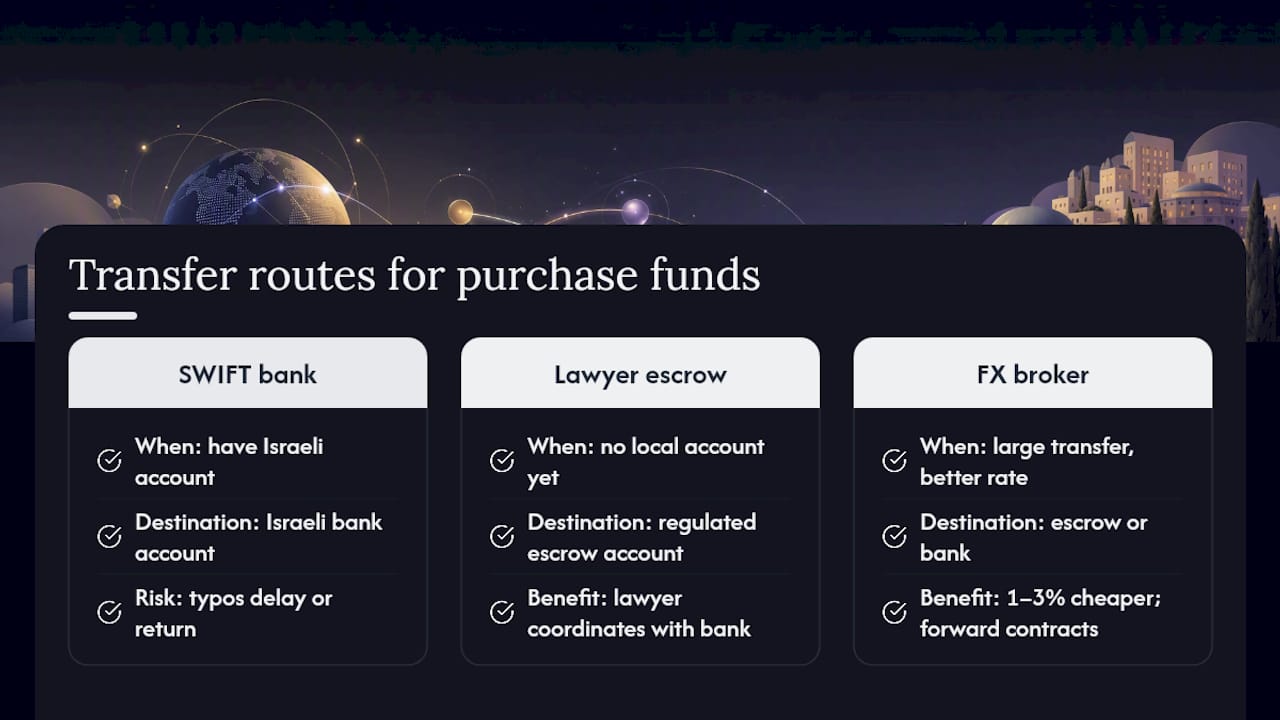
A SWIFT wire straight to an Israeli bank account is the most direct option once you have one open. It typically works fine, but delays creep in fast when the IBAN, SWIFT code, or beneficiary name does not match exactly what the bank has on file. A single typo in a name (missing middle name, transliteration difference) is enough to get funds held or bounced back to the sender, adding days you cannot afford near a closing deadline.
Wiring to your lawyer’s escrow account is the more common route for buyers who have not yet opened a local account, and it is widely accepted because regulated escrow accounts are the standard destination for inbound purchase funds. Your attorney’s trust account sits at an Israeli bank too, so the same AML checks apply, but the lawyer already has your file and can move faster with the receiving bank on your behalf.
Specialist FX brokers often beat retail bank rates by 1 to 3 percent on large transfers, which is real money on a property-sized sum. Many can wire directly into an escrow account and offer forward contracts for buyers locking in a rate ahead of a future payment date.
Banks and attorneys in Israel work from a fairly consistent checklist, and having it ready before you wire anything avoids the single biggest cause of delay: a bank asking for paperwork after the money has already landed.
Banks apply a risk-based approach under Bank of Israel Directive 411, meaning enhanced due diligence kicks in for large transfers, complex ownership structures, politically exposed persons, or funds originating in jurisdictions the bank flags as higher risk. In those cases, expect a request for additional explanation or even a professional opinion backing up the source of funds.
Pro Tip: Keep every document dated within 30 to 45 days of the transfer. A bank statement from three months ago looks stale to a compliance officer, even if nothing about your situation has changed.
If any document is in a foreign language, get it translated to Hebrew, and if you are signing a power of attorney abroad, it needs an apostille before an Israeli bank or lawyer will accept it.
A routine SWIFT transfer to an Israeli account usually clears in 2 to 5 business days. First-time transfers, or ones missing a piece of documentation, commonly stretch to 7 to 10 business days or more, since the receiving bank has to complete its own checks before releasing funds to the seller’s side.
Israeli banking rules set specific reporting triggers that shape how your transfer gets handled. Cash deposits or withdrawals of NIS 50,000 or more require reporting, and cross-border transfers of NIS 1,000,000 or more must be reported as well, with lower thresholds applying automatically for transfers connected to jurisdictions on the bank’s high-risk list.
A few habits keep you off the delay list:
Retail banks are rarely the cheapest way to convert currency for a property-sized sum. Specialist FX brokers routinely undercut them by 1 to 3 percent, and on a $500,000 purchase, that gap alone can run into several thousand dollars.
A forward contract lets you lock today’s exchange rate for a payment due months from now, which matters most for off-plan purchases with completion dates 12 to 36 months out. You pay a small fee or deposit, but you remove the risk of the shekel moving against you before the final payment is due.
Three practical tactics buyers use:
Remember that non-resident buyers also face an 8% to 10% purchase tax depending on price, so factor that into how much you convert, not just the headline purchase price. A currency comparison guide is worth a look if you want a wider view of how bank and broker rates typically diverge before you commit to one provider.
An Israeli bank account is not strictly required to close a purchase. Escrow through your lawyer covers most transactions, but an account becomes practically useful if you plan to pay ongoing costs like property tax or utilities, or if you are financing part of the purchase with an Israeli mortgage.
Pro Tip: Never wire the full purchase amount without your lawyer’s written confirmation that the escrow account is open and ready to receive it. A one-day delay on that confirmation is far cheaper than a wire sent to the wrong account.
Buyers moving funds into Beit Shemesh and the surrounding area face the same compliance system every foreign buyer does, but a local team that has walked through it repeatedly catches problems before they cost you days. A local team can help international buyers align payment schedules against contract milestones so the transfer timeline matches when the seller’s lawyer expects to see funds land.
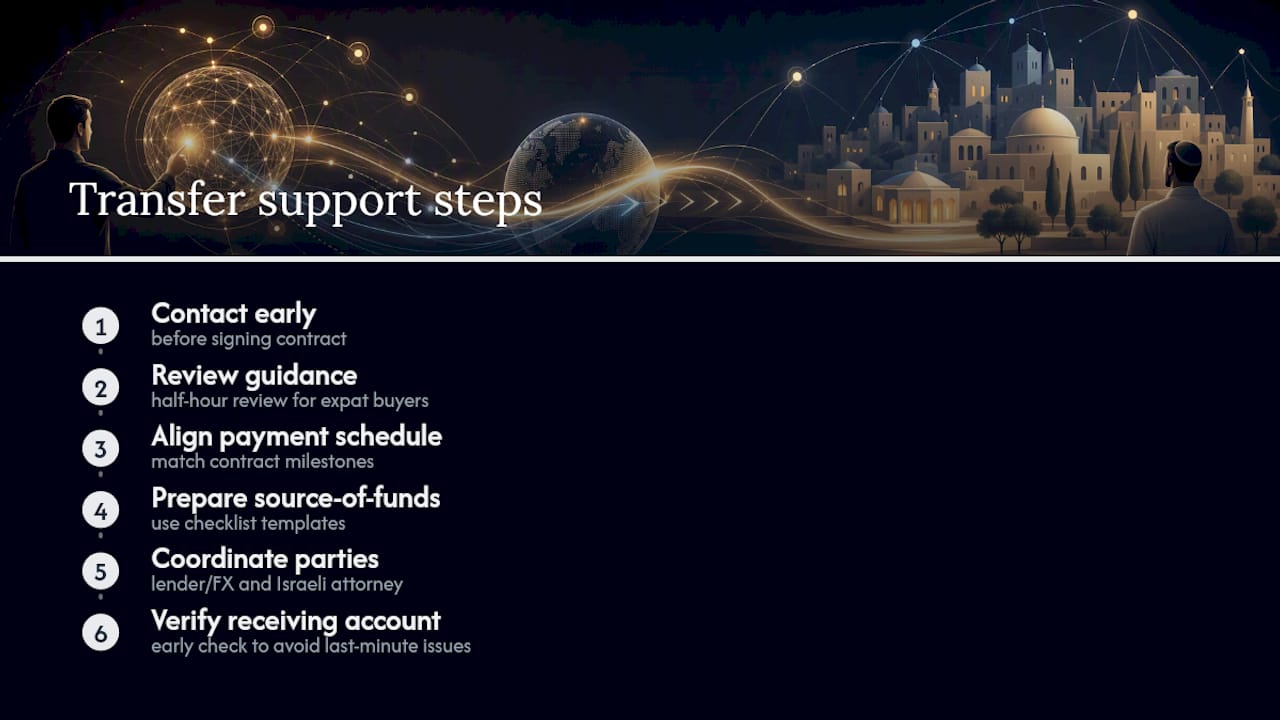
This includes practical help such as checklist templates for your source-of-funds package, coordination between your lender or FX provider and the Israeli attorney handling escrow, and early verification of the receiving account so nothing gets discovered at the last minute. If you are still mapping out your purchase timeline, reviewing Yigal Realty’s guidance for expatriate buyers before you transfer anything is worth the half hour it takes.
Reach out to Yigal Realty early, ideally before you sign a contract, so your payment plan and documentation are ready before the clock starts.
— Spiros
Retail banks and generic FX apps will convert your money, but neither one knows that your closing date is tied to a specific contract milestone or that your lawyer needs a confirmation letter before the seller will proceed. A local realty team familiar with the area can help identify which escrow accounts, lawyers, and lenders are most efficient, and provide guidance on source-of-funds documentation before you wire funds.
If you are planning a purchase in Beit Shemesh or the surrounding communities, contact Yigal Realty now to walk through your payment schedule and get a documentation checklist matched to your specific contract, before your transfer clock starts running.
The compliance thresholds and bank requirements cited here come from the Prohibition on Money Laundering banking order and Bank of Israel Directive 411. Practical FX and documentation guidance draws on the property transfer FX guide and the proof-of-funds breakdown referenced throughout, both worth a direct read if you want the primary language behind these rules.
This article is general information, not a substitute for advice from a qualified financial advisor. Consult a qualified financial professional about your own circumstances before acting on anything here.
Cash deposits or withdrawals of NIS 50,000 or more trigger reporting, and cross-border transfers of NIS 1,000,000 or more must be reported, with lower thresholds for transfers tied to high-risk jurisdictions.
Escrow is standard when you do not yet have an Israeli account open, and it is widely accepted by banks and sellers alike; opening your own account makes sense mainly if you need it for ongoing costs or financing.
Routine SWIFT transfers clear in 2 to 5 business days, but first-time transfers or ones missing documentation often take 7 to 10 business days or longer.
Yes. Yigal Realty works with international buyers to align transfer timing with contract milestones and coordinates document requirements with local lawyers and lenders before funds move.
Sending money before the source-of-funds package is complete, which is the single most common reason banks put a hold on incoming property transfers.