

Yes, you can reduce exchange-rate risk when buying an Israeli home. The three main options are converting funds to shekels early and holding them, taking a mortgage denominated in NIS, or buying explicit FX protection through forwards or options. Each carries a real cost. The practical next step is to get mortgage approval in principle and ask your bank directly about FX clauses before you sign anything.
TL;DR:
- Hedging costs are justified mainly for staged payments over many months or for buyers whose income remains in foreign currencies long after purchase.
- A staged approach to currency hedging, such as converting funds immediately for the deposit and using forward contracts for specific milestones, reduces market timing risk.
- The risk premium embedded in forward and option hedges indicates that protection against NIS movements is never free, and rates vary with market volatility.
- The majority of currency exposure comes from deposit payments, construction milestones, and mortgage draws, which can be sized by multiplying owed amounts by potential rate moves and payment timelines.
- It is essential to confirm your immigration status, tax thresholds, and mortgage options early, as these factors significantly influence the cost and strategy of currency protection.
Currency risk in an Israeli property purchase comes in two forms: a one-off shock, like the rate moving between the day you sign a contract and the day you wire the deposit, and ongoing exposure, where payments are staged across months or years while your income stays in dollars, euros, or another foreign currency. Developer contracts in Israel commonly split payment across several milestones, and each one is a separate currency event.
Common exposure points include:
You can roughly size your exposure by multiplying the amount still owed in a foreign currency by how much the rate could plausibly move and by how long you have until that payment falls due. Hedging is effectively insurance: you pay a known cost now to avoid an unknown cost later, and that trade only makes sense once you have actually measured what you are protecting against.
Israeli purchase tax rules change the math on how much currency exposure is actually worth hedging, and new immigrants get meaningfully different treatment than other buyers. Under the Gov, eligible olim pay no purchase tax on apartments up to 2 million NIS, with a 0.5% rate applying to the portion between 2 million and 6 million NIS. The practical gap is large: a 4.1 million NIS apartment carries a substantially lower purchase tax for an eligible new immigrant compared to a veteran resident, and a 5.6 million NIS apartment also shows a significantly reduced tax for new immigrants versus veterans, according to the same gov.il guidance.
Before you lock in any hedge, confirm your olim status documentation is current, since banks and the tax authority both require proof of eligibility timed to the purchase date. A few points to flag early:
Our guide to unlocking tax benefits walks through these rules in more depth.
Retail and institutional buyers in Israel have a handful of realistic ways to lock in an exchange rate ahead of a payment. A forward contract fixes today’s rate for a future date, with your bank or a licensed FX broker as counterparty. Forwards suit a known payment amount and date, like a developer milestone six months out, but banks often set minimum deal sizes that put small forwards out of reach for a single apartment deposit. An FX swap works similarly but is more common for larger, recurring flows.
Options give you asymmetric protection: you pay a premium up front for the right, not the obligation, to convert at a set rate, so you benefit if the market moves in your favor and still have a floor if it does not. Bank of Israel research on forward call options shows that option prices carry a risk premium, a market-based signal of what buyers are willing to pay for that kind of insurance against NIS movements.
Bank of Israel forward-at option pricing shows that a measurable risk premium is embedded in every hedge, according to the Bank of Israel’s research on forward call options, which means the “insurance” is never free even when the odds favor you.
For individuals, access routes include:
Cost drivers to expect: the length of the contract, current market volatility, the size of the amount being hedged, and the counterparty’s credit terms.
How much you borrow, and in what form, changes how much currency exposure is left for you to manage. Under Bank of Israel banking directive 329, loan-to-value limits are capped at 75% for a single dwelling, 70% for a replacement home, and 50% for an investment property, with payment-to-income constraints layered on top. A larger mortgage in shekels reduces the foreign-currency amount you need to convert or hedge.
Israeli mortgages are typically split across tracks:
Indexation affects your real payment over time independent of any currency move, so it deserves its own line in your planning. Request an approval-in-principle with a full cost forecast before comparing lenders, since the format is now standardized across banks.
A currency-protection plan works best when it follows the purchase timeline rather than being bolted on at the end.
Each step has a natural point of contact: your mortgage officer for financing terms, a real-estate lawyer for contract language, an FX broker for pricing, and your agent for coordinating timing across all three.
Pro Tip: If your payments stretch over many months, hedge them in stages rather than all at once, so you are not locking in a single rate for money you will not need for a year.
A real estate firm offers specialized services for observant and religious community developments in Beit Shemesh and surrounding areas, and maintains an international office to support clients purchasing from abroad. The firm’s project pages, including Neve Amim, Eucalyptus, and Rotshtein Heights, lay out staged payment schedules buyers need for currency planning.
Concrete support includes:
Our tips for international buyers cover more of this process.
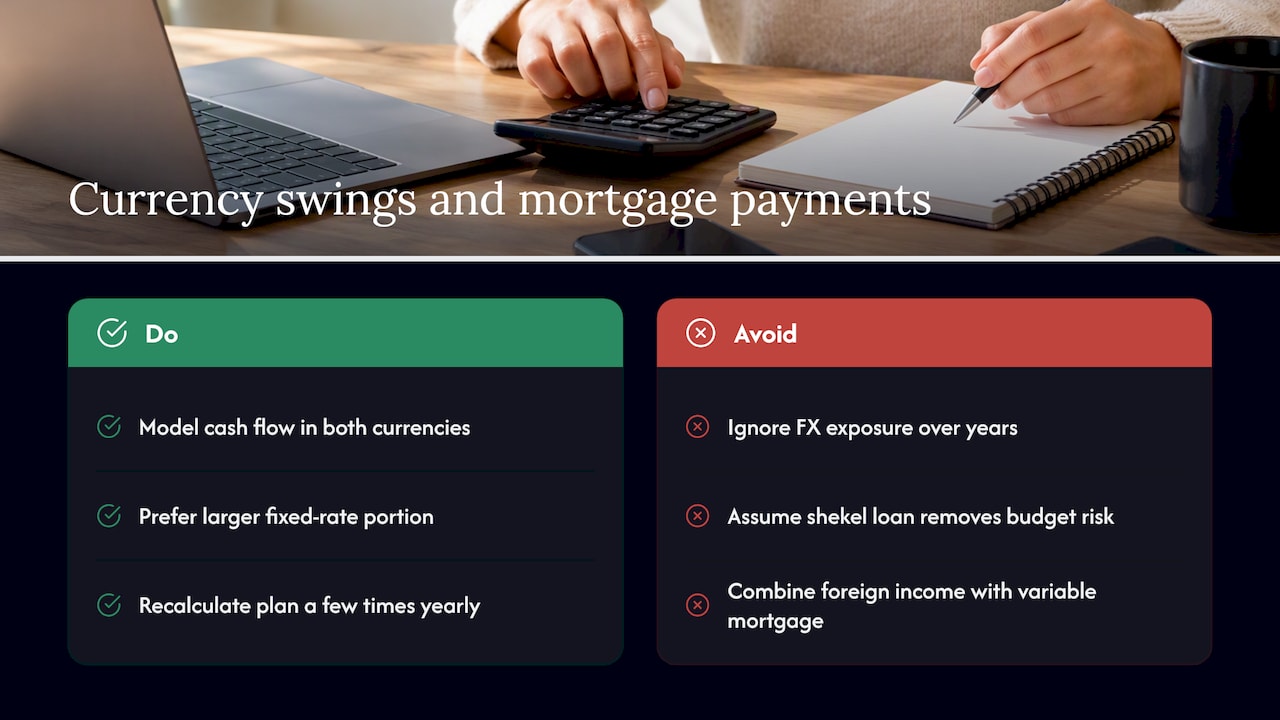
A mortgage denominated in shekels removes direct currency risk from the loan itself, but it does not remove currency risk from your household budget if your income arrives in dollars, euros, or another foreign currency. Every monthly payment effectively gets more or less expensive in your home currency as the exchange rate moves, even though the shekel amount never changes.
This matters most for buyers planning to service the mortgage from overseas earnings for years rather than months. A rate move of a few percentage points, sustained over a mortgage term of 20 or 25 years, changes the real cost of homeownership even if the shekel payment itself stays flat. Buyers who plan to relocate income to Israel eventually face a shorter window of exposure than those who intend to keep earning abroad indefinitely.
The prime-based and variable mortgage tracks add a second layer on top of currency movement, since the shekel payment itself can shift with domestic interest rates. Pairing a currency-sensitive income with a rate-sensitive mortgage track compounds the uncertainty, which is one reason many foreign buyers lean toward a larger fixed-rate portion even if it costs slightly more today. Building a simple monthly cash-flow model in both currencies, updated a few times a year, is a low-cost way to see the real picture before it becomes a problem. Our investment tips for international buyers walk through this kind of planning in more detail.
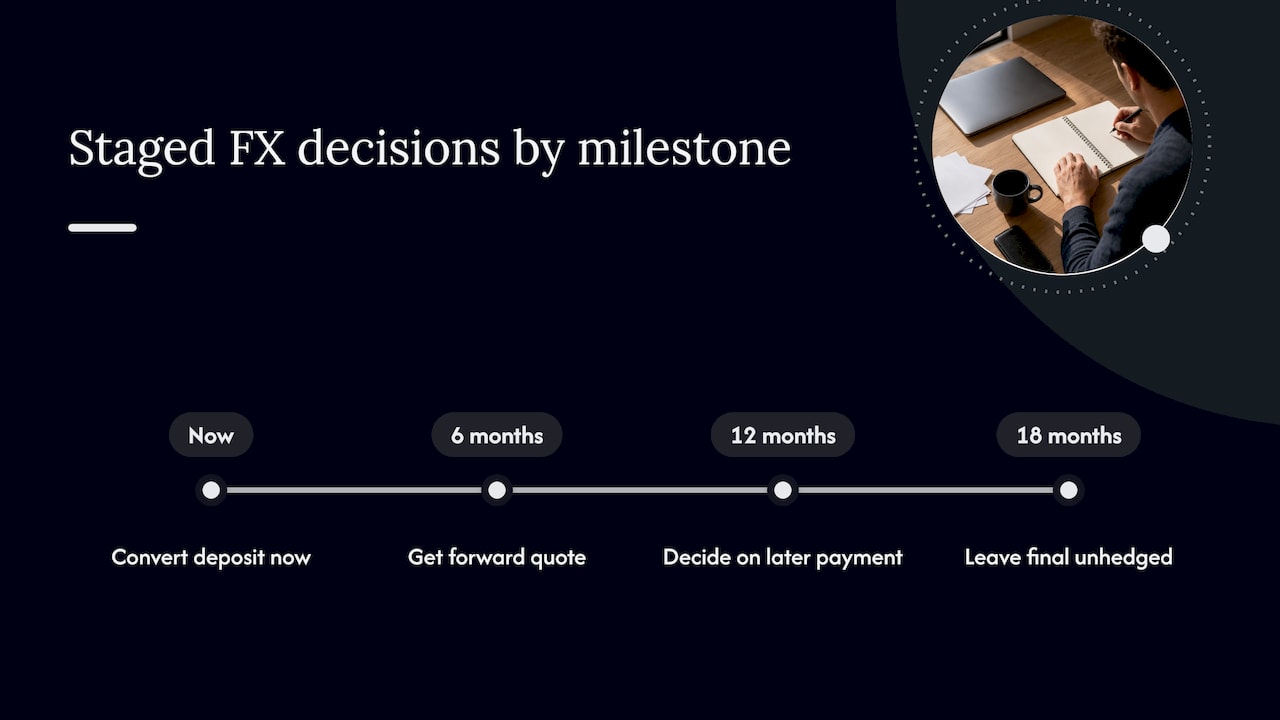
Consider a buyer earning in US dollars who signs a contract for a new-build apartment with payments staged across four milestones over 18 months. Left unhedged, each payment is exposed to whatever the dollar-shekel rate happens to be on that date, and an unfavorable swing on a later, larger milestone could add a meaningful amount to the total cost with no way to plan around it.
A more deliberate approach treats each milestone as its own decision. The buyer might convert funds for the deposit immediately, since it is due almost right away, then get a forward quote for the milestone due in six months once the amount and date are fixed in the contract, and leave the final milestone unhedged if it is too far out to price sensibly. This staged approach spreads the decision-making across the timeline instead of forcing one all-or-nothing call at signing.
Another common pattern involves a buyer taking a larger shekel-denominated mortgage specifically to shrink the amount of foreign currency that needs converting at all, using the loan-to-value limits under Bank of Israel directive 329 as the ceiling for how much of the purchase price can be financed that way. In both patterns, the common thread is that the decision follows the payment schedule rather than a single guess about where the market is headed. Our expatriate buying guide covers similar scenarios buyers commonly face.
Currency risk does not end at closing if you are still repaying a mortgage or holding foreign-currency savings earmarked for future Israeli expenses. A simple habit worth keeping is reviewing your exposure on a fixed schedule, quarterly is reasonable for most homeowners, rather than reacting to every headline about the shekel.
If your mortgage sits on a prime-based or variable track, watch both the exchange rate and the Bank of Israel’s interest-rate decisions together, since the two can move independently and sometimes in offsetting directions. Buyers who hedged only part of their original exposure should revisit that decision as remaining payments come due, since a partial hedge made sense at signing but may look different a year later depending on how rates have moved.
For homeowners planning to eventually move their income to Israel, gradually converting savings rather than waiting for a single ideal moment reduces the risk of mistiming the market. Keeping documentation of every conversion and hedge, including the dates and rates used, also makes future tax reporting and any bank inquiries considerably simpler.
Sorting out payment timing, bank documentation, and olim tax paperwork on your own adds real friction to an already complicated purchase. Yigal Realty’s concierge project guidance service helps international buyers align developer payment schedules with mortgage draws and flags the immigration and tax documents your bank will ask for along the way.
If you are weighing a purchase in Beit Shemesh or the surrounding area and want a coordinated point of contact across your bank, lawyer, and developer, reach out through Yigal Realty to start that conversation.
Hedging is usually worth its cost when payments are staged over many months or when your income will stay in a foreign currency for years after closing, but it is not automatically the right call for every buyer. A small deposit due next week rarely justifies a forward contract’s paperwork and minimums. Before signing anything, pair your mortgage approval-in-principle with two or three actual FX quotes, since comparing real numbers beats guessing at what protection is worth.
— Spiros
This article is general information, not a substitute for advice from a qualified financial advisor. Consult a qualified financial professional about your own circumstances before acting on anything here.
Buyers typically arrange a structural and systems check of the property, review the land registry (Tabu) extract, and confirm the building permit matches what was actually built. A real-estate lawyer usually coordinates these checks alongside the standard title and lien review before contract signing.
Legal fees for an Israeli property purchase are commonly negotiated as a percentage of the sale price plus VAT, though exact rates vary by lawyer and transaction complexity. Ask for a written fee quote before engaging counsel, since there is no fixed national rate.
Purchase tax for a foreign resident depends on the specific property price and whether the buyer qualifies for any immigrant-related discount under gov.il rules; a non-eligible foreign buyer generally faces the standard investment-property tax brackets rather than the olim discount. Confirming eligibility and current thresholds directly on the gov.il page before signing is the safest approach.
A shekel-denominated mortgage removes currency risk from the loan balance itself, but you may still have exposure on the down payment, fees, and any developer payments due before the mortgage is drawn. Reviewing your full payment schedule against your mortgage draw dates is the way to see what, if anything, still needs protecting.
Current loan-to-value and payment-to-income limits are published in Bank of Israel banking directive 329, which sets the caps banks must follow for single dwellings, replacement homes, and investment properties. Checking this source directly is more reliable than relying on secondhand summaries, since limits can be revised.