%20(4).png)
![[background image] image of cityscape background (for an architect firm)](https://cdn.prod.website-files.com/68961ade6feff9cbdffc080d/69384e066e0e9a310b6817f8_061f6bac-48bf-44b8-a689-078dacd8009f.avif)
TL;DR:
- Closing costs in Israel range from 7% to 15% of the property price and include taxes, legal fees, agent commissions, and registration charges. Foreign buyers pay higher costs, often totaling 10% to 16%, with purchase tax starting at 8% on the first shekel. All closing costs must be paid in cash within 60 days, as they cannot be financed through a mortgage.
Closing costs in Israel are the mandatory fees and taxes buyers pay on top of the property purchase price, typically ranging from 7% to 15% of the total transaction value. The industry term for this collection of charges is “transaction costs,” and it covers everything from purchase tax (Mas Rechisha) to legal fees, Land Registry fees, agent commissions, and VAT. Foreign buyers consistently pay at the higher end of that range. Explaining closing costs in Israel requires breaking down each component clearly, because the gap between what buyers expect to pay and what they actually owe is often significant.
Purchase tax, known as Mas Rechisha, is the single largest closing cost for most buyers. Israeli residents buying their first home benefit from a zero-tax threshold on the lower portion of the purchase price, with progressive rates applying above that. Foreign buyers and investors receive no such relief. They pay 8% on amounts up to ₪6,055,070 and 10% on anything above that figure, starting from the first shekel.
Legal fees are the second major expense in any Israeli property transaction. Attorneys in Israel typically charge 0.5% to 1.5% of the property value, plus 18% VAT on top of that fee. Registration fees, municipal charges, and property appraisals are generally not included in that quoted percentage. Buyers who assume the attorney’s fee covers everything often get surprised by an additional 0.5% to 1% in government and registration charges.
Agent commissions add another layer to the total. Standard broker fees in Israel run at 2% of the purchase price, plus 18% VAT. That means a buyer purchasing a ₪3,000,000 apartment pays ₪60,000 in commission before VAT is added.
Here is a quick breakdown of the core closing cost categories:
One fact that surprises many buyers is that closing costs cannot be financed through a mortgage in Israel. Every shekel of these fees must be paid in cash at or shortly after signing. Buyers who plan their mortgage carefully but forget to reserve liquid funds for closing costs find themselves in a serious cash flow bind.
Pro Tip: Request a full written fee breakdown from your attorney before signing any engagement letter. Ask specifically which items are included in the quoted percentage and which are billed separately.
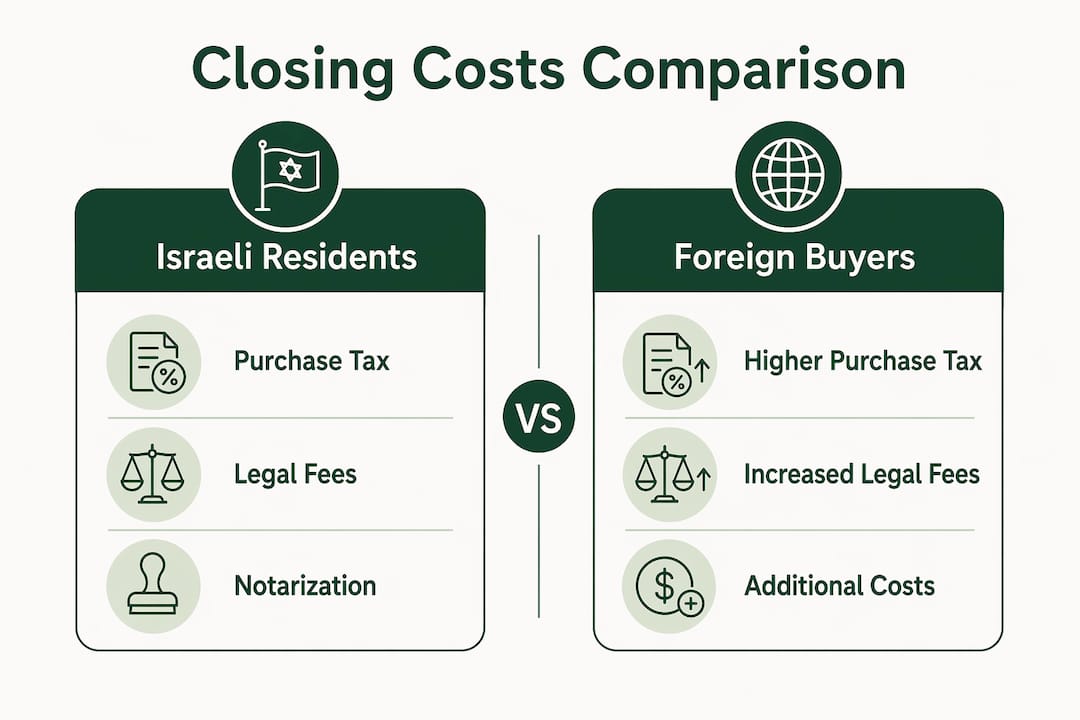
The gap between resident and foreign buyer costs is substantial. Israeli residents purchasing their first home pay zero tax on the lower portion of the purchase price, with rates rising gradually above that threshold. Foreign buyers and non-residents pay purchase tax from the very first shekel, with no exemption and no reduced entry rate.
Foreign buyer closing costs including purchase tax and all associated fees typically run 10%–13% of the property price for standard transactions. Complex or higher-value purchases push that figure to 13%–16%. That difference versus the resident range of 7%–10% represents a meaningful sum on any property priced above ₪2,000,000.
| Cost category | Israeli resident (first home) | Foreign buyer / non-resident |
|---|---|---|
| Purchase tax entry rate | Zero on lower bracket | 8% from first shekel |
| Purchase tax upper rate | Progressive above threshold | 10% above ₪6,055,070 |
| Legal fees | 0.5%–1.5% plus VAT | Often higher due to complexity |
| Agent commission | 2% plus VAT | 2% plus VAT |
| Total closing cost range | 7%–10% | 10%–16% |
Legal fees for foreign buyers are often higher than for residents because of additional documentation requirements. Power of attorney arrangements, tax treaty analysis, and cross-border compliance all add billable hours. Buyers should ask attorneys upfront whether their quoted fee accounts for these foreign-buyer complexities.
Timing is another pressure point. Purchase tax must be paid within 60 days of signing the purchase contract. For off-plan purchases, that clock starts at contract signing, not at completion. Foreign buyers wiring funds from abroad need to account for bank processing times and currency conversion delays.
Pro Tip: If you are buying from outside Israel, consult a real estate attorney familiar with US buyers before signing anything. The 60-day tax payment window leaves little room for administrative delays.
VAT is the most consistently overlooked cost in Israeli real estate transactions. Buyers see a quoted legal fee of 1% and mentally add that to their budget. They forget that 18% VAT applies on top of that fee, on the agent commission, and on various other professional services. That VAT load adds up quickly on a multi-million shekel transaction.
The following costs frequently fall outside what buyers initially budget:
Notarization is another cost that catches foreign buyers off guard. Documents signed outside Israel often require notarization for real estate purposes before Israeli authorities will accept them. That step adds both cost and time to the process.
Transparent, written fee breakdowns from legal professionals are the single best defense against budget surprises. Any attorney unwilling to provide a written itemization of fees before engagement is a red flag worth taking seriously.
Accurate budgeting for Israel property transaction costs starts with a complete checklist, not a rough estimate. Buyers who approach closing costs as a single line item consistently underestimate what they owe.
Calculate purchase tax first. Use the Israeli Tax Authority’s published brackets to estimate your Mas Rechisha liability based on your buyer category (resident, investor, or foreign buyer). This is your largest variable cost and should anchor the entire budget.
Get written legal fee quotes from at least two attorneys. Ask each attorney to specify what is and is not included. Confirm whether registration fees, municipal charges, and VAT are part of the quoted figure or billed separately. Review the legal fees breakdown for Israeli property purchases before those conversations.
Add agent commission with VAT. Budget 2% of the purchase price plus 18% VAT as a fixed line item. Do not assume this is negotiable until you have confirmed otherwise with your specific agent.
Reserve cash for closing costs separately from your mortgage funds. Since closing costs cannot be financed, they must come from liquid savings. Keep this pool separate and accessible before you sign.
Account for currency conversion costs. If you are transferring funds from abroad, compare rates across multiple services. The spread between the mid-market rate and the bank’s offered rate on a $500,000 transfer can easily exceed $5,000.
Build a 5% contingency buffer. Municipal charges, late fees, and unexpected legal complexity can push costs above initial estimates. A buffer prevents a single surprise from derailing the transaction.
Buyers purchasing in Beit Shemesh or surrounding areas can find a detailed Beit Shemesh buyer’s cost guide that covers local-specific fees and tax considerations in depth.
Closing costs in Israel are a defined, unavoidable set of fees that buyers must pay in cash, and foreign buyers consistently pay more than residents due to purchase tax structure.
| Point | Details |
|---|---|
| Total cost range | Closing costs run 7%–15% for residents and 10%–16% for foreign buyers. |
| Purchase tax is the biggest item | Foreign buyers pay 8%–10% from the first shekel, with no zero-rate threshold. |
| Legal fees carry VAT | Attorney fees of 0.5%–1.5% are subject to 18% VAT, plus separate registration charges. |
| Cash payment required | Closing costs cannot be financed through a mortgage and must be paid upfront. |
| 60-day tax deadline | Purchase tax must be paid within 60 days of contract signing or penalties apply. |
The pattern I see most often is not ignorance. It is selective budgeting. Buyers research the purchase price carefully, negotiate hard on the property itself, and then treat closing costs as a vague afterthought. By the time the attorney sends the final fee schedule, the buyer is already emotionally committed to the deal and has little leverage to adjust.
The foreign buyer situation is particularly sharp. Israel’s tax environment for non-residents offers no entry-level relief. A buyer coming from the United States or United Kingdom is accustomed to systems where first-time buyer exemptions or reduced rates soften the blow. In Israel, that cushion does not exist for foreign nationals. The purchase tax rates for non-residents apply in full from shekel one, and the 60-day payment clock starts immediately at contract signing.
My strongest recommendation is to treat the closing cost calculation as a prerequisite to viewing properties, not a follow-up task. Know your purchase tax liability before you fall in love with a specific apartment. Know your attorney’s full fee structure before you sign an engagement letter. The buyers who do this work upfront close with confidence. The ones who skip it often face a stressful scramble for cash in the final weeks before closing.
— Spiros
Yigal-realty works with homebuyers and investors across Beit Shemesh and surrounding areas, including a dedicated international client base served through its New York office. The team provides personalized cost breakdowns covering purchase tax, legal fees, agent commissions, and registration charges before buyers commit to a transaction. That upfront clarity is what separates a smooth closing from a stressful one. Whether you are a first-time buyer navigating Israeli real estate for the first time or an experienced investor managing a portfolio, Yigal-realty offers direct access to agents who understand both the local market and the specific cost structure foreign buyers face. Contact Yigal-realty to get a tailored closing cost estimate for your next property purchase.
Closing costs in Israel are all fees and taxes paid by the buyer on top of the property purchase price, including purchase tax, legal fees, agent commissions, and registration charges. They typically range from 7% to 15% of the purchase price depending on buyer category.
Foreign buyers typically pay 10%–16% of the purchase price in total closing costs. Purchase tax alone runs 8% on amounts up to ₪6,055,070 and 10% above that, with no zero-rate threshold.
Closing costs cannot be financed through a mortgage in Israel. Buyers must pay all fees in cash at or shortly after signing the purchase contract.
Purchase tax must be paid within 60 days of signing the purchase contract. Missing this deadline triggers penalties and interest charges that increase the total cost.
Legal fees in Israel typically run 0.5%–1.5% of the property value plus 18% VAT. Registration fees and municipal charges are usually billed separately and add roughly another 0.5%–1%.