%20(4).png)
![[background image] image of cityscape background (for an architect firm)](https://cdn.prod.website-files.com/68961ade6feff9cbdffc080d/69384e066e0e9a310b6817f8_061f6bac-48bf-44b8-a689-078dacd8009f.avif)
TL;DR:
- Religious communities in Israel vary greatly in amenities, support, and lifestyle, influencing newcomers’ experiences significantly.
- Active participation in community life and understanding local customs are crucial for long-term integration beyond just checking the available services.
When families from the US or other countries consider relocating to Israel, they often assume that “a religious community is a religious community.” That assumption can lead to real surprises. The range of amenities, support systems, and daily life structures across Israel’s religious neighborhoods varies enormously, and what you find in one city may not exist at all in another. Understanding these differences before you move is not just helpful. It can shape your entire experience of life in Israel.
| Point | Details |
|---|---|
| Religious amenities explained | Religious Israeli communities offer unique support networks like gemachs, meal trains, and communal festivities. |
| Compare before choosing | Comparing mixed, religious, and secular neighborhood amenities is key when deciding where to settle. |
| Visit and engage | Personal experiences and participation in community life will shape your family’s adjustment most. |
| Research with expert help | Getting guidance on neighborhoods helps you find the best fit for your lifestyle and values. |
To begin understanding what makes Israeli religious areas unique, let’s break down their core amenities.
Religious communities in Israel are built around a specific set of shared needs. Most established observant neighborhoods include ritual infrastructure, social support networks, and communal programs that secular areas simply do not prioritize. For families making aliyah (immigrating to Israel), these structures can be the difference between a smooth transition and a deeply isolating experience.
The most common amenities you will encounter include:
Communities like Ariel, for example, have built a robust support infrastructure where religious programming includes mikvaot, medical clinics, a university, Shabbat hospitality through their Shulchan Shabbat program (serving roughly 60 people every week), and gemachs covering money, food, medicines, and baby items. This level of organization is not accidental. It reflects decades of intentional community-building.
Here is a quick overview of common amenities by community type:
| Amenity | Fully religious area | Mixed area | Secular area |
|---|---|---|---|
| Mikveh | Almost always | Sometimes | Rarely |
| Gemach network | Extensive | Limited | Very rare |
| Shabbat hosting programs | Common | Occasional | Uncommon |
| Medical clinic | Yes | Yes | Yes |
| Religious day schools | Multiple options | Fewer options | Limited |
| English-language programs | Varies | Varies | Varies |
Understanding which community types fit your family’s observance level and lifestyle is the first step toward a realistic housing search. And the property types available in religious areas tend to reflect those communal priorities as well, from compact apartments near the shul to larger homes designed for hosting guests.
One important statistic to keep in mind: Israel has over 300 cities and towns with some form of organized Jewish community infrastructure, yet the depth and formality of that infrastructure varies wildly. A neighborhood with one shul and no gemach is technically “religious.” A neighborhood with ten shuls, four gemachs, a dedicated absorption center for immigrants, and a weekly communal meal program is something else entirely.
Beyond the physical amenities are deep-rooted cultural practices shaped by religious values.
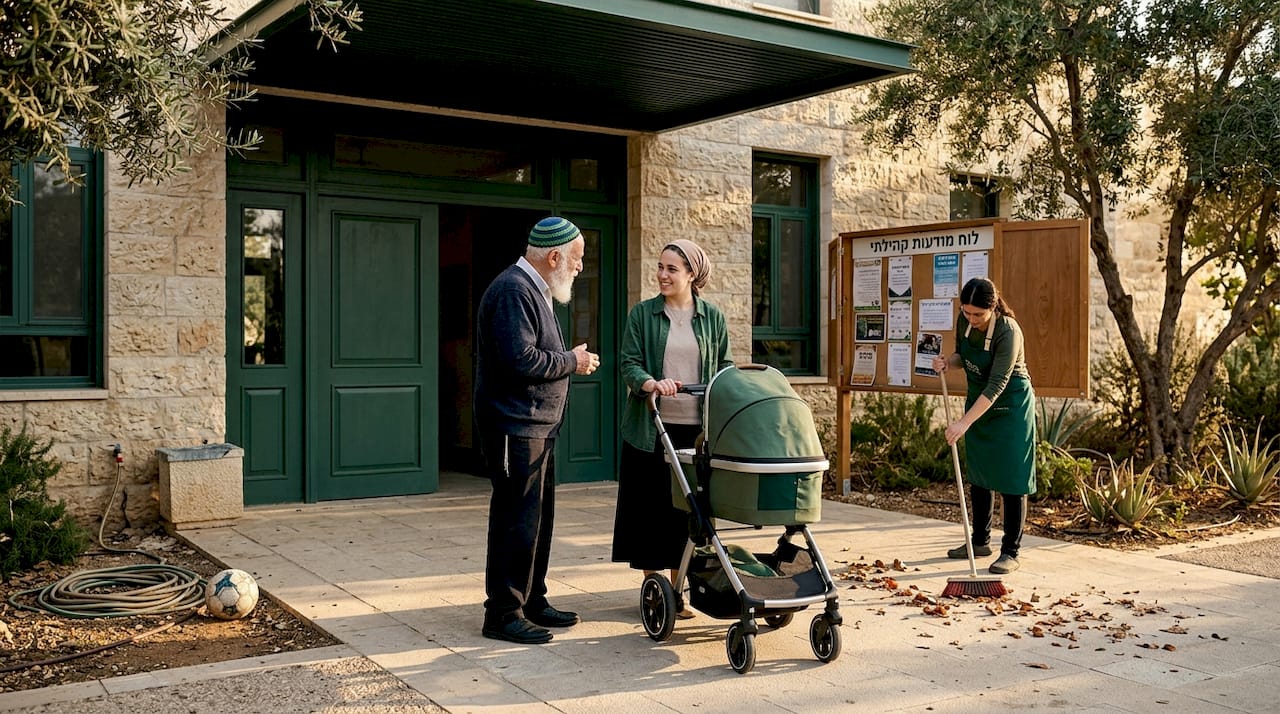
In observant communities, the rhythm of Jewish life is baked into every aspect of the neighborhood. Shabbat and holidays are not events you observe privately. They define when shops close, when neighbors gather, and when the streets fill with families walking to synagogue. This shared calendar creates a powerful sense of cohesion that many newcomers describe as transformative.
Key ways religious values translate into daily community life:
The Shulchan Shabbat program mentioned in Ariel is a strong model. Hosting 60 guests weekly means that nearly every newcomer family has a way to connect during the most socially significant time of the week. That is not small. For families arriving without local relatives, this kind of program can dramatically speed up social rooting.
“The community existed before we arrived, and it was waiting to absorb us. We just had to show up.” This sentiment reflects what many olim (immigrants) describe in well-organized religious communities.
However, it is worth noting the flip side. As one analysis of community trade-offs points out, religious areas provide strong communal support but may isolate those who are less observant. Anglo-heavy communities (those with many English-speaking immigrants) ease the language barrier but can create an insular “bubble” where residents rarely interact with Israeli-born neighbors. Communities near major cities offer employment proximity but often come with higher real estate prices or long commutes.
Pro Tip: Before committing to a neighborhood, ask the local rabbi or community coordinator: “What does this community do for new families in their first six months?” The specificity of the answer will tell you more than any brochure.
When you are evaluating luxury features for religious buyers, remember that location relative to these community services matters enormously. A beautiful apartment that is a 20-minute walk from the nearest mikveh or school may create daily friction that erodes quality of life. And the overall benefits of owning residential real estate in Israel are amplified when your home sits within a genuinely supportive community ecosystem.
Once you understand religiously-motivated amenities, it is crucial to compare them with other neighborhood models.
Not every family relocating to Israel wants full immersion in a highly observant environment. Some prefer a mixed neighborhood where religious and secular residents coexist. Others may prioritize proximity to employment hubs or cultural institutions over ritual infrastructure. Each model has genuine strengths and real limitations.
Here is a side-by-side comparison to make the decision more concrete:
| Factor | Fully religious area | Mixed area | Secular area |
|---|---|---|---|
| Community cohesion | Very high | Moderate | Lower |
| Ritual infrastructure | Extensive | Partial | Minimal |
| English-language support | High in Anglo areas | Varies | Varies |
| Integration with Israeli society | Can be slower | Faster | Fastest |
| Social isolation risk | Low within group | Low | Moderate for religious families |
| Property affordability | Often more affordable | Mixed | Often higher in cities |
| School options for religious kids | Excellent | Limited | Very limited |
Steps to prioritize when comparing neighborhoods:
Communities like Ariel, which blend religious infrastructure with a mixed secular-religious population, show that amenity-rich religious programming can coexist with a more diverse neighborhood feel. The key is knowing in advance what balance works for your family.
For those who are newer to navigating Israeli real estate, this comparison stage is often where professional guidance pays off most. An experienced local agent can tell you which communities are growing, which are plateauing, and what amenity gaps are likely to be filled in the next few years.
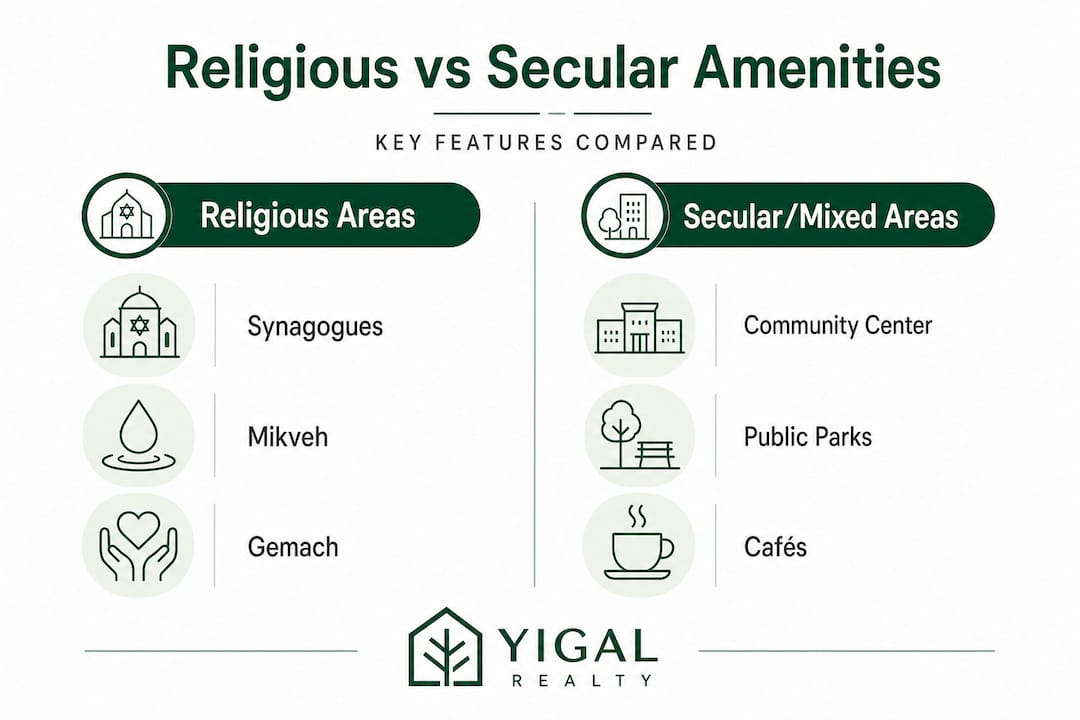
The differences are clear. Now, here is what to prioritize in your own search and preparation.
Evaluating a potential community goes beyond checking boxes. It requires understanding how the daily texture of life in that neighborhood aligns with your family’s values, rhythms, and practical needs. Here is a focused checklist to guide your research:
Practical amenities to confirm:
Questions to ask local residents:
Pro Tip: Spend a Shabbat in the neighborhood you are considering. Book a local guesthouse or stay with a contact. Walk to synagogue, observe who is in the streets, and notice whether people greet strangers. You will learn more in 25 hours than from weeks of online research.
The advantages available to US Jewish families making aliyah are real and meaningful. Tax benefits, mortgage access, and Nefesh B’Nefesh support programs all make the financial side more manageable. But the emotional and social success of the move depends heavily on selecting a community where the amenity infrastructure matches what your family actually needs day to day.
A common mistake is choosing a community based on where friends already live, without checking whether the specific neighborhood offers the services your family depends on. Your close friends’ needs may differ significantly from yours. The better question is: “Does this place support the life I want to build?”
To wrap up, let’s step back and share a more nuanced perspective on what really matters as you choose a community.
Most relocation guides focus on the presence of amenities. Does the town have a mikveh? Check. Is there a shul? Check. And they stop there. What they miss is the gap between infrastructure that exists and infrastructure that functions as a genuine support system for newcomers.
We have seen families move into communities with every amenity on paper, only to feel profoundly disconnected six months later. The reason is almost always the same: they consumed the services but did not participate in creating them. They attended Shabbat meals but never hosted. They used the gemach but never volunteered. They joined the community as recipients rather than contributors.
The communities that produce the highest satisfaction among English-speaking olim are not necessarily the ones with the most services. They are the ones with the strongest culture of active participation. And that culture is harder to see on a website or in a brochure.
There is also a real risk in Anglo-heavy areas that gets underplayed. The same English-language comfort that eases the first year can, as one candid analysis notes, create an insular bubble that delays true integration into Israeli society. If after three years you still cannot hold a conversation with your Hebrew-speaking neighbors, the amenities have served you but the community has not fully absorbed you.
Our perspective, shaped by years of working with relocating families in areas like Beit Shemesh, is this: choose a community where you feel pulled to give, not just to receive. Visit on a regular Shabbat, not a community-organized “welcome Shabbat.” Ask what is expected of new residents, not just what they will be given. And use assessing the real estate in Beit Shemesh as a model for the kind of community-level due diligence that truly pays off long-term.
Amenities are the starting point. Belonging is the destination. And that gap is bridged by participation, not by a longer list of services.
If you are contemplating your own move to Israel, here is how to move from understanding to action. Finding the right community is not something you should navigate alone, especially from overseas. At Yigal Realty, we specialize in matching families and individuals with properties in Beit Shemesh and surrounding areas, communities that are built specifically to support observant Jewish life. Our team offers personalized guidance on which neighborhoods align with your observance level, family size, school needs, and budget. We provide early access to new developments, transparent information about available projects, and direct support throughout the purchase process. Whether you are ready to buy or still in the research stage, explore our listings and resources to start building a clearer picture of where your family belongs.
Most observant communities include mikvaot, medical clinics, synagogues, volunteer support networks, and social programs such as meal trains and gemach services covering food, money, medicine, and baby items.
Anglo-heavy areas typically offer more English-speaking programs and ease the initial language barrier, but they risk creating a bubble that slows broader integration into Israeli society. Native communities push deeper integration but may offer fewer English resources.
Gemachs are free-loan networks common in religious communities, providing practical items and financial help like food, money, medicines, and baby equipment to anyone in need, operating purely on a volunteer and donation basis.
Visit the neighborhood during Shabbat and on a weekday, speak directly with residents who have been there two to three years, and confirm that the schools, clinics, and social support systems actually match your family’s specific needs and level of observance.