%20(4).png)
![[background image] image of cityscape background (for an architect firm)](https://cdn.prod.website-files.com/68961ade6feff9cbdffc080d/69384e066e0e9a310b6817f8_061f6bac-48bf-44b8-a689-078dacd8009f.avif)
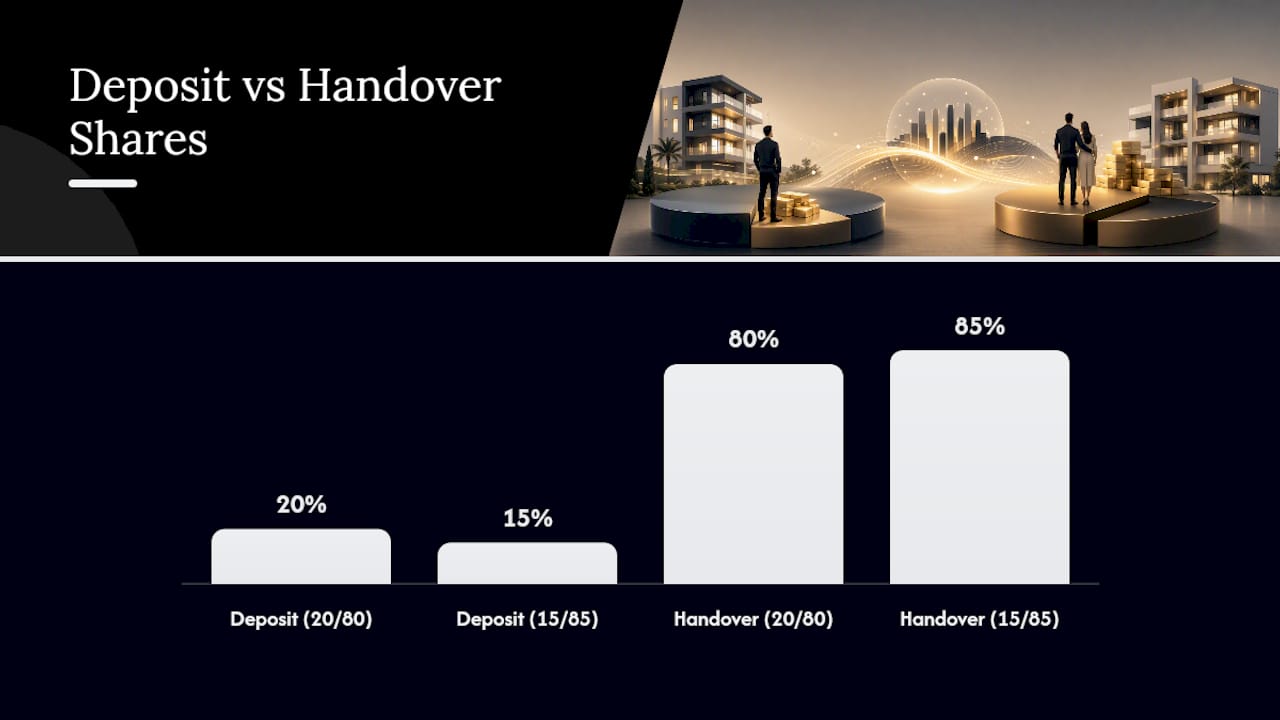
Both plans let you buy a new-construction apartment with a small payment now and the rest due at handover. The numbers describe the split: 20% up front and 80% at key handover for the first plan, 15% up front and 85% at handover for the second. For most owner-occupiers, 20/80 is the lower-risk choice, because it leaves less to finance in one lump sum and makes bank approval easier to secure early. Before signing either, run the stress-test in the checklist below and demand the contract clauses covered in section four.
TL;DR:
- Buyers using deferred payment plans should carefully assess the final costs, as extras like registration fees and furnishings can increase the total amount by 10 to 15 percent at handover.
- The risk of handover shock is heightened if the construction is delayed or interest rates rise, affecting how much liquid cash or financing will be needed at completion.
- Contract review should include verifying loan disbursement timing, guarantees, indexation clauses, and penalty provisions to avoid costly surprises during handover.
- Most bank financing is delayed until property registration, so buyers must be prepared for the entire mortgage to be disbursed near or at handover, not at signing.
- Leveraging project-specific reviews with legal and financial experts helps identify contract pitfalls and ensures the payment plan aligns with the buyer’s financial capacity and market conditions.
The number pairs describe the split between your signing deposit and your balance at handover. Under 20/80, you pay 20% when you sign and the remaining 80% when the developer hands over the keys, typically several years later depending on the project. Under 15/85, you pay only 15% up front and owe the remaining balance at handover, which shrinks your initial outlay but enlarges the final balloon payment.
Banks generally will not disburse a mortgage until the property is registered and ready for transfer, so in both models your main financing arrives at or near handover, not at signing. That timing gap is the heart of the risk: you commit to a purchase price years before your bank formally underwrites the loan against current income and interest rates.
Some deferred deals are marketed as “subvention” plans, where the developer arranges financing that runs through the buyer’s name but that the developer effectively controls until handover. BizPortal’s analysis of developer incentives notes these plans lower upfront buyer cost precisely because they shift funding timing in the developer’s favor, not necessarily the bank’s.
Practical mechanics to compare between the two ratios:
The biggest danger with either ratio is what brokers call handover shock: the moment your final balance, furnishing costs, registration fees, and building management deposit all land at once. Buyers who budgeted only for the unit price often discover the real number at handover is 10% to 15% higher once these extras are added.
Ynet’s coverage of 20/80 promotions reports that the Bank of Israel has flagged these schemes for scrutiny, largely because a buyer who cannot complete the final payment risks losing both the apartment and the deposit already paid. TheMarker’s analysis goes further, comparing the rapid spread of these deals to subprime-style lending patterns, warning that accountants and banks worry buyers may simply fail to complete the purchase when the balance falls due.
Regulatory signal: Bank of Israel scrutiny of 20/80-style promotions centers on completion risk, not the discount itself, since a buyer who cannot fund the balloon payment can lose both the unit and the deposit already paid.
Other risks worth weighing before you sign:
A legal explainer on 80/20 purchase agreements lays out exactly what to verify before committing to either ratio. Work through this in order:
Watch for red flags: a vague or “estimated” completion date with no penalty clause, a subvention arrangement with no clear loan document, or a bank guarantee that covers only part of your deposit.
Pro Tip: Ask the developer’s sales team to put the exact loan disbursement date and the bank’s name in writing inside the contract addendum, not just in a brochure. If they hesitate, that hesitation is itself useful information.
Before you sign for either ratio, build a handover budget that includes the final balance, furnishing, registration fees, VAT, estimated arnona (municipal tax), and the building’s management deposit; for a helpful example of pre-handover inspections and preparations, see this pre-purchase pest inspection service. WBLaw’s consumer advisory on deferred sale promotions documents cases where buyers who skipped this step were caught unprepared when the balance came due.
Build the test around three scenarios: on-schedule handover, a 12-month delay, and a mortgage rate that runs 1 to 2 points higher than today’s. Map each scenario against your actual savings trajectory and bank pre-approval, checked again roughly a year before expected key handover.
Beit Shemesh developments show real variation in how 20/80 and 15/85 plans get structured, and the fine print differs project to project. A real estate firm may walk buyers through project-specific terms, flag contract clauses worth pushing back on, and help run the handover stress-test before you sign anything. One local example shows how a Beit Shemesh buyer navigated a 20/80 plan without getting caught by index-linked cost creep. If you’re weighing a specific project, reach out for a tailored read on the terms.
Investors with strong liquidity and a clear exit plan can use 15/85 or 20/80 as leverage, freeing up cash for other deals while a small deposit holds the unit. It is important to confirm the developer’s bank guarantee covers the full deposit and build a delay scenario into your return projections before you commit.
Owner-occupiers face a different math. If your income is fixed and your handover financing depends entirely on a mortgage approved years from now, a smaller deferred gap or a larger upfront payment is generally the safer path. Either way, talk to a mortgage broker early, demand escrow-style guarantees in writing, and run the stress-test before signing.
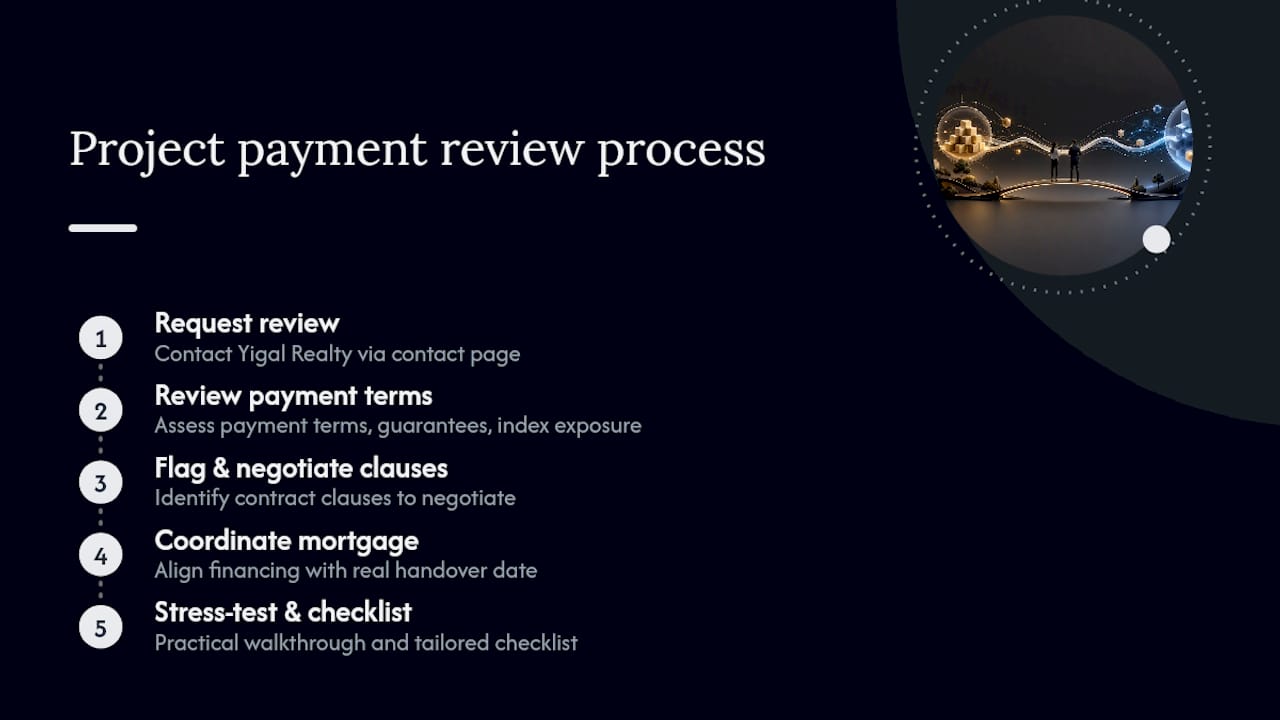
Comparing 20/80 against 15/85 on paper only gets you so far. What actually protects you is knowing the specific terms, guarantees, and index exposure baked into the project you’re eyeing. Yigal Realty works with Beit Shemesh buyers on exactly that: reviewing project-specific payment structures, flagging contract clauses that need negotiation, and coordinating with mortgage brokers so your financing lines up with the real handover date, not the marketed one. Readers who reach out get a practical stress-test walkthrough and a checklist tailored to their target project, not a generic template. If you’re weighing a purchase, get in touch through Yigal Realty’s contact page for a review before you sign anything.