%20(4).png)
![[background image] image of cityscape background (for an architect firm)](https://cdn.prod.website-files.com/68961ade6feff9cbdffc080d/69384e066e0e9a310b6817f8_061f6bac-48bf-44b8-a689-078dacd8009f.avif)
TL;DR:
- Buying off-plan property lets buyers lock in current prices before construction completes, resulting in built-in equity.
- The strategy benefits from market appreciation, lower initial costs, and favorable tax treatment during the construction period.
Buying off-plan property means purchasing a home before construction is complete, locking in today’s price on an asset that will be worth more by the time you move in. This strategy gives families and investors a real financial edge: off-plan properties sell at 5%–15% below their completed market value, creating built-in equity from day one. You also get first pick of the best units, the ones with corner layouts, higher floors, and better views, before they are gone. In markets like Israel, where demand for new residential developments continues to outpace supply, understanding why buy off-plan property is not just useful. It is a competitive advantage.
The single strongest reason to buy off-plan is price. Developers price early units below market to generate cash flow during construction. That gap between your purchase price and the completed value is equity you did not have to earn through renovation or negotiation.
Construction timelines typically run 2–4 years. During that window, property values in growing markets tend to rise. A buyer who locks in at launch pricing benefits from appreciation without putting in additional capital. That is a compounding effect most completed-property buyers never access.
The tax angle is also real. Transaction taxes are often calculated on the agreed purchase price at exchange, not the property’s value at completion. If your property appreciates significantly during the build phase, you pay tax on the lower number. That difference can represent meaningful savings on a high-value purchase.
Here is what the financial structure typically looks like for an off-plan purchase:
Pro Tip: Ask the developer for a payment schedule in writing before signing. Staged payments tied to construction milestones give you more control over your cash flow than a single lump sum at completion.
The flexible payment structure is especially valuable for families who need time to arrange financing or sell an existing property. You are not racing against a 30-day closing clock.
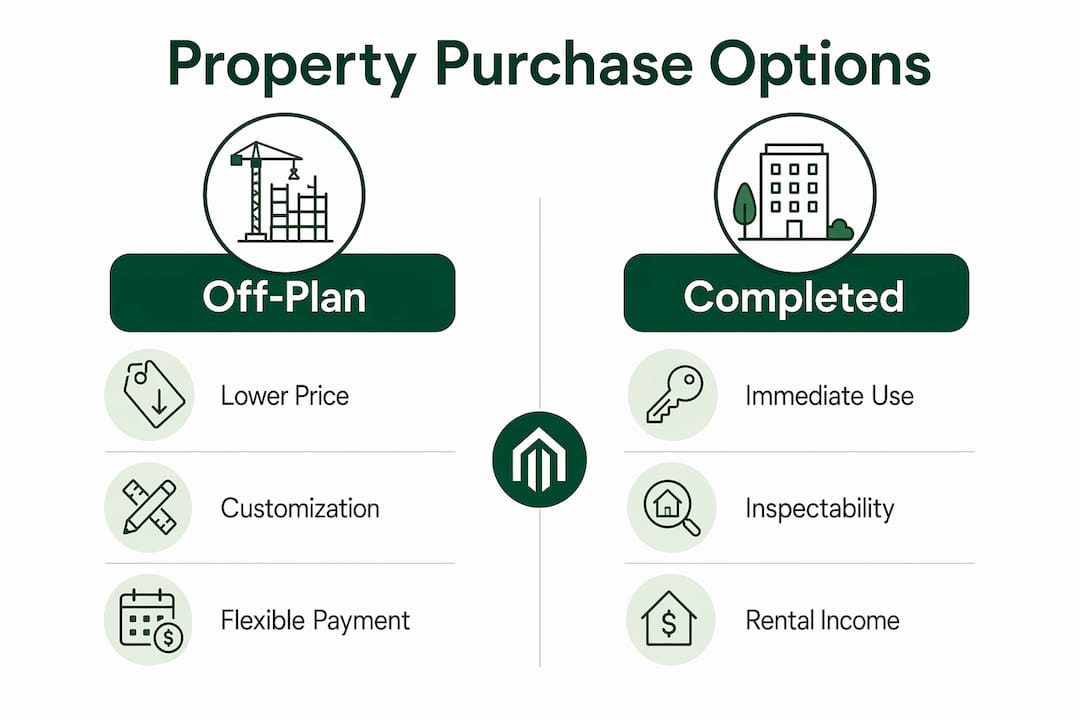
The choice between off-plan and completed property is not about which is objectively better. It depends on your risk tolerance, investment timeline, and whether you need immediate rental income or are building long-term wealth.

| Factor | Off-plan property | Completed property |
|---|---|---|
| Price | Below market at launch | Full market value |
| Availability | Future delivery | Immediate |
| Customization | Often possible | Fixed as-is |
| Capital growth | Built in during construction | Depends on market timing |
| Rental income | Delayed until completion | Starts immediately |
| Risk level | Higher (construction, market) | Lower (known condition) |
Customization is one of the most underrated advantages of buying off-plan. Many developers allow buyers to choose finishes, layouts, and fittings before construction locks in those decisions. A family buying a completed home takes what was built for someone else’s preferences.
Completed properties suit buyers who need rental income right away or who want to inspect exactly what they are buying. Off-plan suits buyers with a longer horizon who want to maximize price growth and unit selection. Neither approach is wrong. They serve different goals.
Pro Tip: If you are buying off-plan as a long-term family home rather than an investment, prioritize the developer’s track record over the launch discount. A 10% price saving means nothing if the project delivers two years late.
Off-plan purchases carry real risks. Knowing them in advance is what separates buyers who profit from those who regret the decision.
Construction delays are the most common problem. A project scheduled to complete in 18 months can stretch to 3 years. That affects your moving plans, your rental income timeline, and your financing.
Mortgage expiration is a risk most buyers underestimate. Mortgage offers typically last six months. If construction runs long, your approved mortgage may expire before you reach completion. Reapplying in a changed interest rate environment can mean worse terms or outright rejection, putting your deposit at risk.
Developer reliability is the most critical variable. Developers with poor track records risk project delays or outright abandonment. When a project fails, your capital is tied up and your returns disappear. Due diligence on a developer’s completed projects, financial backing, and delivery history is not optional. It is the foundation of a sound off-plan purchase.
Here is a practical risk checklist before you sign:
Pro Tip: Request references from buyers in the developer’s previous projects. A 10-minute conversation with someone who has been through the process tells you more than any brochure.
Understanding the property development process in Israel is especially important because local regulatory timelines and permit processes differ from other markets. Working with an agent who knows the local system reduces your exposure to avoidable delays.
Israel’s residential market has specific dynamics that make off-plan purchases particularly attractive for families and investors right now. Demand for new housing in cities like Beit Shemesh continues to grow, driven by population growth, community-focused development, and a shortage of quality new inventory.
Newly built homes are up to 21% more energy-efficient than older properties. That efficiency gap translates directly into lower running costs for owner-occupiers and stronger rental appeal for investors. Tenants increasingly filter their searches by energy ratings and modern amenities.
Modern tenants prefer energy-efficient, low-maintenance, and tech-ready homes. New developments built to current standards meet those expectations out of the box. Older secondary market units often require costly upgrades to compete. For investors targeting the rental market, buying new is a structural advantage, not just an aesthetic preference.
The Israeli real estate market in 2025 and 2026 has seen sustained interest from both domestic buyers and international investors, particularly from North America and Europe. Observant and religious communities have driven concentrated demand in specific neighborhoods, creating micro-markets where well-located off-plan units appreciate faster than the broader index.
Families gain a significant advantage by buying off-plan early, securing premium units with preferred layouts or views that are simply unavailable at resale. In a development with 80 units, the best 10 go to the first buyers. That is not marketing language. That is how allocation works.
The key real estate trends shaping Beit Shemesh in 2026 include growing demand for larger family apartments, proximity to community infrastructure, and access to green space. Off-plan developments in this market are being designed with those preferences built in from the ground up.
Buying off-plan property delivers the strongest returns when buyers combine early pricing, careful developer selection, and a clear understanding of their financing timeline.
| Point | Details |
|---|---|
| Price advantage at launch | Off-plan properties sell at 5%–15% below completed market value, creating immediate equity. |
| Tax efficiency | Transaction taxes locked at exchange value can produce real savings when property appreciates during construction. |
| Developer due diligence | A developer’s track record is the single most important risk factor in any off-plan purchase. |
| Mortgage timing risk | Mortgage offers expire in roughly six months; construction delays can force costly reapplications. |
| Premium unit selection | Early buyers secure the best layouts, floors, and views before they are allocated to later purchasers. |
The financial case for off-plan is real, but the families who do best are not the ones who chased the biggest discount. They are the ones who chose the right developer and held their nerve through the construction period.
I have seen buyers walk away from a 12% launch discount because the developer had one incomplete project on record. That was the right call. I have also seen buyers commit to a less prominent developer because the price was irresistible, and spend two years in limbo. The discount evaporated in legal fees and carrying costs.
What makes Israel’s market genuinely different is the community dimension. Buyers here are not just purchasing square footage. They are buying into a neighborhood, a school system, and a social fabric. That means the location decision carries more weight than in a purely investment-driven market. A premium unit in the right development, in the right community, holds its value through market cycles in ways that purely speculative purchases do not.
My honest advice: treat the price discount as a bonus, not the primary reason to buy. Buy off-plan because you want that specific unit, in that specific project, from a developer you have verified. The financial upside follows from that discipline, not the other way around.
— Spiros
Yigal-realty works directly with families and investors navigating off-plan opportunities in Beit Shemesh and surrounding areas. The firm provides access to new developments before public launch, giving clients first selection of premium units. Yigal-realty’s agents guide buyers through payment plan structures, developer vetting, and contract review so nothing gets missed. For international buyers coordinating from North America or Europe, the New York office handles the early stages of the process directly. If you are weighing whether buying off-plan in Israel fits your timeline and goals, Yigal-realty’s team can walk you through current projects and realistic return expectations without pressure.
Buying off-plan means purchasing a property before construction is finished, typically at a discounted price. Buyers pay a deposit at signing and the balance on completion, which can be years later.
Off-plan purchases give families first access to premium units with preferred layouts and views that are unavailable once a development sells out. The financial benefits are strongest for buyers with a 2–4 year horizon who do not need immediate occupancy.
Construction delays and mortgage expiration are the two most common risks. A mortgage offer typically lasts six months, so a delayed project can force buyers to reapply under less favorable conditions.
Verify the developer’s completed project history, confirm your deposit is held in escrow, and discuss mortgage extension options with your broker before exchanging contracts.
Israel’s sustained housing demand, community-driven buyer preferences, and shortage of quality new inventory in cities like Beit Shemesh create conditions where well-located off-plan units appreciate reliably during the construction period.