%20(4).png)
![[background image] image of cityscape background (for an architect firm)](https://cdn.prod.website-files.com/68961ade6feff9cbdffc080d/69384e066e0e9a310b6817f8_061f6bac-48bf-44b8-a689-078dacd8009f.avif)
TL;DR:
- Home staging involves strategically preparing a property to maximize buyer appeal, primarily through decluttering and neutral presentation. It enhances the property’s perceived value, sells faster, and increases sale price, especially when focusing on entryways, kitchens, and primary bedrooms. Different formats exist—professional in-person, consultation, and virtual—each suited to various budgets and needs, with DIY options offering cost-effective solutions.
Most sellers think home staging means buying new furniture or hiring an interior designer. It doesn’t. What is home staging, really? It’s the strategic preparation of a property to appeal to the broadest possible pool of buyers, with the specific goal of selling faster and for more money. Think of it less like decorating and more like merchandising. You’re not expressing your taste. You’re creating an experience that helps a stranger picture their life inside your home. This guide covers every dimension of the process, from definitions and formats to practical tips and common mistakes.
| Point | Details |
|---|---|
| Staging is merchandising | It’s about buyer appeal, not personal style, and it directly influences sale price and speed. |
| Three main formats exist | In-person, consultation, and virtual staging each serve different needs and budgets. |
| Data supports the ROI | Staging can boost sale price up to 10% and reduces time on market significantly. |
| Subtraction beats addition | Decluttering and removing personal items creates more perceived space than any decorative addition. |
| DIY staging works | With the right priorities, sellers can stage effectively for under $1,000 and still see strong results. |
Home staging is a defined process, not a vague idea. At its core, what does home staging involve? It means preparing every visible part of your home so that buyers see potential rather than problems. The work ranges from simple decluttering to full furniture rentals, depending on which format you choose.
There are three primary staging forms available to sellers today: in-person staging, staging consultation, and virtual staging. Each has a distinct role.
In-person staging is the most hands-on format. A professional stager physically visits your home, rearranges furniture, removes excess items, and sometimes brings in rental pieces to create a polished, buyer-ready look. This is the approach most associated with professional results because the stager controls the entire visual environment. A stager might reposition your sofa to open up a sightline, swap out a bulky dining table for a smaller one, and add a single piece of art to anchor the room. The difference between before and after can be dramatic.
Staging consultation is the middle ground. You hire a professional for guidance, but you do the actual work yourself. The stager walks through your home, provides specific recommendations room by room, and leaves you with a plan. This format suits sellers who are capable and motivated but need an expert eye to identify what a buyer will notice first.
Virtual staging uses digital editing to furnish and decorate photos of empty rooms. It’s cost-effective and works well for online listings. The critical caveat: virtual staging requires disclosure if it materially misrepresents the property. Buyers who show up expecting a furnished look and find bare walls will feel misled, which erodes trust before the offer conversation even starts.
Here’s a quick comparison of the three approaches:
| Format | Best for | Cost range | Hands-on involvement |
|---|---|---|---|
| In-person staging | Vacant or high-value homes | $1,500–$5,000+ | Professional handles it |
| Staging consultation | Occupied homes with good bones | $150–$600 | Seller implements the plan |
| Virtual staging | Empty listings, online-first marketing | $100–$400 per room | Photographer and editor |
The format you choose depends on your timeline, budget, and the condition of the property. But regardless of format, the goal of the home staging process stays the same: create an environment that lets buyers see possibility, not distraction.
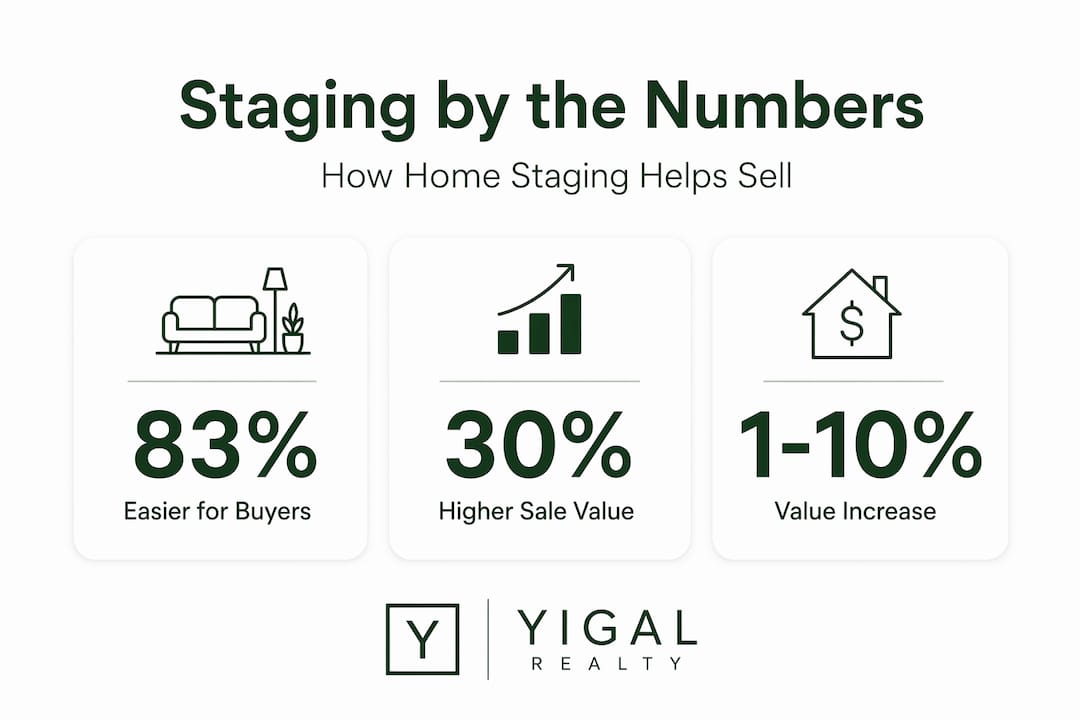
Here’s a number that puts staging in perspective: 83% of buyers’ agents said staging makes it easier for buyers to visualize a home as theirs. That’s not a marginal effect. That’s the majority of professionals who work with active buyers saying staging directly influences how people feel about a property.
The financial data backs this up. 30% of real estate professionals reported a 1% to 10% increase in home value as a result of staging. On a $500,000 home, even a 3% lift translates to $15,000 in additional sale price. That return dwarfs almost any staging investment.
Speed matters just as much as price. Staged homes sell faster, with 30% of agents reporting a slight decrease in time on market and 19% reporting a greatly reduced time. A home that sits on the market longer tends to attract lower offers, as buyers assume something is wrong. Staging helps you avoid that spiral.
The psychological mechanism behind these numbers deserves attention. Staging works because it taps into how buyers make decisions emotionally first and rationally second. When a buyer walks through a home and immediately feels comfortable, that comfort is manufactured through deliberate choices: the warmth of good lighting, the openness of a decluttered room, the sense of scale from correctly proportioned furniture. As one industry insight puts it, staging creates a lifestyle experience rather than just presenting a structure.
“Staging is essentially merchandising. You’re not showing a house. You’re selling a life someone wants to live.” — Real estate staging industry perspective
When you understand staging as emotional merchandising, its value becomes obvious. Buyers don’t just evaluate square footage. They ask themselves, almost unconsciously, “Can I see myself living here?” Staging is how you answer that question before they even ask it. Properly staged property listings consistently outperform unstaged ones across both metrics: time and price.
Knowing the theory is one thing. Knowing how to stage a home room by room is where sellers either gain or lose their advantage. These steps apply whether you’re working with a professional or going the DIY route.
Declutter first, always. Before you add anything, remove everything that shouldn’t be there. Effective staging starts with subtraction: excess furniture, personal photos, collections, and anything that makes a room feel busy. Closets should be ideally 50% full when buyers view them, signaling that there’s room to grow. A closet crammed to capacity tells a different story.
Depersonalize every room. Family portraits, kids’ artwork, sports memorabilia. All of it needs to come down. This isn’t about erasing who you are. It’s about making space for the buyer to mentally move in. Every personal item is a reminder that the home belongs to someone else.
Arrange furniture for flow, not comfort. Most people arrange their living room furniture around the TV. Staging furniture, by contrast, creates conversation areas that define the room’s purpose and draw the eye toward focal points like a fireplace or large window. Pull furniture away from walls slightly. It makes rooms feel larger, not smaller.
Focus on the entryway, kitchen, and primary bedroom. These three areas create the strongest first and lasting impressions. A clean, bright entryway signals care and welcome. A kitchen with clear counters signals space and function. A primary bedroom with neutral bedding and minimal decor signals rest and comfort.
Apply the 10-minute staging test. Walk through your home as if you’ve never seen it before and spend ten minutes addressing the highest-impact areas: kitchen counters, bathroom surfaces, and entryways. These quick wins often matter more than expensive upgrades.
Handle vacant homes differently. Vacant homes need furniture to prevent that cold, uninviting feeling that discourages buyers. Empty rooms also make it harder for buyers to judge scale. A room with no furniture often feels smaller than it is, not larger.
Pro Tip: For occupied homes, do a sniff check before every showing. Sellers go nose-blind to their own homes. Pet odors, cooking smells, and musty areas are among the first things buyers notice and rarely mention directly, though they absolutely factor into their impression.
Decor and furniture choices aligned with buyer demographics also matter more than most sellers realize. A family-oriented neighborhood calls for a different staging approach than a downtown condo targeting young professionals. The goal is familiarity and comfort for the specific buyer most likely to walk through the door.
Many sellers avoid staging because they think it’s expensive. The reality is that DIY staging often costs under $1,000 when it focuses on what you already have. Cleaning, decluttering, and rearranging existing furniture costs almost nothing and still improves outcomes significantly.
Several other misconceptions trip sellers up:
Pro Tip: If budget is genuinely tight, hire a stager for a one-hour consultation only. A professional eye for 60 minutes can identify the three or four changes that will have the biggest impact, and you can execute everything yourself.
Knowing when to call a professional stager is not a sign of weakness. It’s a smart calculation. If the home is vacant, high-value, or has sat on the market without offers, professional staging is almost always worth the cost.
I’ve seen beautifully renovated homes sit on the market for months while less impressive properties sold in days. The difference, more often than not, comes down to presentation.
What strikes me most is how often sellers resist staging because it feels unnecessary. They’ve lived in the home. They know it’s a great space. But buyers don’t know that yet, and the first showing is the only audition that matters.
In my experience, the sellers who get the best outcomes are the ones who stop thinking like homeowners and start thinking like buyers. That shift in perspective is genuinely hard to make when you’ve lived somewhere for years. But it’s also the single most valuable thing you can do before a showing.
The “less is more” principle is where most sellers underinvest. They add things, when the most powerful move is almost always to take things away. An empty corner doesn’t need a plant. It needs to remain empty so the room breathes. That restraint is what makes a home feel spacious rather than stuffed.
Staging is not a cost. It’s a pre-sale investment with a measurable return, and in most markets, skipping it means leaving real money on the table.
— Spiros
Whether you’re preparing a property for sale in Israel or evaluating how to maximize value before listing, Yigal-realty brings the kind of personalized guidance that turns good preparation into great outcomes. The team at Yigal-realty understands that selling a home is a process, not just a transaction. From advising on presentation strategies to helping you understand what buyers in specific communities are looking for, the support goes well beyond showing a listing.
If you’re serious about getting staging right and selling on your terms, explore Yigal-realty’s real estate resources to connect with professionals who can guide you through every step of the process.
Home staging is the process of preparing a property for sale by arranging, decluttering, and presenting it to appeal to the widest range of buyers. The goal is to help buyers visualize living in the home, which typically leads to faster sales and higher offers.
Yes. Research shows that 30% of real estate professionals reported a 1% to 10% increase in sale price as a direct result of staging, with some properties seeing gains up to 10% above unstaged comparables.
Absolutely. DIY staging focused on decluttering, depersonalizing, and rearranging existing furniture can cost under $1,000 and still produce meaningful improvements in buyer perception and sale outcomes.
Virtual staging uses digital tools to add furniture and decor to photographs of empty rooms. It’s cost-effective for online listings but requires disclosure if the edits materially alter how the property appears in person.
Focus on the entryway, kitchen, living room, and primary bedroom first. These spaces create the strongest initial impressions and have the most direct influence on how buyers feel about the property overall.