%20(4).png)
![[background image] image of cityscape background (for an architect firm)](https://cdn.prod.website-files.com/68961ade6feff9cbdffc080d/69384e066e0e9a310b6817f8_061f6bac-48bf-44b8-a689-078dacd8009f.avif)
TL;DR:
- Building a property portfolio in Beit Shemesh offers families and investors a strategic way to reduce risk, increase flexibility, and align investments with community values. Such portfolios enable multi-generational living, support community-based objectives, and enhance long-term growth potential. Managing multiple properties requires systems and local knowledge but can serve as a meaningful expression of life and investment goals.
Buying one apartment in Beit Shemesh feels like a solid plan. And for many families, it is a meaningful first step. But most buyers quickly discover that a single property leaves them exposed to market shifts, vacancy gaps, and limited flexibility when life changes. Experienced investors think differently. They build property portfolios, collections of real estate assets managed together, to create consistent income, reduce risk, and align their holdings with long-term family and community goals. This guide explains exactly what a property portfolio is, why it matters in Beit Shemesh specifically, and how you can start building one that fits your lifestyle and values.
| Point | Details |
|---|---|
| Diversification lowers risk | A property portfolio helps families and investors reduce risk by spreading assets across different properties and communities. |
| Community fit matters | Tailoring your portfolio to Beit Shemesh’s religious and family environments increases both livability and investment success. |
| Management is key | Effective property management is crucial for growing and maintaining a successful portfolio. |
| Long-term flexibility | Owning multiple strategic properties offers more options for family life, investment, or community support. |
A property portfolio is a collection of two or more real estate assets that an owner manages together as a unified financial strategy. Rather than treating each property as a standalone investment, portfolio thinking connects them under shared goals: steady rental income (cash flow), rising property values over time (capital appreciation), and risk spread across multiple assets (diversification).
According to Gate’s glossary, an investment property portfolio refers to multiple income-generating properties managed as a cohesive asset group, pursuing objectives like cash flow and long-term appreciation, with diversification reducing single-property risk. This is the core definition, and it matters because it shifts your mindset from “I own a property” to “I manage a strategy.”
“A well-structured property portfolio reduces your vulnerability to any one property’s vacancy, maintenance issue, or market dip. Diversification is the single most powerful protection for real estate investors who think long term.”
Understanding real estate investment basics is the foundation before building a portfolio. Once you know how individual properties generate returns, layering them into a portfolio becomes far more intuitive.
Here is a quick comparison of owning a single property versus building a portfolio:
| Factor | Single property | Property portfolio |
|---|---|---|
| Income source | One rental stream | Multiple rental streams |
| Risk level | High (vacancy = no income) | Lower (spread across properties) |
| Effort to manage | Moderate | Higher, but scalable with systems |
| Flexibility | Limited | High (sell, refinance, or lease individually) |
| Growth potential | Tied to one market | Accessible across neighborhoods and types |
| Community alignment | Narrow | Can target multiple community segments |
The table makes one thing clear: a portfolio is not just “more properties.” It is a structurally different way to participate in real estate that opens up options single-property ownership simply cannot offer.
Diversification within a portfolio can take several forms. You can diversify by property type (apartments vs. multi-family units), by neighborhood (different areas of Beit Shemesh), or even by community orientation, meaning some properties are positioned for Ashkenazi families, others for Sephardi communities, others for English-speaking olim. Each layer of diversity adds a buffer.

Beit Shemesh is not a generic Israeli city. It is a place where community identity is deeply woven into daily life and, by extension, into real estate values. A property portfolio built here cannot ignore that reality. Families and investors who understand community-fit as an investment factor gain a genuine advantage.
For observant families, community alignment can be as important as square footage or price per meter. Proximity to the right shul, the right school, and the right neighbors shapes both liveability and long-term resale demand. Research into living in Ramat Beit Shemesh confirms that neighborhood and community fit strongly influence both quality of life and investor outcomes, meaning a portfolio may be diversified by community segment rather than by geography or property type alone. That is a Beit Shemesh-specific insight most generic investment guides miss entirely.
Here are the top reasons families and investors in Beit Shemesh build property portfolios:
Exploring types of real estate investments specific to the Israeli market is a smart early move before deciding which asset types to include.
Pro Tip: When evaluating a second property for your portfolio, ask not just “will it rent?” but “does it rent to my community?” Properties that attract tenants who share your values and lifestyle create fewer friction points, lower turnover, and stronger word-of-mouth referrals.
You can also browse local property listings to get a feel for which neighborhoods and price points dominate current supply and demand in Beit Shemesh.
Not all portfolios look the same. The right structure depends on your goals, your budget, and, in Beit Shemesh, your community identity. Here are the three main types of portfolio approaches and how they compare:
| Portfolio type | Description | Best for | Main risk |
|---|---|---|---|
| Single-community | All properties in one neighborhood | Families prioritizing community fit | Over-concentration in one area |
| Multi-community | Properties spread across Beit Shemesh’s various neighborhoods | Investors balancing risk and community access | Slightly more management complexity |
| Geographic spread | Properties across Beit Shemesh and nearby cities | Investors maximizing market exposure | Less community focus, higher coordination effort |
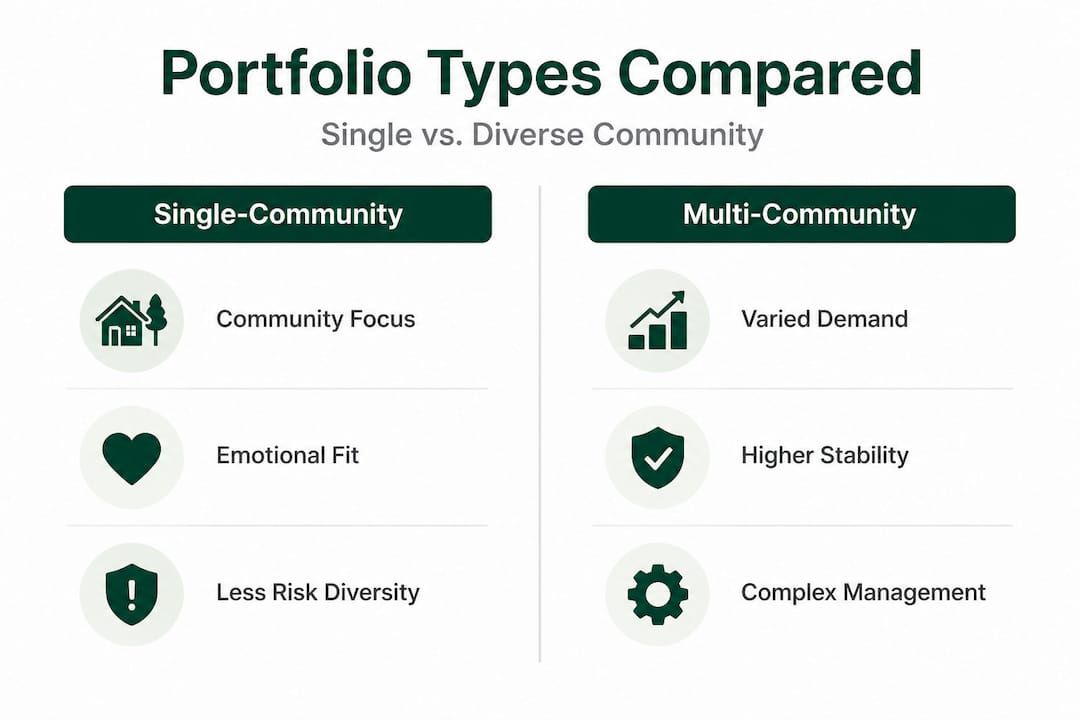
The Gate’s glossary insight on diversification across locations underscores a key point: robust portfolios draw strength from having different types of exposure. In Beit Shemesh’s context, that often means blending a primary family home in a tight-knit community with one or two income-generating rental apartments nearby.
Building your starter portfolio in Beit Shemesh does not require a master’s degree in finance. It requires a clear sequence of steps:
Using a clear step-by-step buying guide when you are ready to add properties helps you avoid the common mistakes buyers make when excitement overtakes analysis.
For religious family buyers, the single-community portfolio often wins emotionally and practically. Keeping everything within one community simplifies management, strengthens relationships with tenants, and ensures every property serves the same lifestyle goals. The trade-off is slightly higher concentration risk, which you can offset by selecting different property types or sizes within that community.
Owning one property is demanding. Owning three or four is a different operation entirely. Managing a full portfolio contrasts sharply with single-property ownership and requires systems, tools, and a more disciplined approach to tracking performance across all assets.
The good news is that the jump from one property to two does not double your workload. Once you build the right habits and infrastructure, adding properties becomes incremental rather than exponential in effort. Here is what becomes essential as your portfolio grows:
Pro Tip: Start tracking each property’s performance from the very first month of ownership. A simple monthly record of rent received, expenses paid, and any vacancy days will build a dataset that helps you make smarter decisions about your next purchase and optimize your portfolio for family or community needs over time.
Exploring top investment tools designed for the Israeli market can dramatically reduce the manual effort of managing multiple properties.
Scaling your portfolio responsibly means resisting the temptation to grow too fast. A common mistake among new investors is purchasing a third property before fully stabilizing the first two. Take time to understand your actual net yield (income after all expenses, not just gross rent), and make sure your cash flow can absorb a short vacancy before adding more leverage.
Most investment guides treat property portfolios as a purely financial exercise. Buy, rent, appreciate, sell. The numbers either work or they do not. But for families and investors in Beit Shemesh’s observant communities, this framing misses something genuinely important.
A property portfolio, built with intention, becomes an expression of your values. We have seen families use a second apartment to house a newly married son or daughter while still generating modest rental income when the unit is between family uses. We have seen investors earmark one property’s income entirely for community causes. These are not naive financial decisions. They are smart ones that also happen to serve life goals a spreadsheet cannot capture.
Community fit is an investment differentiator that matters especially in Beit Shemesh, where demand is driven as much by lifestyle alignment as by market fundamentals. A property in the wrong neighborhood for your target tenant is hard to rent, even at a lower price. A property in the right community, near the right institutions, holds its value through downturns and fills quickly after vacancies.
We would also push back against the common advice that says “spread your portfolio across multiple cities for maximum diversification.” For religious families, geographic diversity often undermines the community cohesion that makes Beit Shemesh real estate so compelling in the first place. A focused, community-aligned portfolio in one well-chosen city often outperforms a scattered portfolio stretched across markets you cannot meaningfully monitor.
The best portfolios we have seen are not the largest ones. They are the ones that serve the owner’s life, not just their bank account. Exploring investment approaches for families that integrate both financial and lifestyle considerations helps you build a portfolio you will actually want to manage for the long term.
For faith-driven buyers, aligning investments and community can be as valuable as cash flow.
Building a property portfolio tailored to your family’s needs and community values is not something you figure out alone. At Yigal Realty, we specialize in exactly this kind of guidance, helping families and investors from Israel, the US, and beyond find the right properties in Beit Shemesh’s most desirable neighborhoods. Whether you are buying your first investment property or looking to add to an existing portfolio, our team provides personalized consultations, local market insights, and access to exclusive new developments. Visit info.yigal-realty.com to explore current listings, connect with our agents, and take the next step toward a portfolio that works for your life and your legacy.
A property portfolio starts with two or more income-generating properties managed together under a shared financial strategy. There is no legal minimum, just a shift in how you think about and manage your real estate assets.
Yes, and in Beit Shemesh this approach is often ideal. Community fit strongly influences both liveability and investment outcomes, making a concentrated, community-aligned portfolio a smart strategy for observant families.
Managing a full portfolio requires more planning and organization than owning a single property, but with the right tools and systems, the added effort is manageable and the financial upside is significantly greater.
Absolutely. For observant families in Beit Shemesh, a portfolio offers multi-generational flexibility, the ability to house adult children nearby, and the option to align property income with community and family values in ways a single property cannot.