

In Beit Shemesh, luxury is less a single prestigious address than a combination: a new building with a strong specification, a view, a short walk to your shul and your children’s school, and a community that matches the way you live. There is no Israeli equivalent of a Rehavia or a Herzliya Pituach here. The premium sits in specific projects inside Ramat Beit Shemesh, the hillside developments and the boutique buildings, so this guide shows you how to read the market, what to compare, and where the tax and planning traps are.
Beit Shemesh is a city of distinct sub-communities. Experienced buyers note that the market is segmented by religious sub-community, and that proximity to schools, synagogues and shopping, often on foot, tends to matter more over time than finishes alone. The character of a neighborhood (Haredi, Religious Zionist or Anglo-mixed) shapes daily life more than the floor plan does.
So when buyers ask for “luxury neighborhoods,” they usually mean one of four things:
A few examples of how developers describe the top end today: one boutique project in Ramat Beit Shemesh Dalet is marketed as 66 apartments in three buildings facing the park, with garden apartments and roof-terrace penthouses. Treat descriptions like this as marketing until you have seen the permit and the specification sheet.
Price context helps you judge what a premium really is. According to the 2025 Beit Shemesh report from ERRA Analytics, the city recorded 2,238 transactions, the median apartment price was about ₪2,001,809, the median area was 92 sqm, and the median price per square meter was ₪22,898, up 2.4% on 2024. About 32.9% of transactions involved properties built within the previous three years, which shows how much of the market is new construction.
Two things follow for a luxury buyer:
For more detail on how prices have moved, see our guide to Beit Shemesh apartment prices and our review of key trends for Beit Shemesh buyers.
We will not pretend there is an official luxury ranking. What we can do is describe where the premium new construction tends to sit and what to weigh in each.
This is where most English-speaking and Religious Zionist families look, and where most new, high-specification building is concentrated. The older phases are established, with mature services. The newer phases (Gimmel and Dalet) are where boutique and park-view projects are found. If your priority is a ready community and a short walk to everything, the older phases win. If your priority is a new building and a modern layout, you will look further out.
Edge sites give you views and air, and often lower density. The trade-off is distance from the city’s established services, and, in some cases, future construction nearby. Always ask what is planned on the land next to your building, not just in front of it.
Urban renewal changes the picture. A plan discussed by the District Committee for Givat Sharett includes demolishing 468 old units and building a total of 3,270 new ones. New towers on the site of old blocks can be attractive, but such plans often meet intense scrutiny from environmental and local groups, which can mean multi-year timelines. If you are buying for a family to move in, that matters. If you are an investor, build the delay into your model.
The city is expanding. The municipality announced that a new quarter, Rova Vav 1, was approved with thousands of new homes alongside dozens of education buildings and green space. Separately, dozens of objections were filed against a Ministry of Housing plan for a new neighborhood of 2,653 units in the east. These are long-horizon projects. They shape where the next premium areas will be, but they are not something to buy into on the basis of a brochure.
For a wider map, our list of popular neighborhoods in Beit Shemesh goes through each area.
When two projects both claim to be “premium,” compare them on the same short list.
| Criterion | What to ask |
|---|---|
| Community fit | Which sub-community lives here today? Which shuls and schools are within walking distance? |
| Building | Number of units, Shabbat elevator, parking, storage, sukkah balcony size |
| Views and surroundings | What is permitted to be built next door? |
| Specification | Written specification (mifrat), not the brochure |
| Timeline | Permit status, delivery date, payment schedule and linkage to the index |
| Resale | Are comparable units resold, and at what price per sqm? |
A practical tip for listings: many online pages are written to rank in search, not to inform you, and a growing share are produced by automated SEO platforms for real estate sites. That is not a reason to distrust a project, but it is a reason to ask for the permit, the specification and the contract before you form a view. Our guide to understanding property listings in Beit Shemesh shows what to look for.
The Planning Administration runs Mavat, its official planning information site, where you can look up plans, requests and appeals. For urban renewal and new-quarter projects especially, check the plan’s status there rather than relying on marketing materials. Have your own lawyer do the same before you sign.
This is where well-meaning buyers lose the most money, so the specifics matter. Rates change, so confirm with a tax advisor before you commit.
Non-residents. As of October 2026, non-residents pay 8% purchase tax on the price up to ₪6,055,070 and 10% on any portion above, starting from the first shekel. There is no first-time buyer exemption for foreign buyers. According to the same source, this temporary order is in effect until February 10, 2027. The Israel Tax Authority’s notice on the temporary order covers the related rates for additional apartments.
New immigrants (Olim). Olim can receive sharply lower progressive rates on a single home bought within one year before or up to seven years after Aliyah, but only if they apply. In the Knesset Finance Committee’s description of the improved benefits, an Oleh buying a first apartment at ₪4.1 million pays about ₪10,000 in purchase tax. Documentation of your Aliyah date is essential.
Israelis who already own property are treated differently from a first-time resident buyer, so classification matters for them too.
If you are planning Aliyah, speak to a tax advisor and a real estate lawyer before you sign a contract, not after. For the full picture, read our buyer’s guide to Israeli property taxes.

We work in Beit Shemesh and surrounding areas, and we see the same pattern with buyers of premium homes. They arrive asking for the most luxurious project, and they leave choosing the right one. The difference is almost always community and logistics: which shul you will walk to on Shabbat, how far the school is, and whether your family will feel at home in the neighborhood a year from now.
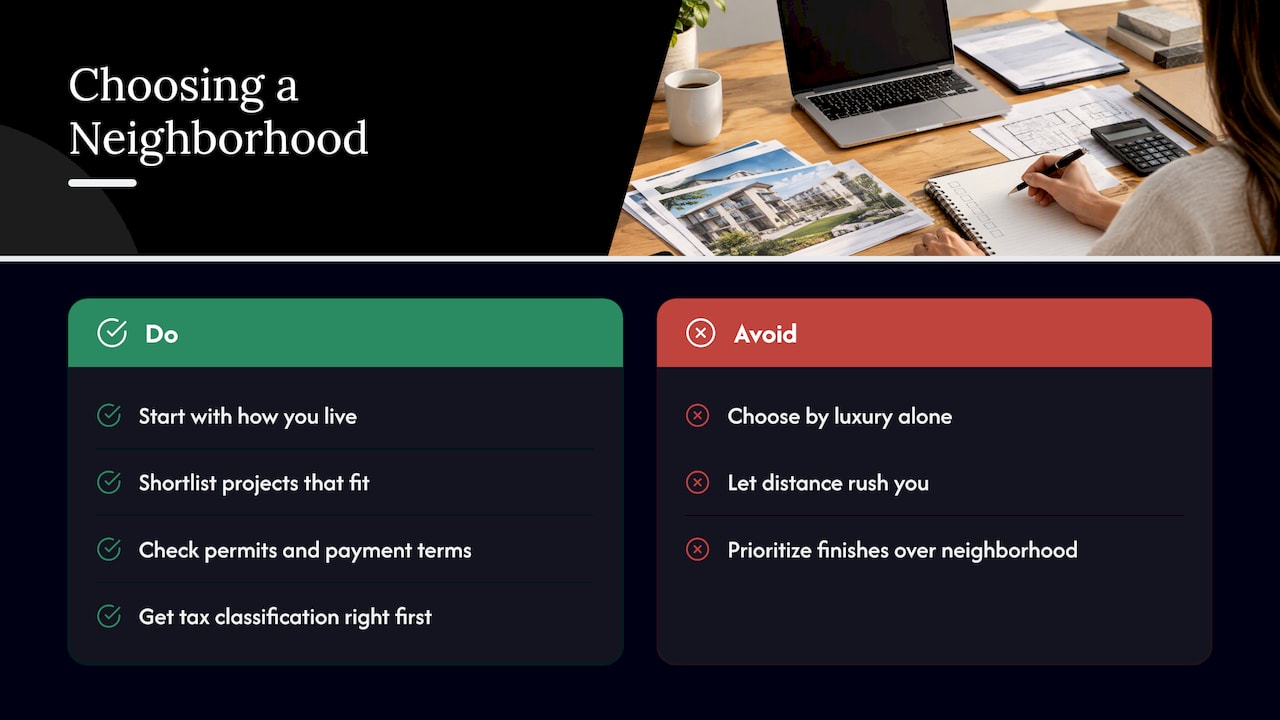
Our view is that a premium finish can be replaced, but a neighborhood cannot. So we start with the way you live, shortlist the projects that fit, and only then compare specifications and payment terms. We also push for transparency in the process: the permit, the specification, the payment schedule and the real resale picture, before a commitment.
For international buyers, we would add one more piece of advice: do not let distance rush you. A well-run purchase from abroad is slower on paper and safer in practice. Get your tax classification right first, then choose the building.
— Spiros
If you are buying to rent or to resell, the logic shifts slightly.
Our article on why new developments suit religious families and our guide to assessing Israeli real estate in Beit Shemesh go deeper on the numbers. Observant buyers will also find practical buying tips for Beit Shemesh useful.
We guide buyers through several developments in and around Beit Shemesh. Each has its own page with details:
If you would like help narrowing these down to the one that fits your family or your investment plan, our concierge project guidance walks you through the options, the process and the paperwork, in English if you prefer.
No. “Luxury” is a market label, not a planning category. In practice it refers to new boutique projects with views and a high specification, mainly in the newer parts of Ramat Beit Shemesh and on the city’s hillside edges. Compare projects one by one rather than relying on a neighborhood name.
There is no single figure. The 2025 city median was about ₪2,001,809 for a 92 sqm apartment, according to ERRA Analytics. Premium new units, larger and with views, are priced above that, and the price per square meter is the fairest way to compare. Ask for current pricing on the specific project.
No. Non-residents pay 8% from the first shekel up to ₪6,055,070 and 10% above, under a temporary order valid until February 10, 2027, according to IsraelLaw.info. Olim can qualify for much lower rates if they claim the benefit, so speak to a tax advisor before you sign.
Look it up on the Planning Administration’s Mavat site and confirm the permit status with your lawyer. This matters most for urban renewal and new-quarter projects, where objections can delay construction for years.