%20(4).png)
![[background image] image of cityscape background (for an architect firm)](https://cdn.prod.website-files.com/68961ade6feff9cbdffc080d/69384e066e0e9a310b6817f8_061f6bac-48bf-44b8-a689-078dacd8009f.avif)
That band puts Beit Shemesh in line with Jerusalem and below what periphery towns pay, which tells you this market rewards patient appreciation more than monthly cash flow. If you’re weighing a specific unit, the formulas and the worked example below, along with this example report, will tell you fast whether the deal actually pencils out.
TL;DR:
- Beit Shemesh’s median annual rental yield is 2.65%, with actual transaction data showing a typical sale price around NIS 2.31 million.
- Gross yield estimates around 3.86% for a standard apartment, but net yield is closer to 3.04% after accounting for ongoing costs like maintenance and vacancy.
- Rental prices vary significantly by unit size, with three-room apartments around NIS 5,132 per month and four-room units roughly NIS 7,424; neighborhood demand influences rent stability.
- Homebuyers should consider controlling for purchase costs, ongoing expenses, and vacancy rates, especially in growth neighborhoods near yeshivas and family-focused areas.
- Local market insight and verification of tenant demand, building conditions, and maintenance history are key to accurately assessing a property’s true yield potential.
Nadlan, Israel’s official land registry portal, reports a median annual rental yield of 2.65% for Beit Shemesh, with a weighted median sale price around NIS 2.31 million across all room counts. That figure comes from actual closed transactions, not asking prices, which makes it the most reliable anchor for what buyers are paying today.
Rent data tells a complementary story. Realta’s listings put the citywide median monthly rent around NIS 6,500, but that number hides a lot of spread once you break it down by unit size:
| Metric | Figure | Source |
|---|---|---|
| Median sale price (all rooms) | ~NIS 2.31 million | Nadlan |
| Median annual gross yield | 2.65% | Nadlan |
| Median monthly rent (citywide) | ~NIS 6,500 | Realta |
| 3-room median rent | ~NIS 5,132/month | Realta |
| 4-room median rent | ~NIS 7,424/month | Realta |
One caution worth flagging: Nadlan’s yield figure comes from closed deals, while Realta’s rents are listings based, meaning current asking prices rather than signed leases. Treat the gap between the two as a real range, not a contradiction.
Three different numbers answer three different questions, and mixing them up is the single most common mistake buyers make when comparing Beit Shemesh listings.
Tools notes that net yield in Israeli residential markets typically runs 1 to 2 percentage points below gross yield once expenses are honestly accounted for.
Vacancy allowance means budgeting for one or two months of empty unit time per year even in a strong rental market. Vaad Bayit, the building maintenance fee, comes straight off your net number every single month and gets skipped by buyers who only look at the listing price.
The acquisition side eats into your return before you’ve collected a single rent check. Purchase tax brackets change periodically, so confirm current rates with your lawyer rather than relying on last year’s figures. Beyond tax, you’re looking at broker commission, legal fees, and an appraisal if your lender requires one. Our Beit Shemesh buyers guide on purchase costs breaks these down in more detail.
Ongoing costs that hit net yield every year:
Initial renovation or staging costs should be amortized across your expected holding period rather than dumped entirely into year one.
Pro Tip: Add a soft-cost buffer of extra cash on top of your purchase price when modeling returns. Investors who skip this step routinely overstate their yield by ignoring closing surprises, immediate repairs, and the first vacancy gap.
Location inside Beit Shemesh moves both your rent ceiling and your vacancy risk, sometimes more than the citywide averages suggest. Ramat Beit Shemesh has posted above-average price and rent appreciation driven by strong population growth and its position as a more affordable alternative to Jerusalem for religious families relocating from abroad or from within Israel.
That demand pattern changes the risk profile in a way headline yield numbers miss entirely:
Match your unit size to the tenant profile you’re targeting. A three-room apartment near a family-dense neighborhood will lease faster and more reliably than an identical unit in a less established pocket of the city, even if the asking rent looks similar on paper.
Take a representative four-room apartment priced at NIS 2.3 million, renting for NIS 7,400 a month, both figures pulled from the Nadlan and Realta medians above.
If your lender finances 60% of the purchase, cash-on-cash yield rises above the net figure since you’re measuring return against a smaller cash outlay, not the full price. Red flags that quietly kill yield: an outdated Vaad Bayit report hiding a special assessment, no elevator in a building marketed to families with young children, or a rent estimate based on a single optimistic comparable rather than the neighborhood median.
A local realty firm working in Beit Shemesh and the surrounding area daily can see which numbers on a listing sheet hold up and which ones don’t survive a building walkthrough. A few habits separate investors who hit their projected yield from those who don’t:
The local realty firm can also share current market insight for specific Beit Shemesh streets and buildings for investors who want a second opinion before signing an offer.
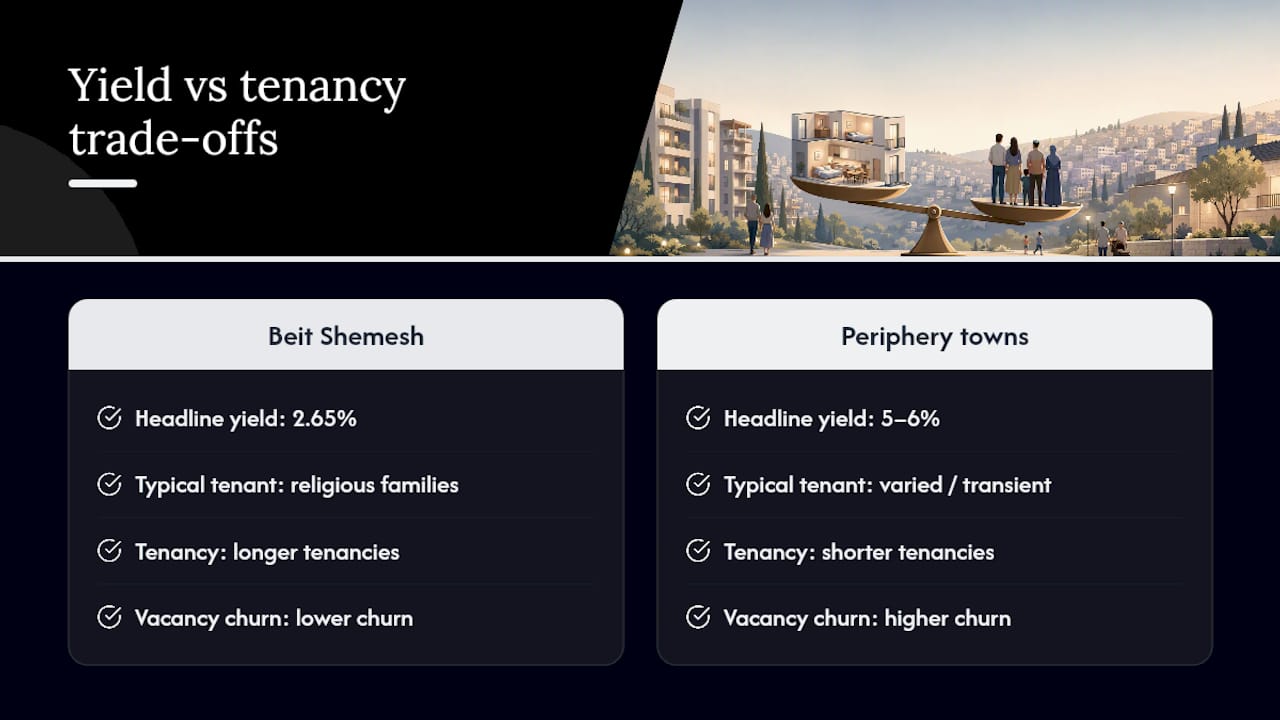
The conventional advice on rental yield treats it like a single number that settles the argument. It doesn’t. A 2.65% headline yield sounds unremarkable next to periphery towns advertising 5% or 6%, but that comparison skips the part that matters most: Beit Shemesh’s religious-family demand base and its position relative to Jerusalem produce longer tenancies and lower vacancy churn than most higher-yield markets ever see.
What gets underrated is the gap between gross and net. Buyers anchor on the listing’s advertised yield and skip the 1 to 2 percentage point haircuts that Vaad Bayit, vacancy, and maintenance reserves impose every single year. Run the net number before you fall in love with the gross one.
If Beit Shemesh is on your list, prioritize unit size and neighborhood fit over squeezing an extra tenth of a percent from the purchase price. A well-matched four-room unit in a family-dense pocket will outperform a cheaper unit that sits vacant for three months waiting for the right tenant.
— Spiros
Running these formulas on paper is one thing. Getting a local read on a specific building’s Vaad Bayit history, tenant demand, and true rent ceiling is another, and that’s where Yigal Realty earns its keep versus a spreadsheet alone. A firm focused specifically on Beit Shemesh and its surrounding neighborhoods can pull current listing intel, flag underwriting red flags before you make an offer, and connect you with early access to new developments that haven’t hit the general market yet.
If you’re evaluating a specific property or want a neighborhood-level briefing before you commit capital, reach out to Yigal Realty to request a tailored yield assessment for the address you have in mind.

This article is general information, not a substitute for advice from a qualified financial advisor. Consult a qualified financial professional about your own circumstances before acting on anything here.
A gross yield above 4% is generally considered strong for Israeli residential property, while anything above 3% net is solid given how compressed yields run in high-demand cities.
The weighted median sale price across all room counts is approximately NIS 2.31 million, based on official Nadlan transaction data, though prices vary significantly by neighborhood and unit size.
Nadlan does not publish a single citywide price-per-square-meter figure separately from room-count medians, so the most reliable way to estimate it is dividing a specific unit’s price by its registered square meterage using its Nadlan transaction record.
Gross yield equals annual rent divided by property price, multiplied by 100. Net yield subtracts ongoing costs like Vaad Bayit, maintenance, insurance, and vacancy allowance from annual rent before dividing by the total investment, giving a more realistic picture of actual returns.