%20(4).png)
![[background image] image of cityscape background (for an architect firm)](https://cdn.prod.website-files.com/68961ade6feff9cbdffc080d/69384e066e0e9a310b6817f8_061f6bac-48bf-44b8-a689-078dacd8009f.avif)
TL;DR:
- Financing Beit Shemesh properties involves strict bank rules, Halachic compliance, and community considerations.
- Israeli bank mortgages typically offer up to 75% LTV for residents but only 50% for non-resident investors.
- Alternative paths like private lenders, community loans, and subsidies help overcome financing challenges.
Financing investment property in Beit Shemesh is not straightforward, especially when you’re navigating Israeli bank rules, community expectations, and Halachic compliance all at once. Israeli bank mortgages follow strict tracks, with fixed rates running 4.8–5.6% and loan-to-value (LTV) ratios capped at 50% for non-resident investors. Add in the specific religious and cultural standards of Beit Shemesh’s growing community, and the financing puzzle gets complex fast. This guide walks you through the market realities, your real financing options, Halachic compliance requirements, and creative paths that work specifically for observant and overseas buyers targeting this market.
| Point | Details |
|---|---|
| Market-specific hurdles | Beit Shemesh investors face unique price, yield, and competition factors requiring focused financing strategies. |
| Tailored financing options | Israeli bank mortgages, private lenders, and community solutions each serve different investor profiles. |
| Halachic compliance matters | Religious buyers must ensure their financing uses Heter Iska or true kosher alternatives to align with Jewish law. |
| Olim and community aid | New immigrants and religious buyers have access to subsidized loans and community Gemach programs. |
| Expert guidance is vital | Working with local pros familiar with market, faith, and paperwork can streamline deals and avoid costly mistakes. |
Before you approach any lender, you need to understand exactly what you’re financing into. Beit Shemesh has become one of Israel’s fastest-growing cities, driven by strong demand from Anglo, Haredi, and Dati Leumi communities. That demand isn’t slowing. New neighborhoods in Ramat Beit Shemesh continue to attract religious families relocating from the U.S., UK, and across Israel, creating a resilient buyer pool that keeps prices stable even when other Israeli markets soften.
According to residential yield data, family homes in Beit Shemesh range from 1.8 million to 4.5 million NIS, with rental yields sitting at 2–4%. That yield figure is modest by global standards, but the real value here is long-term capital appreciation and community stability, not short-term cash flow.
Key market snapshot for Beit Shemesh (2026):
| Factor | Detail |
|---|---|
| Typical family home price | 1.8M–4.5M NIS |
| Gross rental yield | 2–4% |
| Primary buyer profile | Anglo, Haredi, Dati Leumi |
| Market resilience | High, community-driven demand |
| Investor LTV limit | 50% (non-resident) |
Before you sit down with a bank or broker, you need honest answers to these questions:
Understanding Israeli property benefits goes beyond yield calculations. The community infrastructure, school networks, and long-term population growth in Beit Shemesh create a floor under property values that pure numbers don’t capture. Investors who grasp this dynamic make better financing decisions because they understand the asset they’re leveraging.
Statistic: Beit Shemesh’s population has grown over 300% in the past two decades, making it one of Israel’s most dynamic residential markets.
With market context in hand, you can evaluate your real financing choices side by side. Each option has a different risk profile, documentation burden, and suitability depending on your residency and religious requirements.
Financing options at a glance:
| Option | LTV Available | Rate Range | Best For |
|---|---|---|---|
| Israeli bank mortgage | Up to 75% (Olim/residents); 50% (investors) | 4.2–5.6% | Most buyers |
| Private lender | Flexible, case by case | 6–10%+ | Speed, non-standard cases |
| Developer/seller finance | Varies by deal | Negotiated | Off-plan purchases |
| U.S. HELOC | Based on U.S. equity | U.S. prime-linked | U.S. homeowners |
| Family/private capital | No formal limit | Agreed privately | Community buyers |
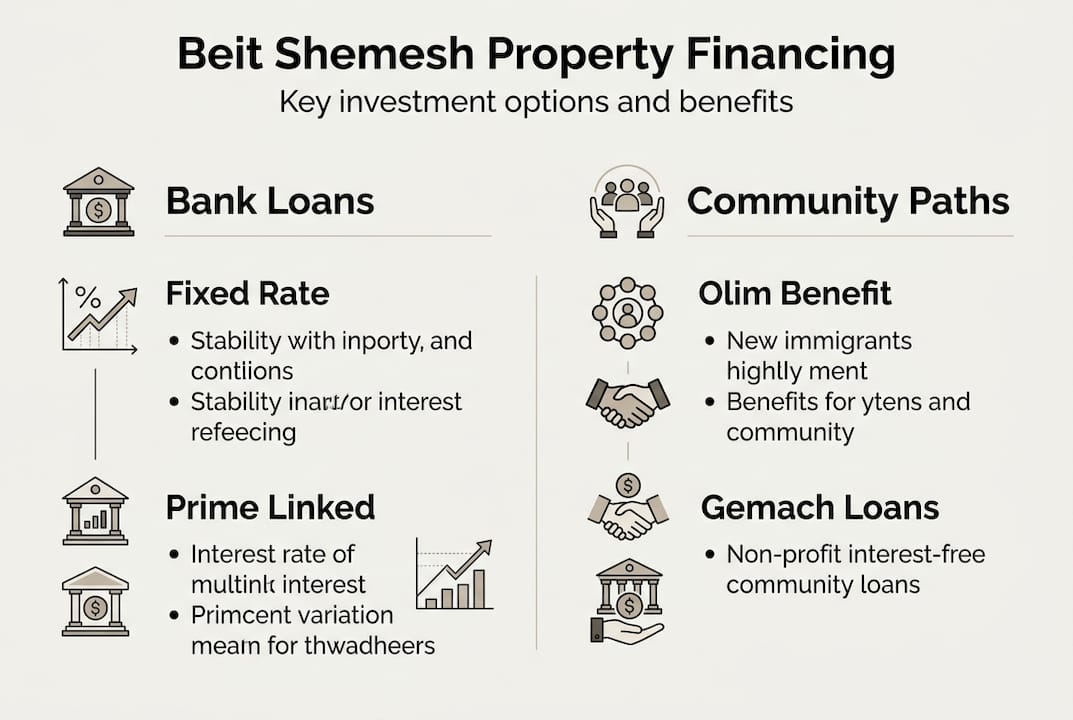
Israeli bank mortgages are structured in tracks. The fixed-rate track runs 4.8–5.6%, the prime-linked track sits at 4.2–5.0%, and the CPI-linked track ties your payments to inflation. The Bank of Israel requires at least one-third of any mortgage to be in fixed-rate format, which limits your flexibility but protects you from rate spikes.

Alternative financing paths are more common than many buyers realize. Private lenders, seller plans, and U.S. HELOCs give you flexibility when bank documentation requirements are too rigid or when you need to close fast. Down payments through these routes typically run 25–50% of the purchase price.
Here’s a practical decision framework:
Pro Tip: Work with a mortgage broker who has specific experience with U.S. or UK buyers in religious communities. They know which Israeli banks are most flexible with foreign income documentation and which lenders routinely include Heter Iska arrangements. This single step can save you weeks of frustration. For a broader overview, reviewing basic Israel investment finance principles before your first bank meeting is time well spent.
For observant buyers, financing isn’t just a financial decision. It’s a religious one. Jewish law (Halacha) prohibits Ribbis, which is the charging or paying of interest on loans between Jews. In a practical mortgage context, this creates a real problem: virtually every standard bank loan involves interest.
The solution used throughout Israel is the Heter Iska. This is a legal and religious document that restructures a loan as an investment partnership rather than a debt with interest. Instead of you paying the bank interest, you are technically sharing profits from your investment with a partner. The bank’s “profit share” mirrors what interest payments would look like, but the structure satisfies Halachic requirements.
How it works in practice:
“Heter Iska includes safeguards like witnesses and oaths for loss claims, but no successful borrower loss claims have been recorded in practice.”
What about truly “kosher” banking? Some institutions market themselves as fully Halachically compliant lenders. The reality is that true kosher banking carries fees roughly 80% higher than standard bank mortgages. For most buyers, the standard Heter Iska addendum on a regular Israeli bank mortgage is both Halachically accepted and financially practical.
Pro Tip: Before signing, ask your Rav to review the specific Heter Iska document your bank uses. Not all versions are identical, and some are more robust than others in their Halachic structure. Understanding Israeli home finance rules in full helps you ask the right questions at the right time.
Beyond the banks, Beit Shemesh’s religious and immigrant communities offer financing resources that many buyers overlook entirely. These paths can meaningfully reduce your cash burden or bridge gaps that standard lenders won’t cover.
Olim benefits are the most significant formal advantage available. New immigrants to Israel qualify for subsidized mortgages of 300,000–500,000 NIS at approximately 3–3.5%, in fixed or CPI-linked tracks, with LTV ratios up to 75%. Olim also receive purchase tax discounts that can save tens of thousands of NIS on a standard family home purchase. These benefits are time-limited after Aliyah, so timing matters.
Community-based financing is less formal but widely used. Gemach loans and Haredi partnership structures allow community members to access interest-free or very low-cost loans to supplement a primary mortgage. These are typically short-term bridges, not full financing solutions, but they can cover the gap between your bank loan and the full purchase price.
Here’s a practical checklist for preparing your documentation as a foreign or religious buyer:
These creative financing tips work best when combined. A typical observant Olim buyer in Beit Shemesh might use a subsidized Olim mortgage for 75% of the purchase, a Gemach loan to cover part of the down payment, and a family contribution for the remainder. None of these sources alone is sufficient, but together they make the deal work.
Here’s the part most guides skip. Every financing option available to you in Beit Shemesh carries real risk, and religious compliance does not eliminate financial exposure. It just changes the paperwork.
The Heter Iska, for example, is widely accepted and genuinely meaningful from a Halachic standpoint. But the safeguards built into it favor lenders in every practical scenario. No borrower has successfully used the loss-claim provision to reduce payments. That’s not a reason to avoid it. It’s a reason to understand what it actually does and doesn’t protect you from.
True kosher banking costs significantly more and is rarely justified for standard residential purchases. Community reputation matters in Beit Shemesh, but overpaying by 80% in fees to use a niche lender when a standard Heter Iska achieves the same Halachic outcome is not a wise trade-off for most investors.
The investors who succeed here are the ones who use smart investor tools alongside experienced advisors who understand both the Israeli market and the religious community’s standards. Rate optimization matters less than deal certainty, documentation accuracy, and working with people who have closed transactions like yours before.
Ready to put these steps into action? Navigating Israeli bank requirements, Halachic compliance, and Beit Shemesh’s competitive market is genuinely easier with a local partner who has done it before. Yigal Realty specializes in serving observant and overseas investors in Beit Shemesh, offering property search, negotiation support, financing guidance, and connections to trusted advisors who understand both the market and the religious community’s needs. Whether you’re exploring your first Israeli investment or adding to an existing portfolio, their team can help you move from confusion to contract with confidence. For a deeper look at your funding options, explore their guide on alternative property financing before your first consultation.
For non-resident or investor buyers, Israeli banks cap loan-to-value at 50%, while Olim and first-home residents may qualify for up to 75%.
Heter Iska restructures a loan as a partnership, allowing religious buyers to avoid forbidden interest when borrowing from Israeli banks.
Yes, Olim qualify for subsidized mortgages at 3–3.5% with higher LTV and purchase tax discounts that can save significant sums on a standard family home.
Investors can use private lenders, seller plans, U.S. HELOCs, family loans, and community Gemach lending as flexible alternatives to standard bank mortgages.
Investors face FX risk, CPI-linkage inflation exposure, prepayment penalties, and tighter LTV caps that non-residents often underestimate before entering the market.