%20(4).png)
![[background image] image of cityscape background (for an architect firm)](https://cdn.prod.website-files.com/68961ade6feff9cbdffc080d/69384e066e0e9a310b6817f8_061f6bac-48bf-44b8-a689-078dacd8009f.avif)
TL;DR:
- In Israel, lawyer-managed escrow holds funds or documents until all legal and tax clearances are completed. The process relies on a cautionary notice and strict documentation, as no independent escrow companies or title insurers operate locally. The success of a transaction depends heavily on the competence of the lawyer and proper registration in the land registry.
In Israel, escrow (Ne’emanut) is a lawyer-managed trust that holds funds or documents until legal and tax clearances are satisfied. There are no independent escrow companies or standard title insurers in Israel; instead, lawyer trust accounts handle what U.S. buyers expect from a neutral third party. That single fact reshapes everything about how you close a deal here.
Your three immediate steps:
Under Israeli law, a Ne’emanut is an arrangement in which an agent holds an asset for the benefit of a beneficiary. The relationship can technically arise by conduct alone, but professional practice always uses a written, lawyer-managed agreement to avoid disputes.
The critical legal distinction: An escrow (Ne’emanut) does not change the status of proprietary rights or transfer ownership. A lawyer typically holds the deeds of transfer in escrow until the full consideration is paid and all approvals are received for recording with the Land Registry. This is fundamentally different from a proprietary trust, where ownership of assets is actually transferred to the trust itself.
That distinction matters practically. Because ownership has not transferred during the escrow period, the arrangement is not automatically enforceable against third parties unless it is registered. Registration in the Land Registry or with the Corporations Registrar is the only reliable way to bind third parties to the arrangement. An unregistered escrow agreement protects you against the counterparty but not against a creditor or a subsequent buyer who records first.
The Israeli Trusts Law governs the field, and the 2005 amendment to the Income Tax Ordinance added a tax layer that affects how assets move in and out of trust structures. For plain real estate closings, the escrow framework is relatively straightforward. For corporate or cross-border structures, the tax complexity rises sharply, and you need counsel licensed in both Israel and your home jurisdiction.
The process runs in a defined sequence from contract signing to final Tabu registration. Here is the practical flow:
| Milestone | Who Acts | Documents That Trigger Release |
|---|---|---|
| Purchase agreement signed | Both lawyers | Signed contract; deposit paid into trust account |
| He’arat Azhara recorded | Buyer’s lawyer / Tabu | Cautionary notice confirmation from Land Registry |
| Mortgage approval (if applicable) | Bank | Conditional funding letter; lien registration |
| Tax clearances obtained | Seller / Real Estate Taxation Office | Mas Shevach confirmation; Arnona clearance letter |
| Final payment tranche released | Trustee (lawyer) | All clearances verified; possession documents signed |
| Tabu registration completed | Buyer’s lawyer | Title deed registered in buyer’s name |
Banks participate actively in mortgage-backed deals. They typically tie disbursements to approvals, releasing funds in stages as lien clearances and registration rights are verified rather than in a single lump sum.
A concrete example: The buyer pays the final tranche into the lawyer’s trust account. The trustee holds those funds until the seller produces the Mas Shevach confirmation from the Real Estate Taxation Office. Once that document arrives and the Arnona clearance is confirmed, the trustee releases the funds to the seller and the Tabu registration proceeds.
Holdback amounts are negotiated case by case and should reflect a realistic estimate of the seller’s outstanding Arnona, betterment levies, and potential capital gains exposure. There is no standard figure.
Pro Tip: Ask your lawyer to record the He’arat Azhara on the same day the purchase agreement is signed. A cautionary notice in the Tabu gives you priority and prevents the seller from recording a conflicting transaction during the registration gap.
The trustee will not release funds until specific documents land on their desk. Know this list before you sign the purchase agreement, because it determines your closing timeline.
Mandatory clearances and documents:
For international transfers, the trustee will also want payment traceability: SWIFT confirmations, notarized bank statements, or electronic debit records. The Bank of Israel recognizes SWIFT transfers, electronic debits, and payment cards as standard channels. Cash transfers that cannot be traced are a red flag and can delay or block a closing entirely.
Timing varies. Mas Shevach clearance can take several weeks if the seller’s tax situation is complex. Arnona clearance is usually faster. Build a holdback into the contract for any clearance that may not arrive before the possession date, and set a hard deadline by which the seller must produce each document.
U.S. buyers arrive with a specific mental model: a neutral escrow company holds funds, a title insurer backstops any ownership defects, and the closing agent coordinates the paperwork. None of that infrastructure exists in Israel in the same form.
| Feature | Israel (Ne’emanut) | United States |
|---|---|---|
| Who holds funds | Licensed real estate lawyer (trustee) | Independent escrow company or title company |
| Title insurance | Rare; not standard practice | Standard; widely available |
| Recording protection | He’arat Azhara (cautionary notice) in Tabu | Deed recording in county recorder’s office |
| Release authority | Trustee lawyer per written instructions | Escrow officer per closing instructions |
| Dispute resolution | Contract terms; Israeli courts | Escrow instructions; state law |
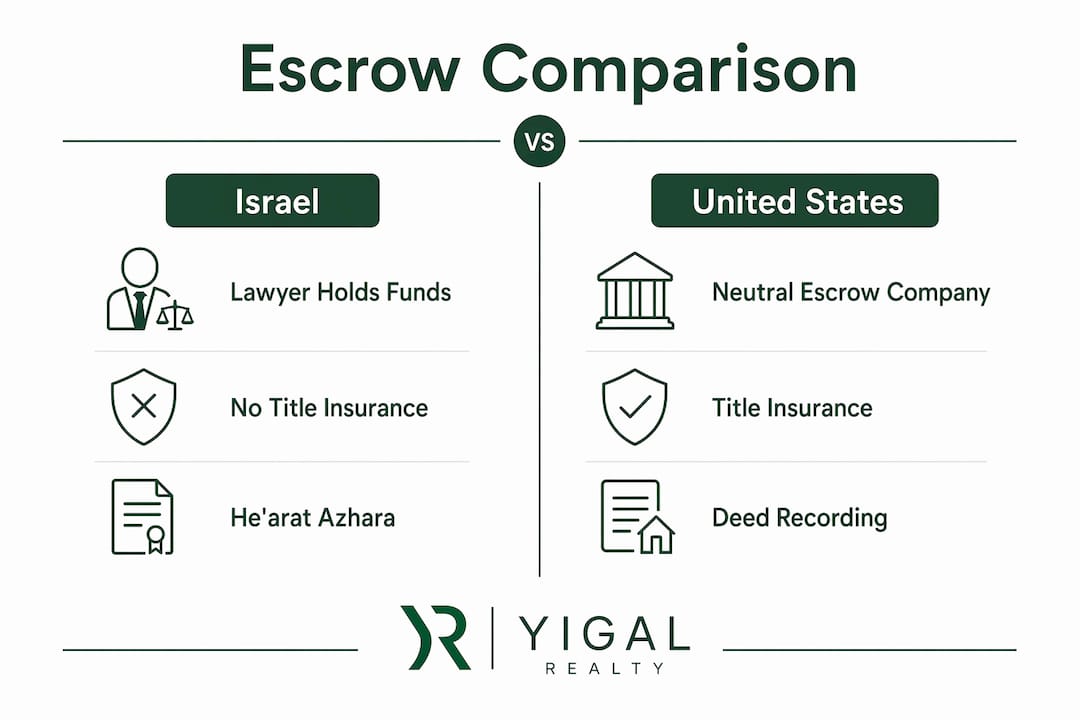
The absence of title insurance and independent escrow companies means the quality of your lawyer is the primary protection. In the U.S., a weak attorney is partially backstopped by institutional infrastructure. In Israel, that backstop does not exist.
The He’arat Azhara performs a function similar to deed recording, but it is a cautionary notice, not a completed transfer. It signals your claim to the world and blocks conflicting registrations while the full transfer is processed. Think of it as a placeholder that holds your place in line at the Tabu.
Pro Tip: Before wiring funds, verify the lawyer’s trust account details directly by phone with the firm, not just by email. Wire fraud targeting real estate closings is a global problem, and Israeli transactions are not immune.
The trustee’s role is active, not passive. A good trustee withholds funds until every legal and tax milestone is satisfied. A careless or conflicted one can release funds prematurely, and recovering them is expensive and slow.
Primary risks to watch:
Trustee vetting checklist:
For property due diligence, pull a fresh Tabu extract yourself and read it for existing He’arat Azhara entries, mortgages, attachments, and any registered rights that could complicate the transfer. Do not rely solely on what the seller’s lawyer provides.
Pro Tip: A Tabu extract costs a small fee and is publicly accessible. Pull one at the start of negotiations and again immediately before closing. Any new entry between those two pulls is a signal to pause and investigate.

Corporate transactions in Israel use escrow arrangements for shares and securities, but the mechanics differ from real estate. The trustee holds share certificates or electronic share records under a notarized escrow agreement until closing conditions are met.
For employee share plans and tax-benefit schemes, shares are often held by an approved trustee under Section 102 of the Israel Income Tax Ordinance. The Israel Tax Authority sets specific requirements for these arrangements, including approval of the trustee and compliance with holding period rules.
Extra checks for corporate escrow:
A typical share escrow clause will name the trustee, specify the share class and quantity, list the release conditions (regulatory approvals, payment milestones, tax confirmations), and set a long-stop date after which the arrangement terminates if conditions are not met.
A well-drafted escrow clause removes ambiguity about when funds move and who decides. Ask your counsel to include each of these items.
Negotiable items buyers should prioritize: the holdback amount (push for a figure that genuinely covers worst-case Arnona and betterment levy exposure), the deadline for tax confirmations (shorter is better for buyers), and the long-stop date (longer protects you if Tabu processing is delayed).
Ne’emanut is a lawyer-managed trust that holds funds until Tabu registration and tax confirmations are complete — the quality of your chosen counsel is the single most important variable in an Israeli transaction.
| Point | Details |
|---|---|
| Ne’emanut is lawyer-managed | No independent escrow companies exist in Israel; your attorney is the trustee and primary protection. |
| Tax confirmations trigger release | Mas Shevach and Arnona clearances must arrive before the trustee releases funds to the seller. |
| He’arat Azhara fills the gap | Record a cautionary notice in the Tabu at signing to prevent conflicting transactions during registration. |
| Holdbacks are negotiated | No standard escrow amount exists; base the holdback on realistic Arnona, betterment levy, and capital gains exposure. |
| Yigal-realty coordinates the process | Yigal-realty connects international buyers with vetted local counsel and guides escrow logistics from contract to closing. |
The conventional wisdom among international buyers is that the legal framework protects them. In Israel, the framework is sound, but it is almost entirely administered by the lawyer you hire. There is no institutional backstop — no title insurer, no independent escrow officer, no county recorder who catches errors automatically.
What this means in practice: two buyers can sign nearly identical purchase agreements on the same street in Beit Shemesh and have completely different outcomes based solely on the competence and diligence of their respective attorneys. The one whose lawyer records the He’arat Azhara the same day, pulls fresh Tabu extracts at each stage, and drafts explicit release conditions into the escrow clause will close cleanly. The one whose lawyer treats the cautionary notice as optional and uses boilerplate release language will face delays, disputes, and potentially worse.
An experienced local broker adds a layer that most buyers underestimate: they know which lawyers actually close deals efficiently in a given municipality, which developers have a track record of producing tax confirmations on time, and where the local Tabu office tends to create bottlenecks. That local intelligence is not in any legal guide. It comes from doing this repeatedly in the same market.
Buying property in Israel from abroad means coordinating across time zones, currencies, and legal systems that work nothing like what you know at home. Yigal-realty specializes in exactly this situation, connecting international buyers with vetted local attorneys, advising on escrow instructions before contracts are signed, and managing payment logistics so that SWIFT transfers arrive in the right account with the right documentation.
The practical next step is straightforward: reach out to Yigal-realty to request an initial escrow checklist tailored to your transaction and to get a referral to qualified local counsel in Beit Shemesh or the surrounding area. When you make contact, have your purchase timeline, approximate budget, and any existing draft agreements ready. That information lets the team give you specific guidance rather than generic advice, and it shortens the path from first conversation to a signed, properly structured purchase agreement.
This article is general information, not legal or tax advice. Israeli real estate and tax law is complex and changes frequently. Consult a licensed Israeli real estate lawyer and, for cross-border transactions, a qualified tax advisor before acting on any information here.