%20(4).png)
![[background image] image of cityscape background (for an architect firm)](https://cdn.prod.website-files.com/68961ade6feff9cbdffc080d/69384e066e0e9a310b6817f8_061f6bac-48bf-44b8-a689-078dacd8009f.avif)
Yes, you can complete many Israeli real-estate signings remotely, but only when your lawyer follows the Bar Association’s committee opinions and the Land Registrar’s filing procedure. That means attorney-supervised visual verification, a recorded session, and a formal declaration filed with the transaction. Foreign signers usually need an apostille too. Confirm your specific document and your bank’s stance with your lawyer before you assume remote-only will work.
TL;DR:
- Remote signing of Israeli real estate documents is valid only when the lawyer supervises via recorded visual verification and files a declaration confirming all procedural steps.
- Most standard transaction documents in Israel now qualify for remote signing, but irrevocable powers of attorney, wills, and mortgage-critical papers often require in-person notarization.
- Completing a compliant remote signing involves early coordination, a reliable video platform, and preparation of high-quality ID images before the session.
- Technical issues are the primary cause of failure; delays often stem from apostille or courier processing times rather than legal requirements.
- Working with an experienced lawyer and properly managing document timing, especially abroad, is crucial to avoid rejection and ensure smooth escrow closure.
The legal foundation is older than the current practice. The Electronic Signature Law 2001 gave electronic signatures general legal standing in Israel, but it never guaranteed that every registry or bank would treat a basic e-signature the same as a signature made in person. That gap matters enormously for real estate, because the Land Registrar (טאבו) has its own, stricter bar for what counts as a valid signature on a deed, power of attorney, or registration request.
What changed the picture for חתימה מרחוק לעסקת נדל"ן is a set of Bar Association committee opinions issued between 2024 and 2025. Opinion את/163/22 laid out when an attorney can supervise a signing without being in the same room, and later rulings, את/150/25 and את/149/24, expanded that permission for signers located abroad. The Land Registrar then built an online submission procedure around those opinions, accepting remote-verified documents when the attorney’s declaration accompanies the filing.
The rules boil down to a short list of conditions:
Skip any one of those steps and Tabu can, and often does, reject the filing.
Most transactional paperwork in a standard Beit Shemesh or Jerusalem-area purchase now fits the remote pathway. Purchase agreements, many powers of attorney, Tabu registration requests, and standard affidavits or declarations generally qualify once your lawyer runs the visual verification process correctly.
Some documents still resist it. Irrevocable powers of attorney tied to land transfers, wills, and certain court-directed affidavits often require in-person notarization regardless of what the Bar allows elsewhere. Banks add their own layer on top: even when Tabu accepts a remotely verified document, a lender may still insist on an original for mortgage paperwork, particularly for foreign borrowers.
Before you plan around remote-only execution, check three things:
A compliant remote signing follows a fairly predictable sequence, and knowing it in advance saves you from the delays that trip up first-time foreign buyers.
Pro Tip: Ask your lawyer for the exact wording of the declaration before the signing session, not after. If the attorney’s template doesn’t match what the Land Registrar currently accepts, you’ll find out at the worst possible moment: after the signer has already left the call.
The attorney isn’t just a witness clicking “approve” on a video call. Under the Bar’s framework, the lawyer carries direct legal responsibility for the entire verification chain, which is precisely why remote signing survives regulatory scrutiny at all.
During the session, the lawyer has to confirm the signer’s identity against government ID, verify the signer is acting voluntarily and understands the document’s legal effect, and keep the recording running throughout. Afterward, the declaration filed with Tabu must state that these steps happened, that the received file matches the recording, and that no gap exists between what was shown and what was signed.
Working with a lawyer who already handles remote closings routinely, rather than one improvising the process for the first time, is worth the extra vetting — see real estate transactions and litigation services for legal expertise in this area. Hiring the right real estate lawyer matters more in a remote deal than in a standard in-person one, because there’s no second chance to fix a botched verification session after the fact.
A remote signing fails more often for boring technical reasons than legal ones. Before your scheduled session, confirm you have stable internet on both ends, a platform capable of recording video reliably, and a way to capture clear, legible images of your ID rather than a blurry phone photo.
Pro Tip: If you’re signing from abroad, get your apostille process started the same week you sign your purchase agreement, not after. Consular and apostille offices rarely move on your timeline, and a late original can hold up a filing that would otherwise be finished.
Most failed remote signings trace back to a handful of repeat mistakes. Using a generic e-signature app never vetted for Tabu compliance is the most common one; it can feel fine at the time and then get rejected weeks later. Vague power-of-attorney wording, skipping the apostille step for a foreign signer, and failing to secure the attorney’s recorded verification round out the usual list.
Some situations call for in-person signing regardless of what’s technically permitted. Irrevocable powers of attorney over land, court-directed affidavits, and any document your bank flags as mortgage-critical fall into that category.
Every remote signing we help arrange starts the same way: matching the buyer with an Israeli attorney who already knows the current Bar procedures, then mapping out exactly which documents in the file need visual verification versus a physical original. International buyers, especially those juggling time zones between New York and Israel, tend to underestimate how much the apostille and courier stage shapes the calendar rather than the signing itself.

Coordination work usually covers scheduling the verification session around the buyer’s location, confirming document requirements with the bank ahead of time, and keeping the purchase paperwork organized so nothing surfaces as a surprise during the lawyer’s final review. When international clients reach out, having a property reference, valid ID, and a rough timeline ready speeds everything up considerably.
Everyone assumes the hard part of remote signing is the technology: the video call, the recording, the digital file. It isn’t. The hard part is the mismatch between what a buyer assumes their document needs and what Tabu, the bank, and the Tax Authority each separately require. A purchase agreement can sail through visual verification while the power of attorney backing it gets flagged because nobody checked whether it needed to be irrevocable in form.
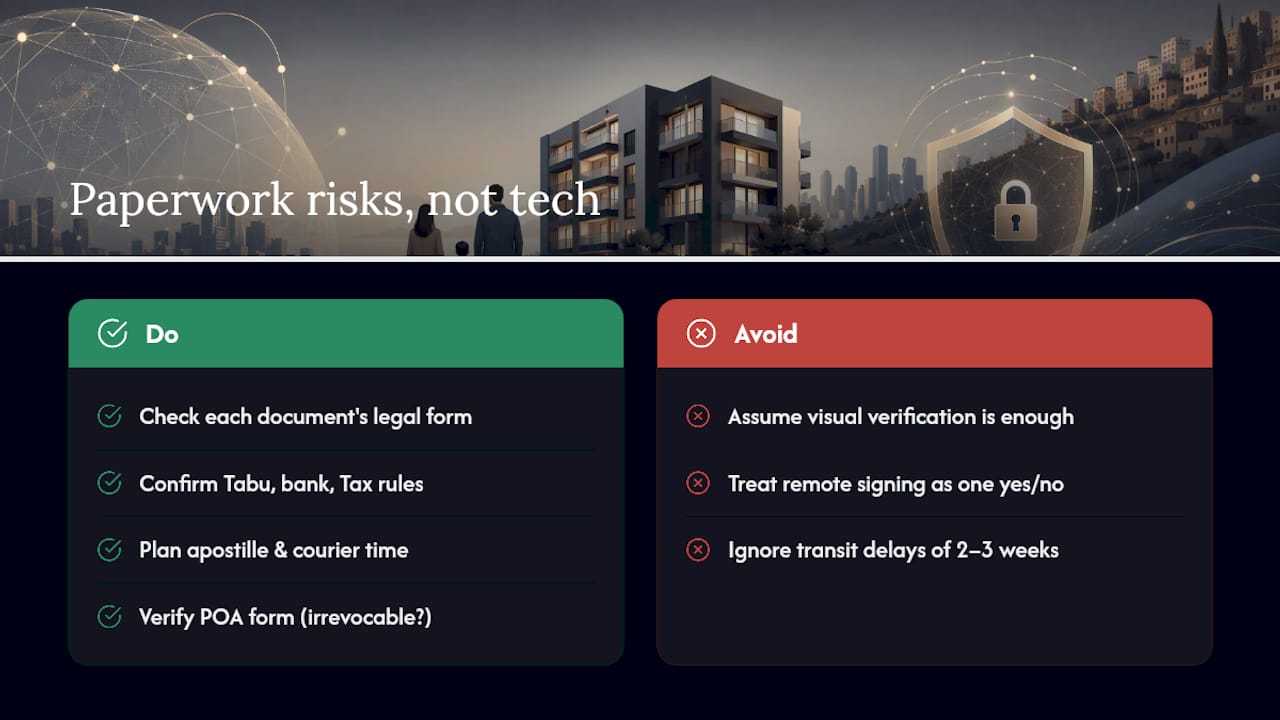
The conventional advice online treats “remote signing” as a single yes-or-no question. It isn’t. It’s a document-by-document question, and treating it otherwise is how buyers end up with a signed file that Tabu bounces back weeks later. The Bar’s cumulative-conditions framework exists precisely because regulators know a shortcut on one document type doesn’t generalize to the next.
If there’s one place foreign buyers consistently underinvest, it’s the apostille and courier timeline. Everyone plans for the signing call. Almost nobody plans for the two or three weeks a physical document can spend in transit, and that gap causes more closing delays than any legal ambiguity around remote verification itself.
— Spiros
Yigal-realty handles the coordination layer that makes a remote signing actually work: pairing you with counsel familiar with current Bar procedures, mapping your document set against Tabu’s requirements, and managing the back-and-forth across time zones so nothing stalls in transit. That’s the practical advantage over trying to piece this together yourself from a generic e-signature app and a hopeful email chain.
Before reaching out, have your property listing or reference number ready, a valid ID scan, and a rough sense of your timeline, especially if you’re signing from outside Israel. Visit the Yigal-realty contact page to start the conversation and get a coordination plan built around your specific transaction.
This article is general information, not a substitute for advice from a qualified lawyer. Consult a qualified legal professional about your own circumstances before acting on anything here.