%20(4).png)
![[background image] image of cityscape background (for an architect firm)](https://cdn.prod.website-files.com/68961ade6feff9cbdffc080d/69384e066e0e9a310b6817f8_061f6bac-48bf-44b8-a689-078dacd8009f.avif)
TL;DR:
- Property exclusivity impacts who can market and purchase a home, going beyond mere availability.
- Understanding legal versus informal exclusivity and market differences in Israel and the U.S. is essential for informed decisions.
- Building trust-based, community-driven access often outweighs contractual labels for observant buyers in Beit Shemesh.
Many buyers hear the word “exclusive” and immediately picture a shorter list of available properties. That is a costly misunderstanding. In reality, property exclusivity shapes who markets a home, who earns commission, how discreetly a deal unfolds, and who even gets the chance to make an offer. For families and investors in observant and religious communities seeking homes in Beit Shemesh and nearby areas, these distinctions carry real weight. This guide walks you through every layer of exclusivity, from formal legal contracts to quiet word-of-mouth networks, so you can approach your next purchase or investment with full clarity and confidence.
| Point | Details |
|---|---|
| Exclusive means sole broker | Property exclusivity typically gives one agent the exclusive right to market and sell, reducing public exposure. |
| Privacy versus legal exclusivity | Off-market or restricted-access listings aren’t always contractually exclusive, but create privacy for buyers and sellers. |
| Contracts have fine print | Exclusivity agreements contain commission, duration, and termination clauses; always review these closely. |
| Israeli and U.S. exclusivity differ | Israeli heskem baladiyut and U.S. office exclusives vary in their legal, marketing, and privacy effects. |
| Access through trusted channels | Connecting with local brokers and networks is the most reliable way to access exclusive listings in Beit Shemesh. |
The term “exclusive” gets used loosely in real estate. Agents use it in marketing materials, sellers use it to describe their arrangement with a broker, and buyers sometimes hear it to mean a property is simply hard to find. But the legal definition is much more specific.
An exclusive listing means the seller authorizes one agent or brokerage the sole right to market and sell the property for a set period. No other agent can advertise or negotiate the sale during that window without the authorized broker’s involvement. This is a contractual obligation, not just a marketing label.
Understanding the difference between exclusive and open listings matters immediately:
There is also a meaningful gap between legal exclusivity and informal exclusivity. A legal exclusive listing restricts access through contract. Informal exclusivity is a marketing approach. An agent might describe a property as “exclusive” simply to signal limited availability or a quiet sale, without any binding restriction in place.
Important: Before assuming a property labeled “exclusive” is legally restricted, always ask the agent to show you the listing agreement. Knowing which type you are dealing with changes how you negotiate, what access you have, and whether other agents can assist you.
If you are still learning the landscape, reviewing the different property listing types available in Beit Shemesh will give you a stronger foundation for the sections ahead.
The mechanics of exclusivity are not universal. What an exclusive agreement means in New York is not identical to what it means in Beit Shemesh. Buyers who have experience in one country and are purchasing in another sometimes make expensive assumptions.
In Israel, an exclusivity agreement gives the broker sole right to market and collect commission for a defined period. These agreements are regulated, and Israeli law provides specific protections for both buyers and sellers. The Hebrew term often used is heskem baladiyut (הסכם בלאדיות), which translates roughly to “exclusivity agreement.” A key detail: even if you find the property on your own or through a friend, the exclusive broker may still be entitled to commission if the agreement is in force. This surprises many buyers.
In the U.S., the system runs through the Multiple Listing Service (MLS). An office exclusive is filed with the MLS but not publicly marketed. This means it exists in the system but is not broadcast to all agents or platforms. It gives sellers more control and buyers less public visibility.
Here is how the two markets compare on key points:
| Feature | U.S. market | Israeli market |
|---|---|---|
| Exclusivity governed by | MLS rules and state law | Israeli Brokerage Law |
| Term length | Typically 3 to 6 months | Typically 3 to 6 months |
| Commission trigger | Agent earns on any sale during term | Broker earns even if seller finds buyer |
| Public visibility | Office exclusive may be MLS-listed but not marketed | Often advertised only through broker’s network |
| Buyer representation | Buyer’s agent can assist | Dual agency is common |
| Cancellation flexibility | Varies by contract | Often requires written notice |
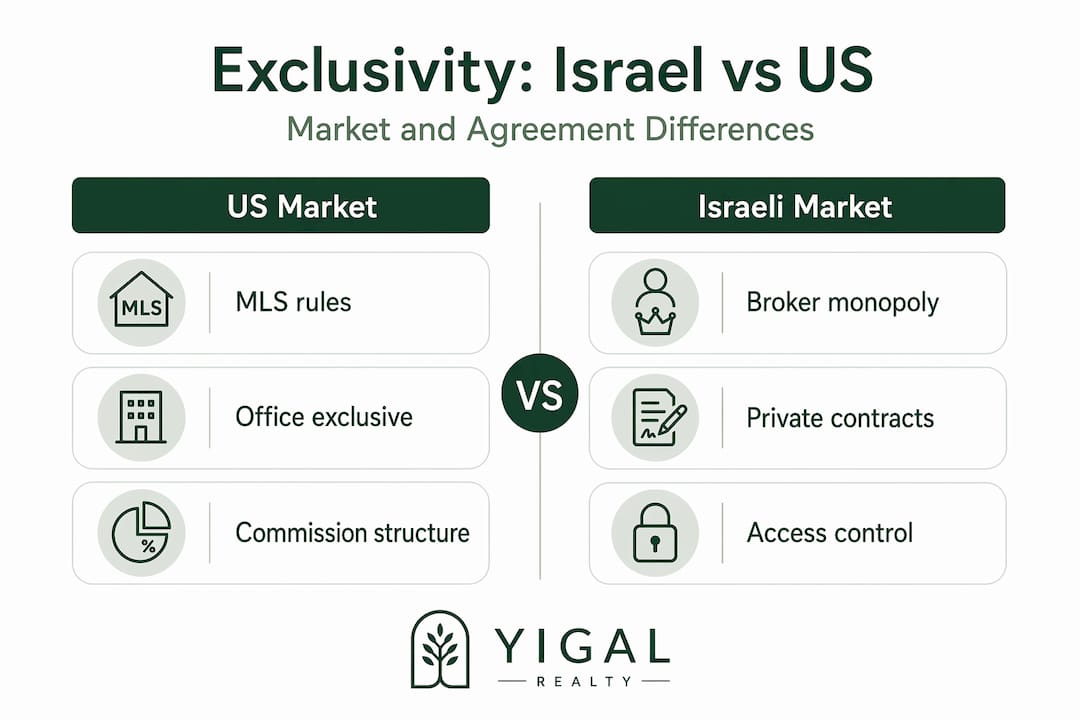
For observant buyers, these structural differences matter in practical ways. In Beit Shemesh, many desirable properties circulate within community networks before they ever appear online. A broker with a strong exclusive agreement can control access to exactly the type of quiet, pre-launch opportunity that fits your timeline and values.
Pro Tip: When reviewing an Israeli exclusivity agreement, ask specifically whether the broker’s commission applies if you, your family, or your community rabbi locates the seller independently. This clause is negotiable and worth clarifying in writing before signing anything.
Understanding the exclusive listing impact on your purchase timeline and the structure of Israeli broker contracts will help you engage any agreement with informed confidence.
Not every property kept out of public view has a formal exclusive agreement behind it. This is one of the most misunderstood corners of real estate for buyers in values-driven communities.
Property exclusivity sometimes refers informally to privacy and restricted access, not just legal contracts. A seller may instruct their broker to share a listing only within a trusted circle, with no formal MLS filing and no public advertisement. This is called an off-market property, and it operates differently from a legally exclusive listing.

Here is how the categories break down:
| Type | Legally binding? | Publicly advertised? | Who has access? |
|---|---|---|---|
| Exclusive listing | Yes | Sometimes | Only via exclusive broker |
| Office exclusive (U.S.) | Yes (MLS filed) | No | Broker’s clients only |
| Off-market listing | No | No | Private network, word-of-mouth |
| Informal “exclusive” marketing | No | Limited | Selective distribution |
For observant and religious buyers, off-market listings in Beit Shemesh often travel through synagogue networks, community WhatsApp groups, and trusted rabbi referrals long before they reach any platform. This informal channel is powerful and frequently offers better pricing because sellers prefer transacting within the community.
Key distinction: Off-market exclusivity is not a legal restriction. If you hear about a property through a community contact, you are not violating any agreement by pursuing it. Legal exclusivity, by contrast, routes all negotiations through the designated broker, regardless of how you found the property.
The benefits of off-market access for observant buyers are significant:
Gaining exclusive early access to new developments and accessing exclusive listings through trusted local brokers are two of the most reliable ways to tap into this layer of the market before it goes public.
Exclusivity is not automatically good or bad. It is a tool. Used well, it protects your privacy and simplifies your purchase. Used poorly, it can cut you off from better options or lock you into unfavorable commission terms.
Exclusivity agreements often come with time limits and commission and termination mechanics that buyers and investors should examine carefully, especially whether the arrangement is an exclusive agency or an exclusive right to sell. These two sound similar but carry very different financial consequences.
Common risks to watch for:
Clear benefits when managed correctly:
Practical steps to protect yourself:
The due diligence checklist for Israeli buyers covers these contractual checkpoints and many more, and working through it systematically before any signature is one of the best habits you can build as an international or first-time buyer in the Israeli market.
Here is the uncomfortable truth we have learned after years working specifically with observant families and investors in Beit Shemesh: the word “exclusive” is used more to create urgency than to describe access.
Many listings labeled exclusive are simply properties where one agent has a short-term marketing advantage. The property may still be accessible. The price may still be negotiable. The seller may still prefer a community buyer over a higher outside bid. But the label creates a perception that the window is closing, which pressures buyers into faster decisions and less careful due diligence.
We have also seen the opposite problem. Some buyers assume that an off-market or exclusive property is automatically a better deal because it feels private and special. That is not always true either. Off-market pricing reflects market conditions, not just exclusivity. A property hidden from public view may be priced above market simply because the seller has not received competitive offers.
The buyers who consistently come out ahead in Beit Shemesh are not the ones chasing “exclusive” labels. They are the ones who build relationships with brokers who already move in their community, understand their lifestyle preferences, and have standing access to listings before any label is applied. That kind of access is built on trust, not contracts.
Community word-of-mouth in Beit Shemesh frequently outperforms any legal exclusivity arrangement for observant buyers. A neighbor, a shul contact, or a known community figure recommending a property often carries more value than a marketing label. Understanding the advantages of Israeli real estate for American Jewish families highlights exactly why relationship-driven access is a competitive edge that no listing agreement can fully replicate.
Ask hard questions. Read every clause. And choose your broker based on community fit and proven access, not just the exclusivity labels they advertise.
If this guide has made one thing clear, it is that understanding exclusivity is only half the work. Accessing the right properties, through the right channels, at the right moment requires local expertise you can actually trust. At Yigal Realty, we specialize in connecting observant homebuyers and investors with vetted exclusive and off-market listings in Beit Shemesh and surrounding communities. Our team works within privacy-focused buying networks built specifically for families who value discretion, community alignment, and professional guidance at every step. Whether you are purchasing from New York or already based in Israel, our brokers bring the local relationships and exclusive listings insights that make a real difference in both access and outcome. Reach out today to start the conversation.
An exclusive listing limits property access to buyers working through the designated broker, which creates more privacy but fewer publicly visible options.
Exclusive agency allows the seller to find a buyer independently with no commission owed, while exclusive right to sell requires commission for the agent regardless of who finds the buyer.
No. Off-market properties operate on an informal, privacy-based model rather than a legally binding listing contract, so access depends on relationships rather than formal restrictions.
Yes. In the U.S., an office exclusive may be filed with the MLS while remaining off public marketing platforms, so it technically exists in the system but is not broadcast to the general public.